By Jon Tharp, Broker · June 7, 2026
Quick Answer: Franklin is the county seat of Macon County, North Carolina, an affordable, year-round, full-service town of about 4,400 people sitting at roughly 2,113 feet on the Little Tennessee River, about 20 minutes down the mountain from luxury Highlands. It is the practical, value-minded alternative to the Highlands-Cashiers plateau: the median home sold for about $260,000 over the past year with a large, buyer-friendly inventory. Franklin is known as a gem-mining town, a major Appalachian Trail community, and a real working town with a hospital, shopping, and a riverside greenway, and Macon County has one of the lowest property tax rates in the state.
Franklin at a Glance
| Population | About 4,400 (2020 Census 4,175); a growing, year-round county seat |
| Elevation | ~2,113 feet, roughly 2,000 feet lower than Highlands, so milder with far less snow |
| Median home price | ~$260,000 sold over the past year; large active inventory, median list ~$212,000 (as of June 2026) |
| Time on market | Roughly 90 days, a balanced, buyer-friendly market |
| Property tax | Macon County $0.27 per $100 (one of NC's lowest); about $0.60 combined inside town limits |
| Drive to Highlands / Asheville | ~20 min up the Cullasaja Gorge to Highlands; ~1 hr 25 min to Asheville |
| Anchor airport | Asheville Regional (AVL) ~1.5 hr; Atlanta ~2.5 hr |
| Locally famous for | Gem and ruby mining, the Appalachian Trail (the first AT Community), the Little Tennessee River Greenway, and the Nikwasi Mound |
What is it actually like to live in Franklin?
Living in Franklin means living in an affordable, year-round mountain town with real services, an outdoor-and-gem-mining culture, and a fraction of the price tag of the resort towns just up the mountain. It is a working county seat, not a seasonal resort, and that is exactly its appeal.
Franklin has what the luxury plateau towns lack: a Walmart and grocery stores, a hospital, county offices, a community college campus, and a genuine downtown Main Street with shops and breweries, all in a town you can actually afford to live in full-time. At about 2,113 feet, roughly 2,000 feet lower than Highlands, it is milder and gets far less snow, a real year-round-living advantage. The identity is outdoorsy and down-to-earth: ruby and sapphire mining heritage, a major Appalachian Trail hiker culture, a riverside greenway, and the Cherokee history of the Nikwasi Mound downtown. The market matches the personality, a roughly $260,000 median sale with a large, buyer-friendly inventory (as of June 2026), and Macon County's tax rate is among the lowest in North Carolina.
This guide is written for the buyer Franklin actually fits, the primary-residence buyer, the value-minded retiree, and the outdoor lover: the affordable market, the low taxes, the gem-and-trail lifestyle, the flood and rural-property realities, and who Franklin suits.
Table of Contents
- What kind of town is Franklin? - What is the Franklin real estate market like? - What are the areas and communities around Franklin? - Why is Franklin called a gem-mining town? - What outdoor recreation is around Franklin? - How far is Franklin from Highlands, Asheville, and other towns? - What internet and utilities can you get in Franklin? - How did Hurricane Helene affect Franklin? - What should buyers know about property here? - What are the property taxes in Franklin? - What are the schools and healthcare like? - How does Franklin compare to nearby towns? - Is Franklin right for you? - Frequently Asked Questions
What kind of town is Franklin?
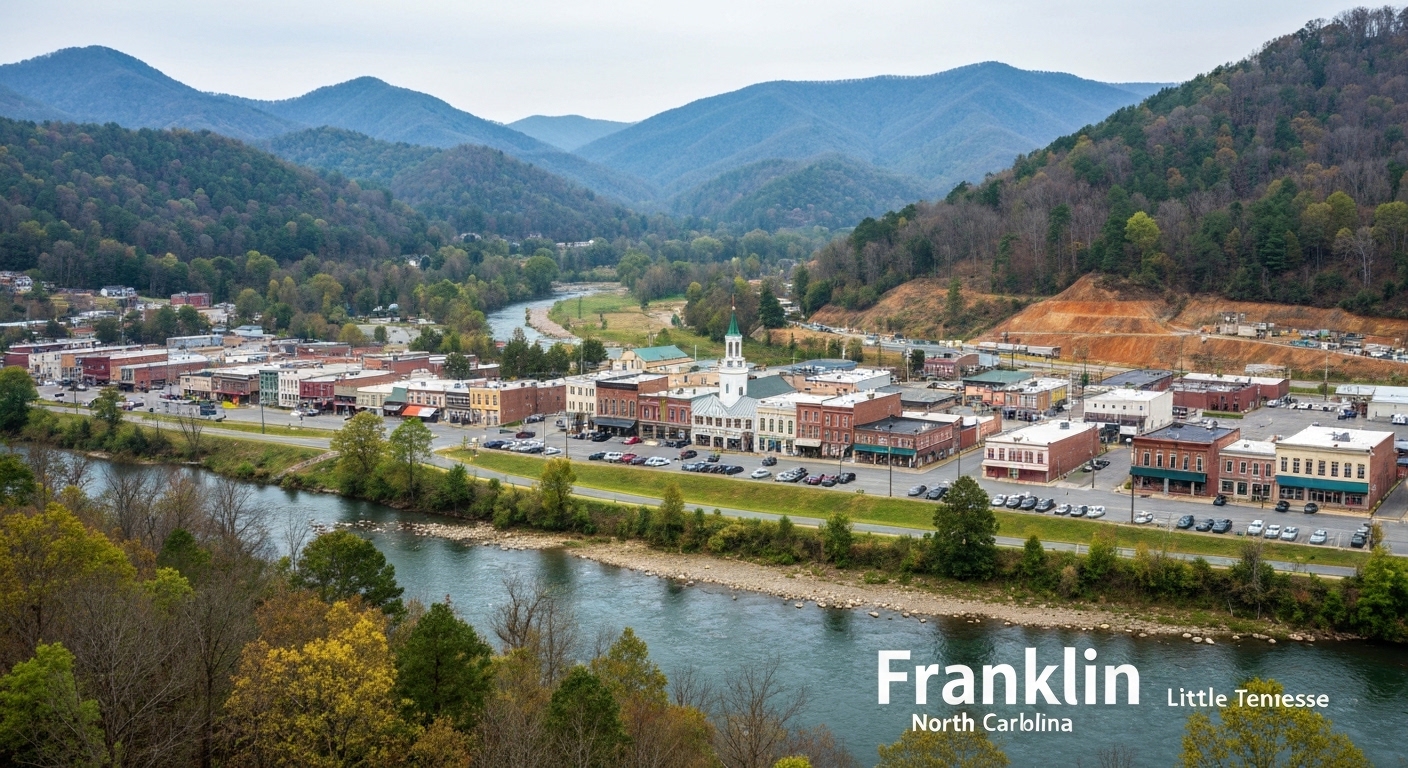
Franklin is a real, working, year-round county seat, the full-service hub of Macon County, not a seasonal resort. That distinction is the single most important thing to understand about living here.
Franklin was built on the site of the Cherokee town of Nikwasi ("Star Place"), one of the Cherokee Mother Towns, and the Nikwasi Mound, a platform mound dating to around 1000 CE, still stands downtown; in February 2026 it was deeded back to the Eastern Band of Cherokee Indians after more than two centuries, so it is now Cherokee-owned. The town was later named for Jesse Franklin, a North Carolina governor. Today the 2020 census count of 4,175 (now closer to 4,400) understates the area, since Macon County overall holds roughly 37,000 people. What you get is a town with everyday services, a hospital, big-box and local retail, county offices, and a community college, plus a genuine Main Street of shops, restaurants, and breweries.
Day to day, Franklin is practical and outdoorsy: people work, shop, and live here year-round, with gem mining, the Appalachian Trail, and the river greenway shaping the local culture. It is the kind of town where you can have mountain life and full-time affordability at once.
See what is on the market in Franklin
See Homes for Sale in FranklinWhat is the Franklin real estate market like?
Franklin is an affordable, high-inventory, year-round market with a wide range and a buyer-friendly pace, the opposite of the luxury plateau just up the mountain. The median home sold for about $260,000 over the past year, and there is a lot to choose from.
Over the past year roughly 378 properties sold with a median near $260,000 and an average around $310,000 (up to about $2.8 million for the rare estate), while the active market is large, about 726 listings, with a median list near $212,000 and days on market around 90 (as of June 2026). That deep inventory and balanced pace mean buyers have room to choose and negotiate, unlike the tight, pricey plateau. The range is wide: the lower tiers include land, manufactured homes, and modest cottages, while the upper end has river-frontage and view homes and a handful of estates. The headline is simple, Franklin is the affordable alternative to Highlands and Cashiers, about 20 minutes down the Cullasaja Gorge, and buyers priced out of the plateau routinely look here.
With this much inventory across such a wide range, knowing the areas and the property types pays off. Start with current Franklin listings, and if you also want to weigh the resort option, compare Highlands homes for sale up the mountain.
What are the areas and communities around Franklin?
Beyond downtown, Franklin is ringed by named valleys and rural communities, each with its own character, from the historic gem country of Cowee to the trail-and-forest west side. Here is a read on the main ones.
| Area | Direction | Character | Typical property |
|---|---|---|---|
| In-town Franklin | central | Walkable to Main Street, services, the greenway | Established homes, town lots |
| Cowee Valley | north | Historic ruby/sapphire gem country, scenic | Land, farms, river homes |
| Iotla Valley | north | Rural valley, farmland along the Little Tennessee | Acreage, farms, homes |
| Cartoogechaye | west | Toward Wayah and the AT, forested | Mountain homes, land, cabins |
| Holly Springs | west/southwest | Rural residential, valley and ridges | Homes and land |
| Cullasaja | east | Along US-64 toward the gorge and Highlands | Homes, land, river/creek parcels |
The pattern: in-town Franklin is the convenient, walkable choice near services and the greenway, the northern valleys (Cowee, Iotla) are scenic farm-and-river country with the gem heritage, the western communities (Cartoogechaye, Holly Springs) lean toward forest, trail access, and mountain land, and Cullasaja stretches east toward the gorge and the Highlands drive. Franklin does not have the gated golf communities of the plateau; it is more a town-and-rural-valley market. For land and acreage, browse land and lots around Franklin.
Why is Franklin called a gem-mining town?
Franklin bills itself as a gem capital because Macon County's Cowee Valley is historic ruby and sapphire country, with commercial mining since around 1870 and dig-your-own mines that are a genuine year-round, family-friendly draw. It is a real and marketable part of local life.
The gem scene is active today: the Franklin Gem & Mineral Museum occupies the historic 1850 Macon County jail (free admission), Ruby City Gems is a large gem-and-mineral store and museum, and several dig-your-own mines operate, including the Cherokee Ruby & Sapphire Mine and Mason Mountain Ruby & Sapphire Mine in the Cowee Valley, where visitors sift native gravel for real stones. The signature event is the Leaf Lookers Gemboree each October, with additional wholesale gem-and-mineral showcases in the summer that draw collectors from around the country (confirm current dates with the Franklin Chamber). For a family or a hobbyist, this is a distinctive lifestyle perk you will not find in most mountain towns.
What outdoor recreation is around Franklin?
Franklin is an outdoor hub anchored by the Appalachian Trail, the Little Tennessee River, and the surrounding Nantahala National Forest. For hikers, anglers, and paddlers, the access is excellent and a core part of the town's identity.
Franklin was the first officially designated Appalachian Trail Community (2010), sits near AT mile 110, and the trail crosses US-64 at Winding Stair Gap about ten miles west, with Standing Indian, Albert Mountain, and the Wayah Bald CCC stone fire tower nearby, plus the Nantahala Outdoor Center to the northwest; each spring the town hosts Trail Days celebrating thru-hikers. In town, the Little Tennessee River Greenway is a roughly 4.5-mile paved riverside trail with fishing piers, canoe put-ins, and picnic areas, and the Little Tennessee River itself offers smallmouth bass and trout. Beyond that, the Bartram Trail passes through the area, Nantahala National Forest brings waterfalls (Cullasaja, Dry, and Bridal Veil Falls line the gorge toward Highlands) and endless trails, and Lake Emory in town plus Nantahala Lake about an hour west add fishing and paddling. It is a remarkable amount of outdoor access for an affordable town.
How far is Franklin from Highlands, Asheville, and other towns?
Franklin is centrally placed in far western North Carolina: about 20 minutes from Highlands up the Cullasaja Gorge, half an hour from Sylva, and within reach of Cherokee, Georgia, and the regional airports. Mountain roads make some drives longer than the mileage suggests.
| From Franklin to | Distance | Drive time |
|---|---|---|
| Highlands, NC | ~12 mi | ~20 min (US-64 through the Cullasaja Gorge) |
| Sylva, NC | ~19 mi | ~30 min |
| Clayton, GA | ~22 mi | ~30 min |
| Bryson City, NC | ~27 mi | ~40-45 min |
| Cherokee, NC | ~31 mi | ~45 min |
| Cashiers, NC | ~28 mi | ~45 min |
| Murphy, NC | ~48 mi | ~1 hr |
| Asheville, NC (and AVL airport) | ~68 mi | ~1 hr 25 min |
| Greenville-Spartanburg, SC (GSP) | ~114 mi | ~2 hr 10 min |
| Atlanta, GA | ~139 mi | ~2 hr 30 min |
(Distances and times as of June 2026, via mapping calculators; some are approximate.) Asheville Regional is the nearest commercial airport at about an hour and a half, with Greenville-Spartanburg and Atlanta as the big-hub options about two to two and a half hours out. The drive up to Highlands via the Cullasaja Gorge is scenic but winding, worth knowing for anyone who will use the plateau's amenities often.
What internet and utilities can you get in Franklin?
Internet in Franklin is solid in town, with cable and some fiber, and thinner in the rural valleys where satellite often fills the gap, so confirm service at the exact address before counting on it for remote work.
| Provider | Type | Coverage in Franklin | Top speed | Notes (as of mid-2026) |
|---|---|---|---|---|
| Optimum / Vyve | Cable | broad in town | high | the main in-town option |
| Frontier | Fiber / DSL | partial fiber in town, DSL rural | up to ~1 Gbps where fiber reaches | address-specific |
| Comporium | Cable / fiber | parts of the area | high | additional local option |
| Starlink | Satellite | anywhere | ~25-100 Mbps typical | the realistic default for remote rural lots |
(Coverage from broadband aggregators, mid-2026; treat as directional.) In-town addresses generally have good cable and some fiber, while rural parcels in the valleys often rely on DSL, fixed wireless, or satellite, so any remote-work buyer should verify the specific address. On utilities, in-town homes are typically on Franklin municipal water and sewer, while rural properties are usually on private wells and septic, so budget for a well test and septic inspection on rural land. Cell coverage can drop in the coves.
How did Hurricane Helene affect Franklin?
Franklin and Macon County fared comparatively well in Hurricane Helene (September 2024) versus the catastrophic damage to the east, with mostly moderate-to-minor damage in town, though river-floodplain parcels did flood and the county saw real losses. Lower elevation helped.
Helene dropped roughly 10 to 15 inches of rain across Macon County with strong winds, and the Little Tennessee River rose significantly, but the town of Franklin sustained mostly moderate-to-minor damage and cleared its roads relatively quickly, while the worst local impacts were up in the Highlands and Cullasaja areas. The county recorded two storm-related deaths and dozens of damaged structures, with utilities restored to the Franklin area fairly fast. The lasting buyer lesson is specific: riverfront and floodplain parcels along the Little Tennessee and area creeks can and did flood, so any river or creek-front property deserves a careful flood-zone check (the FEMA and North Carolina flood maps are the tools) and a look at flood-insurance cost, while homes up off the water are a different profile. Franklin's lower, milder valley setting is generally a year-round-living advantage.
What should buyers know about property here?
Six things shape a smart Franklin purchase: the affordability-and-inventory advantage, flood risk on the river, well-and-septic on rural parcels, manufactured homes in the lower tiers, old-mine land considerations, and the gorge drive to Highlands. The good news is most are easy to navigate with the right help.
First, the upside: large inventory and a roughly 90-day market give buyers genuine room to choose and negotiate, which suits primary-residence and value-retiree buyers well. Then the diligence items: river and creek parcels carry real flood exposure (see Helene above), so pull the flood map on any waterfront lot; rural properties are typically on private wells and septic, so budget for a well test, a septic inspection, and a recorded Road Maintenance Agreement on shared private roads, which lenders require. In the lower price tiers, manufactured and mobile homes are common, so understand the home-versus-land value, the home's age and HUD tag, and the financing and appraisal implications. On historic gem-and-mine ground in places like Cowee Valley, check for old workings, mineral rights, and slope stability. And if you plan to use Highlands' amenities, factor the winding 20-minute Cullasaja Gorge drive. I walk buyers through all of it, and in an affordable, high-inventory market like Franklin, good guidance is what turns choice into the right choice.
What are the property taxes in Franklin?
Franklin sits in Macon County, which has one of the lowest property tax rates in North Carolina at $0.27 per $100 (for 2025-26), and even with the Town of Franklin rate added in town, the total stays low by national standards. A property just outside town limits pays only the county rate plus any fire district.
The Town of Franklin municipal rate is $0.33 per $100, so inside town limits the combined county-plus-town rate is about $0.60 per $100 (a fire-district levy of about $0.07 applies in the fire-protection district; confirm with the Town finance office whether it stacks inside town limits or applies to the unincorporated district). A home outside town in a fire district typically pays roughly $0.33 to $0.37 combined. On a $260,000 home, the in-town rate works out to roughly $1,560 a year, genuinely affordable for a full-service town. Macon County's most recent revaluation took effect January 1, 2023 (values rose about 57.5% countywide), with the next reappraisal expected around 2027, so bills reflect the 2023 values.
On the state side, North Carolina is favorable for retirees: Social Security is not taxed, government and military pensions can be exempt under the Bailey settlement, and there is no estate tax. There is no special $35,000 senior exemption (that is a Georgia benefit, not North Carolina); other retirement income is taxed at the state's flat rate (3.99% in 2026). This is general information, not tax advice, so confirm the current town and fire-district figures with Macon County and the Town of Franklin, and your situation with a CPA.
What are the schools and healthcare like?
Franklin is served by Macon County Schools, including Franklin High School and a community college campus, and by Angel Medical Center, the county's hospital with a modern campus that opened in 2022. For an affordable town, the institutions are solid.
For schools, Franklin High School is Macon County's main high school, with Mountain View Intermediate and elementary and middle schools across the area (confirm the exact assigned schools for a specific address), and Southwestern Community College's Macon Campus offers transfer degrees, career and technical programs, and an early-college partnership. For healthcare, Angel Medical Center in Franklin is a critical-access hospital (part of the Mission Health system) whose new roughly $70 million campus opened in September 2022, with an emergency department and inpatient care; for higher-acuity or specialty care, Mission Hospital in Asheville is the regional referral center about an hour and a half away. Having a modern hospital in town is a meaningful advantage for retirees choosing Franklin.
How does Franklin compare to nearby towns?
Franklin is the affordable, year-round, full-service option, distinct from the luxury plateau resorts of Highlands and Cashiers, the county seat of Sylva over in Jackson County, and the smaller communities around it. Here is the honest head-to-head.
- Why buyers choose Franklin over Highlands or Cashiers: Franklin is a fraction of the cost, year-round, lower in elevation with far less snow, and full of everyday services, while Highlands and Cashiers are seasonal luxury resorts at much higher prices and elevations. Many buyers priced out of the plateau, or who simply want practical full-time living, choose Franklin and drive up the mountain for the resort amenities. Choose Franklin for value and year-round living, the plateau for the luxury-resort lifestyle. - Why buyers choose Franklin over Sylva: Both are affordable, year-round county seats with real downtowns and hospitals, about half an hour apart. Franklin (Macon) has the gem-mining and Appalachian Trail identity, the river greenway, and a slightly larger, more spread-out feel, while Sylva (Jackson) has a celebrated brewery-and-bookstore Main Street and Western Carolina University nearby. Choose based on which town and amenities fit; many buyers tour both. - Why buyers choose Franklin as a base: From Franklin you are within reach of Highlands, Cashiers, Cherokee, the Nantahala, and Georgia, with the area's services and the lowest-elevation, mildest year-round living of the bunch. It is the practical hub of far western North Carolina.
Is Franklin right for you?
Franklin is a strong fit for a primary-residence buyer, a value-minded retiree, or an outdoor lover who wants affordable, year-round mountain living with real services, low taxes, and great access to the Appalachian Trail, the river, and gem country. If you want a full-time mountain home you can actually afford, with a hospital and shopping in town and the resort plateau a short drive away, Franklin delivers more for the money than almost anywhere in the region.
It is not the right fit for someone seeking a prestige resort address with golf clubs and a designer Main Street (that is Highlands or Cashiers), a high-elevation cool-summer retreat (Franklin is warmer and lower), or a turnkey luxury home (the market skews affordable and practical). And river-floodplain and rural-property diligence is part of buying here.
If affordable, year-round mountain living is what you are after, reach out and I will help you sort the areas and property types, check flood and well-and-septic on rural parcels, and find the right home in this practical, welcoming town.
Frequently Asked Questions
Is Franklin, NC a good place to live? For a year-round, value-minded buyer, yes. Franklin is Macon County's affordable, full-service county seat at about 2,113 feet, with a hospital, shopping, a community college, a real downtown, and standout outdoor access (the Appalachian Trail, the Little Tennessee River Greenway, gem mining, and Nantahala National Forest), all about 20 minutes down the mountain from luxury Highlands. It has one of the lowest county tax rates in North Carolina and a large, buyer-friendly housing inventory. It fits primary-residence buyers, budget retirees, and outdoor lovers far better than someone seeking a prestige resort address.
How much does it cost to buy a home in Franklin? It is affordable with lots of choice. Over the past year about 378 properties sold with a median near $260,000 and an average around $310,000, while the active market is large, around 726 listings, with a median list near $212,000 and days on market around 90 (as of June 2026). The lower tiers include land, manufactured homes, and modest cottages; the upper end has river and view homes and a few estates. The deep inventory gives buyers real room to negotiate, so ask me for a current, area-specific read before making an offer.
Why are property taxes so low in Franklin? Because Macon County has one of the lowest county property tax rates in North Carolina at $0.27 per $100 (2025-26). Inside the Town of Franklin you also pay the town rate of $0.33, for about $0.60 combined, roughly $1,560 a year on a $260,000 home, with a small fire-district levy in the fire-protection district (confirm how it applies with the Town). A home outside town limits pays only the county rate plus any fire district. North Carolina does not tax Social Security and has a flat income tax (3.99% in 2026); there is no $35,000 senior exemption (that is Georgia), though government and military pensions can be exempt under the Bailey settlement.
What is Franklin known for? Three things: gems, the Appalachian Trail, and being an affordable, full-service mountain town. Franklin is historic ruby and sapphire country, with the Franklin Gem & Mineral Museum, Ruby City Gems, dig-your-own mines in the Cowee Valley, and the October Leaf Lookers Gemboree. It was the first officially designated Appalachian Trail Community and hosts an annual Trail Days celebration for thru-hikers. And it is the practical, affordable county seat of Macon County, with a hospital, shopping, and the Little Tennessee River Greenway running through town.
How far is Franklin from Highlands? About 12 miles and 20 minutes up US-64 through the scenic Cullasaja Gorge, past Bridal Veil and Dry Falls. Franklin is the affordable, year-round alternative to the Highlands-Cashiers plateau, so many buyers live in Franklin and drive up for the resort amenities. The gorge road is beautiful but winding, worth factoring in if you will make the trip often. Sylva is about 30 minutes north, Cherokee about 45 minutes, and Asheville about an hour and 25 minutes.
Does Franklin flood? The river floodplain can. Franklin and Macon County fared comparatively well in Hurricane Helene (September 2024) versus areas to the east, with mostly moderate-to-minor damage in town, but the Little Tennessee River rose significantly and floodplain parcels did flood. For any river or creek-front property, pull the FEMA flood-zone determination and weigh flood-insurance cost; homes up off the water are a different profile. Franklin's lower, milder valley setting is generally a year-round-living advantage, including far less snow than the Highlands plateau.
What is the elevation and weather in Franklin? Franklin sits at about 2,113 feet, roughly 2,000 feet lower than Highlands, so it is milder, warmer, and gets far less snow, which is a real advantage for full-time living. You still get four seasons and beautiful falls, but winters are gentler than on the high plateau. That lower elevation is a big part of why Franklin works as a year-round town while the plateau towns are more seasonal.
What healthcare and schools does Franklin have? Franklin has Angel Medical Center, a critical-access hospital (part of Mission Health) whose new roughly $70 million campus opened in September 2022, with an emergency department and inpatient care, plus Mission Hospital in Asheville about an hour and a half away for higher-acuity care. For schools, Macon County Schools serves the area, with Franklin High School as the main high school and Southwestern Community College's Macon Campus for two-year degrees and career programs. A modern in-town hospital is a meaningful plus for retirees.
Is Franklin or Sylva better? They are similar in the best way: both affordable, year-round county seats with real downtowns and hospitals, about half an hour apart. Franklin (Macon County) has the gem-mining and Appalachian Trail identity, the Little Tennessee River Greenway, and a slightly larger, more spread-out feel, while Sylva (Jackson County) has a celebrated brewery-and-bookstore Main Street and Western Carolina University nearby. Neither is objectively better; choose based on which town's feel and amenities fit you, and many buyers tour both before deciding.
About the Author
Jon Tharp is a licensed NC real estate broker with Keller Williams. He's helped buyers and sellers across Western North Carolina for over 10 years, specializing in mountain homes, land, and short-term rental investments, with offices throughout WNC covering all mountainous areas. If something in this post has you thinking about a move, he's easy to reach — (828) 347-9055 or smokymountainhomes4sale.com or Jon@jontharphomes.com.
Ready to Find Your Mountain Home Near Franklin?
Whether you're looking to buy, considering a short-term rental investment, or ready to sell, the Jon Tharp Team brings deep local knowledge and marketing that puts your home in front of 50,000+ buyers in the first 30 days.
Search available homes across Western NC or call Jon directly at (828) 347-9055.
Talk to JonWhat Our Clients Say
43 five-star Google reviews — read them all on Google
"Jon is hands down the most dedicated and knowledgeable realtor that I have ever worked with. His expertise made the entire process of selling my home and finding a new one a smooth process."
Amy Davis · 2025
"Jon & his team are the greatest! Very professional, friendly like your neighbor, and always get back to your texts, phone calls & emails within minutes or same day, not days or weeks."
Cynthia Oelschlager · 2025
"I can’t say enough good things about Jon and his team. I was looking for investment properties and Jon spent time researching where would be a good place for an Airbnb — he found 2 beautiful properties."
Diane Cogswell · 2025
More from the Blog