By Jon Tharp, Broker · June 7, 2026
Quick Answer: Tuckasegee is a small, rural, unincorporated community in Jackson County, North Carolina, strung along NC-107 in the valley between Sylva and Cashiers at about 2,165 feet, where the East and West forks of the Tuckasegee River meet. It is known for some of the best trout fishing in Western North Carolina, a cluster of quiet high-elevation lakes, and mountain land, and it is a patient, rural market: lots of affordable land and cabins at one end, a handful of high-end river and lake estates at the other. Because Tuckasegee is unincorporated, buyers pay no town property tax, only the Jackson County rate plus a small fire-district levy.
Tuckasegee at a Glance
| Status | Unincorporated rural community (no published population); ZIP 28783 |
| Setting | The Tuckasegee River valley on NC-107, between Sylva and Cashiers, at ~2,165 ft |
| The water | The Tuckasegee River (a premier trout river) plus the East Fork lakes (Bear, Cedar Cliff, Wolf, Tanasee) |
| Market | Rural and bimodal: affordable land and cabins, a few high-end river/lake estates; slow (median sale ~$350K, DOM ~167) (as of June 2026) |
| Property tax | Jackson County $0.31 per $100 (2025-26), no town tax (unincorporated), plus a small Cullowhee fire-district levy |
| Drive to Sylva | ~6-7 miles, ~12 minutes to the county seat, services, and the hospital |
| Locally famous for | Trout fishing on "the Tuck," quiet mountain lakes, and remote rural land |
What is it actually like to live in Tuckasegee?
Living in Tuckasegee means living in a quiet, remote river valley surrounded by national forest, where the draw is fishing, land, water, and privacy rather than town conveniences. It is one of the most rural communities in this guide series, and that is exactly the appeal for the right buyer.
Tuckasegee sits in the valley where the two forks of the Tuckasegee River come together, with the river itself a marquee trout fishery and a string of small, lightly developed high-elevation lakes nearby. There is no real town center; general stores and gas stations stand in for retail, and everything else, groceries, pharmacy, the hospital, is a short drive to Sylva or Cullowhee. The market reflects the rural setting: mostly affordable land and cabins, with a handful of higher-end river and lakefront properties, and a slow pace where listings can sit (as of June 2026). Because Tuckasegee is unincorporated, there is no town property tax, only the Jackson County rate plus a small fire-district levy.
This guide is written honestly for what Tuckasegee is: a patient, land-and-lifestyle market for anglers, nature lovers, and privacy seekers, and how to buy here well, from flood risk on the river to well-and-septic realities and the rural-internet question.
Table of Contents
- What kind of place is Tuckasegee? - What is the fishing like on the Tuckasegee River? - What are the lakes near Tuckasegee? - What is the Tuckasegee real estate market like? - What is there to do in Tuckasegee? - How far is Tuckasegee from Sylva, Cashiers, and the feeder cities? - What internet and utilities can you get in Tuckasegee? - How did Hurricane Helene affect Tuckasegee? - What should out-of-state buyers know about property here? - What are the property taxes in Tuckasegee? - What are the schools and healthcare like? - How does Tuckasegee compare to nearby areas? - Is Tuckasegee right for you? - Frequently Asked Questions
What kind of place is Tuckasegee?
Tuckasegee is a rural, unincorporated mountain community, not a town, defined by the river, the surrounding Nantahala National Forest, and a quiet, neighborly valley culture. Its whole character is remote and land-oriented.
There is no official population count because Tuckasegee is an unincorporated community rather than a formal census place, and there is no town government, so there is no municipal tax, just Jackson County governance and a local volunteer fire district. The name carries deep history: it comes from a historic Cherokee town shown on maps as early as 1730. Today the valley is a string of homes, cabins, and land along NC-107 and its side roads, with general stores rather than chains, where, as locals put it, everyone knows their neighbors. The river runs through the heart of it, and the forest wraps everything.
Day to day, life here is rural and self-reliant: fishing and paddling the river, exploring the lakes and waterfalls, working land, and driving to Sylva or Cullowhee for shopping, schools, and services. For someone who wants quiet, space, and water access over walkable convenience, that trade is the entire point.
See what is on the market in Tuckasegee
See Homes for Sale in TuckasegeeWhat is the fishing like on the Tuckasegee River?
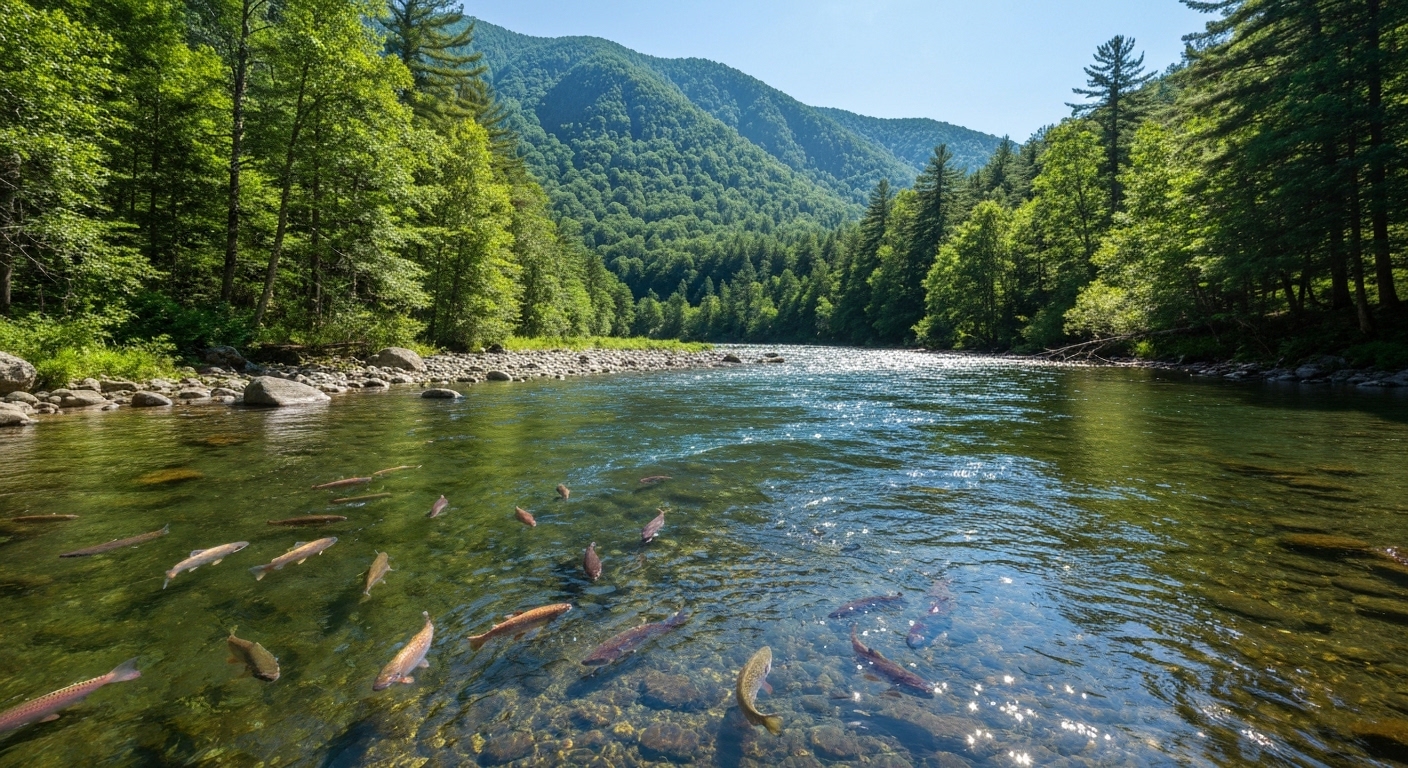
The fishing is the headline: the Tuckasegee, "the Tuck," is one of the largest and most productive trout rivers in Western North Carolina and a marquee stop on the Western North Carolina Fly Fishing Trail. For an angler-buyer, it is a genuine draw.
The river is wade-friendly, larger and shallower than most mountain streams, and heavily stocked, with a popular roughly five-mile Delayed Harvest (catch-and-release, single-hook artificial flies only) section near Sylva that runs October through May, plus a second delayed-harvest stretch downriver near Bryson City. Brook, rainbow, and brown trout are all in play, and guide services and fly shops work the river year-round. Flows are influenced by Duke Energy dam releases on both forks, which anglers and paddlers learn to read. Beyond fly fishing, the river supports rafting and tubing, with riverside access points in the area. For someone whose dream is walking out the door to a great trout river, Tuckasegee is one of the best addresses in the region.
What are the lakes near Tuckasegee?
Tuckasegee sits near a cluster of small, high-elevation, lightly developed Duke Energy reservoirs on the East Fork, quiet alternatives to the bigger, busier Lake Glenville on the West Fork. They are a defining feature of the area.
| Lake | Size | Character |
|---|---|---|
| Bear Creek (Bear) Lake | ~476 acres (largest) | Along NC-281; public boat ramp and ADA fishing dock; home to the gated Bear Lake Reserve resort community; Sols Creek Falls (~120 ft) nearby |
| Wolf Creek (Wolf) Lake | ~183 acres | East Fork system; boating, paddling, swimming, fishing |
| Cedar Cliff Lake | ~100+ acres | Closest to NC-107; paved boat ramp off Shook Cove Road (confirm current access, post-maintenance) |
| Tanasee Creek Lake | ~40 acres (smallest) | Secluded off NC-281; no motorboats, paddling and fishing only |
These East Fork lakes are surrounded by national forest and are far less developed than Lake Glenville, so true private lakefront is scarce, with the gated Bear Lake Reserve community the notable developed exception. They are prized for quiet paddling, fishing, and scenery rather than a big boating scene. As with all the area's lakes, Duke Energy controls the shoreline, so any dock or shoreline use requires its permit. Note that Lake Glenville (the larger West Fork lake) is a separate, more developed market near Glenville and Cashiers, often confused with these East Fork lakes.
What is the Tuckasegee real estate market like?
Tuckasegee is a rural, patient, bimodal market: mostly affordable land and cabins, with a handful of higher-end river and lakefront estates, and long marketing times. It is a land-and-lifestyle market more than a move-in-ready-home market.
Over the past year roughly 51 properties sold with a median near $350,000 but an average around $512,000 and a high around $2.8 million, while the active market shows about 148 listings with a median list near $277,500 and a high around $4.6 million, with days on market running around 170 (as of June 2026). That long DOM and the gap between median and average tell the story: lots of raw mountain land, acreage, and rustic cabins at the lower end, a few river-frontage and high-end properties at the top, and a slow pace where both buying and reselling take patience. What most buyers actually purchase here is land, a cabin, or river frontage, not a conventional subdivision home.
Because this is a land-heavy rural market with long timelines, pricing and due diligence matter more than speed. Start with current Tuckasegee listings, and widen into the nearby Sylva and Cullowhee markets for more conventional inventory.
What is there to do in Tuckasegee?
Tuckasegee is about the outdoors: fishing, paddling, hiking, and waterfalls, with the broader plateau and Sylva a short drive for everything else. It is a base for water and forest more than for nightlife.
On and around the water you have the trout river, the East Fork lakes, and waterfalls like Sols Creek Falls near Bear Lake, plus paddling and tubing on the river. The community is wrapped in Nantahala National Forest, with hiking and backcountry access, and Panthertown Valley, the "Yosemite of the East," lies just to the south toward Cashiers. East LaPorte River Park is a local riverside gathering spot. For shopping, dining, breweries, and events, Sylva and Cullowhee are about fifteen minutes north, and the Cashiers village scene is to the south. The appeal here is genuinely the quiet and the access to water and forest, not a busy social calendar.
How far is Tuckasegee from Sylva, Cashiers, and the feeder cities?
Tuckasegee sits about fifteen minutes from both Sylva and Cullowhee and roughly twenty minutes from Cashiers, with Asheville and the feeder metros well beyond. Mountain roads make the drives longer than the mileage suggests.
| From Tuckasegee to | Distance | Drive time |
|---|---|---|
| Sylva, NC (Harris Regional Hospital) | ~6-7 mi | ~12-13 min |
| Cullowhee / WCU | ~7 mi | ~13 min |
| Glenville / Lake Glenville | ~9 mi | ~15-20 min |
| Cashiers, NC | ~15 mi | ~22 min |
| Asheville, NC (and AVL airport) | ~52 mi | ~1 hr |
| Greenville-Spartanburg, SC (GSP) | ~87 mi | ~1 hr 50 min |
| Atlanta, GA | ~160 mi | ~3 hr |
| Charlotte, NC | ~160 mi | ~3 hr |
(Distances and times as of June 2026, via mapping calculators; some are approximate.) Sylva, about fifteen minutes north, is the practical hub for groceries, the full-service hospital, and shopping, while the critical-access Highlands-Cashiers Hospital is to the south. Asheville Regional is the nearest commercial airport at about an hour, with Greenville-Spartanburg and Atlanta as the larger feeder metros.
What internet and utilities can you get in Tuckasegee?
Internet is the real rural challenge here: wired options are limited, and satellite is the dependable answer for most parcels, so anyone planning to work from home must confirm service at the exact address before buying.
| Provider | Type | Coverage in Tuckasegee | Top speed | Notes (as of mid-2026) |
|---|---|---|---|---|
| Frontier | DSL | where copper reaches | varies | limited; no major rural investment planned |
| Fixed wireless | Wireless | some areas | varies | tower-dependent; a SkyFi tower has been planned for the area |
| Starlink | Satellite | anywhere | ~25-100 Mbps typical | the realistic default for most rural lots |
| Viasat / HughesNet | Satellite | available | lower | legacy fallback |
(Coverage from broadband aggregators and local reporting, mid-2026.) Connectivity is a known pain point in this part of Jackson County, so treat strong internet as something to verify, not assume. On utilities, essentially all rural property here is on private wells and septic rather than municipal water and sewer, so budget for a well test, a septic inspection, and perc tests on raw land. And expect genuine cell and GPS dead zones in the valleys and on forest roads, so do not rely on phone navigation everywhere.
How did Hurricane Helene affect Tuckasegee?
The Tuckasegee-to-Cashiers corridor was among the hardest-hit parts of Jackson County during Hurricane Helene in September 2024, with major river flooding and road damage, even though the county overall fared better than areas to the east. River-adjacent property is the key flood consideration here.
During Helene the Tuckasegee River rose from a normal level of about 4.5 feet to over 17 feet, the area got more than eleven inches of rain in three days with wind gusts near 60 mph, and the central-and-southern county from Tuckasegee to Cashiers saw many rural roads left impassable. The county lost cell service and internet from Friday afternoon into late Monday, and some river-access points remained closed into 2025. Recovery has progressed, but the episode is a clear flood marker. For a buyer, the takeaway is concrete: any river-frontage or low-lying parcel deserves a careful flood-zone check (North Carolina's flood mapping at fris.nc.gov is the tool), along with a look at road and bridge access and the property's storm history, while homes set up and away from the river are a different profile.
What should out-of-state buyers know about property here?
Five things define a smart Tuckasegee purchase: the rural remoteness, well-and-septic on essentially every parcel, steep and shared access roads, flood risk on the river, and the slow market. All reward preparation, and none should surprise you at closing.
First, remoteness: groceries, pharmacy, full retail, and the hospital are all a drive to Sylva or Cullowhee, so plan your life around that. Second, water and septic: almost all rural property here is on private wells and septic, so budget for a well test, a septic inspection, and perc tests on land before you rely on buildability. Third, access: steep, gravel, and shared private roads are common, so confirm who maintains the road, the cost split, and that there is a recorded Road Maintenance Agreement, which lenders require. Fourth, flood: river and creek parcels carry real flood exposure (see Helene above), so pull the flood map and weigh elevation. Fifth, the market: with days on market around 170, both buying and reselling take patience, and pricing and timing should be set realistically up front. Add Duke Energy shoreline rules on any lakefront, and the small fire-district tax, and you have the homework. I walk land and cabin buyers through every piece, because in a rural market the due diligence is the deal.
What are the property taxes in Tuckasegee?
Tuckasegee buyers pay only the Jackson County rate of $0.31 per $100 (for 2025-26) plus a small Cullowhee fire-district levy, with no town tax, because Tuckasegee is unincorporated. That keeps the total bill low, a genuine plus for rural land and second-home buyers.
On the county side, Jackson County completed a revaluation effective January 1, 2025 that raised assessed values significantly and cut the county rate from $0.38 to $0.31 to partly offset it, so bills reflect the new values. Tuckasegee is served by the Cullowhee Volunteer Fire Department (Station 2 sits right on NC-107 in Tuckasegee), so a small fire-district tax applies on top of the county rate; confirm the current fire-district figure for a specific parcel, but there is no municipal layer at all.
On the state side, North Carolina is favorable for retirees: Social Security is not taxed, government and military pensions can be exempt under the Bailey settlement, and there is no estate tax. There is no special $35,000 senior exemption (that is a Georgia benefit, not North Carolina); other retirement income is taxed at the state's flat rate (3.99% in 2026). This is general information, not tax advice, so confirm current rates and the fire-district levy with the county and a CPA.
What are the schools and healthcare like?
Tuckasegee is served by Jackson County Public Schools, zoned to Cullowhee Valley School for K-8 and Smoky Mountain High in the Sylva area for high school, with healthcare anchored by Harris Regional Hospital about fifteen minutes away in Sylva. For a rural valley, the essentials are a reasonable drive.
For schools, Tuckasegee is zoned to Cullowhee Valley School (K-8), which serves Cullowhee plus the surrounding communities including Tuckasegee, and to Smoky Mountain High School in Sylva for grades 9-12; Western Carolina University in Cullowhee adds higher-education and cultural options nearby. For healthcare, Harris Regional Hospital in Sylva is the closest full-service hospital and ER, about fifteen minutes north, with the critical-access Highlands-Cashiers Hospital to the south and Mission Hospital in Asheville as the regional referral center about an hour away. Buyers should expect to drive for medical care, which is the rural trade-off, with a full hospital within about fifteen minutes.
How does Tuckasegee compare to nearby areas?
Tuckasegee is the rural, river-and-land option, distinct from the year-round towns of Sylva and Cullowhee to the north and the lake-and-resort markets of Glenville and Cashiers to the south. Here is the honest head-to-head.
- Why buyers choose Tuckasegee over Sylva or Cullowhee: Tuckasegee offers more privacy, more land, lower prices, and direct access to the trout river and the quiet East Fork lakes, while Sylva and Cullowhee have walkable services, more inventory, and shorter drives to everything. Choose Tuckasegee for rural quiet and water access, the Sylva area for convenience and selection. - Why buyers choose Tuckasegee over Glenville: Tuckasegee is more affordable and more rural, with the river and the lightly developed East Fork lakes, while Glenville is built around the much larger, more developed Lake Glenville with true lakefront estates. Choose Tuckasegee for land and the river, Glenville for big-lake living. - Why buyers choose Tuckasegee over Cashiers: Tuckasegee is a fraction of the cost of Cashiers and far more rural and private, while Cashiers is the high-end plateau resort with clubs and a village. Choose Tuckasegee for affordable rural land and fishing, Cashiers for the luxury resort lifestyle.
Is Tuckasegee right for you?
Tuckasegee is a strong fit for an angler, a land buyer, or a privacy seeker who wants a rural river valley with great trout fishing, quiet lakes, and mountain acreage, and who is comfortable driving fifteen minutes for services and being patient in a slow market. If your dream is a cabin on or near the Tuck, a piece of mountain land, or a quiet escape wrapped in national forest, Tuckasegee delivers it affordably and authentically.
It is not the right fit for someone who wants walkable conveniences (look to Sylva), a turnkey selection of move-in-ready homes (the market is land-heavy and slow), reliable high-speed internet without checking the address, or a property on the river without taking flood risk seriously. Rural self-reliance, well-and-septic, and access-road homework are part of the deal.
If a rural river-and-land lifestyle is what you are after, reach out and I will help you sort buildable land from problem parcels, check flood and access on river property, and find the right piece of this quiet valley for how you want to live.
Frequently Asked Questions
Is Tuckasegee, NC a good place to live? For an angler, land buyer, or privacy seeker, yes. Tuckasegee is a rural, unincorporated river valley in Jackson County, strung along NC-107 between Sylva and Cashiers, known for excellent trout fishing on the Tuckasegee River, a cluster of quiet high-elevation lakes, and affordable mountain land, all wrapped in national forest. Because it is unincorporated, there is no town property tax, only the Jackson County rate plus a small fire-district levy, and Sylva's services and hospital are about fifteen minutes away. The trade-offs are real remoteness, well-and-septic property, limited internet, and a slow market, so it fits rural land-and-lifestyle buyers far better than someone wanting town conveniences.
How much does it cost to buy in Tuckasegee? It is a rural, bimodal market. Over the past year about 51 properties sold with a median near $350,000 but an average around $512,000 and a high around $2.8 million, while active listings show a median list near $277,500 and reach about $4.6 million, with days on market around 170 (as of June 2026). The lower end is raw land, acreage, and rustic cabins; the higher end is river-frontage and a few high-end properties. Most buyers here purchase land, a cabin, or river frontage rather than a conventional home, so ask me for a current, parcel-specific read before making an offer.
How is the trout fishing on the Tuckasegee River? Excellent. The Tuckasegee, "the Tuck," is one of the largest and most productive trout rivers in Western North Carolina and a marquee stop on the WNC Fly Fishing Trail. It is wade-friendly and heavily stocked, with a popular roughly five-mile Delayed Harvest (catch-and-release, single-hook artificial flies) section that runs October through May, plus a second delayed-harvest stretch near Bryson City, holding brook, rainbow, and brown trout. Flows are affected by Duke Energy dam releases. For an angler who wants to live near a great river, Tuckasegee is one of the best addresses in the region.
What lakes are near Tuckasegee? Tuckasegee sits near four small, high-elevation, lightly developed Duke Energy reservoirs on the East Fork: Bear Creek Lake (the largest at about 476 acres, with a public ramp and the gated Bear Lake Reserve community), Wolf Creek Lake (about 183 acres), Cedar Cliff Lake (about 100-plus acres, closest to NC-107), and Tanasee Creek Lake (about 40 acres, paddling only, no motorboats). They are quiet, forest-surrounded alternatives to the bigger, more developed Lake Glenville on the West Fork. Because they sit in national forest and Duke controls the shoreline, true private lakefront is scarce.
Does Tuckasegee have a town property tax? No. Tuckasegee is unincorporated, so buyers pay only the Jackson County rate of $0.31 per $100 (2025-26) plus a small Cullowhee fire-district levy, with no municipal tax on top. Jackson County completed a 2025 revaluation that raised assessed values and cut the county rate from $0.38 to $0.31. Confirm the current fire-district figure for a specific parcel. North Carolina does not tax Social Security and has a flat income tax (3.99% in 2026); there is no $35,000 senior exemption (that is Georgia), though government and military pensions can be exempt under the Bailey settlement.
What is the internet like in Tuckasegee? Limited, and a real consideration. Wired options are sparse (Frontier DSL where copper reaches, with no major rural investment planned), some areas have fixed wireless, and satellite, especially Starlink, is the dependable default for most rural parcels. Connectivity is a known pain point in this part of Jackson County, so if you plan to work from home, verify service at the exact address before buying rather than assuming it.
Did Tuckasegee flood during Hurricane Helene? The river corridor did. The Tuckasegee-to-Cashiers area was among the hardest-hit parts of Jackson County during Helene in September 2024, when the river rose from about 4.5 feet to over 17 feet, more than eleven inches of rain fell in three days, and many rural roads were left impassable, with cell and internet out for several days. The county overall fared better than areas to the east, and recovery has progressed, but flood risk on river and creek parcels is real. For any river-frontage or low-lying property, pull the FEMA flood-zone determination (fris.nc.gov) and weigh elevation; homes set up away from the river are a different profile.
Is Tuckasegee too remote to live in full-time? It depends on your tolerance for rural life. Tuckasegee is genuinely rural, with general stores rather than chains and a fifteen-minute drive to Sylva or Cullowhee for groceries, the hospital, and shopping, plus well-and-septic property, limited internet, and cell dead zones. For someone who wants quiet, space, and water and forest access, that is the appeal, and many people live here full-time and love it. For someone who wants conveniences close at hand, a town like Sylva is a better fit. Spending real time here in different seasons before buying is the smart move.
About the Author
Jon Tharp is a licensed NC real estate broker with Keller Williams. He's helped buyers and sellers across Western North Carolina for over 10 years, specializing in mountain homes, land, and short-term rental investments, with offices throughout WNC covering all mountainous areas. If something in this post has you thinking about a move, he's easy to reach — (828) 347-9055 or smokymountainhomes4sale.com or Jon@jontharphomes.com.
Ready to Make Western NC Your Home Base?
Whether you're looking to buy, considering a short-term rental investment, or ready to sell, the Jon Tharp Team brings deep local knowledge and marketing that puts your home in front of 50,000+ buyers in the first 30 days.
Search available homes across Western NC or call Jon directly at (828) 347-9055.
Talk to JonWhat Our Clients Say
43 five-star Google reviews — read them all on Google
"Jon is hands down the most dedicated and knowledgeable realtor that I have ever worked with. His expertise made the entire process of selling my home and finding a new one a smooth process."
Amy Davis · 2025
"Jon & his team are the greatest! Very professional, friendly like your neighbor, and always get back to your texts, phone calls & emails within minutes or same day, not days or weeks."
Cynthia Oelschlager · 2025
"I can’t say enough good things about Jon and his team. I was looking for investment properties and Jon spent time researching where would be a good place for an Airbnb — he found 2 beautiful properties."
Diane Cogswell · 2025
More from the Blog