By Jon Tharp, Broker · August 13, 2026
At a Glance
Western North Carolina's Scottish roots come mostly from Scots-Irish families who traveled the Great Wagon Road into the backcountry in the mid 1700s, not from the Highland Scots who settled the Cape Fear valley near Fayetteville. That heritage survives at the Scottish Tartans Museum in Franklin, the Grandfather Mountain Highland Games at MacRae Meadows near Linville, and in Cherokee family lines shaped by Scottish traders.
Most of the Scottish families who shaped North Carolina never saw these mountains. They landed on the coast, moved up the Cape Fear valley, and settled the country around what is now Fayetteville. Flora MacDonald, the most famous Scottish emigrant in state history, arrived there in 1774, and half the mountain towns that have a tartan hanging in a storefront window still claim her.
The mountain story is different, and better. It belongs to the Scots-Irish, and it came in overland, on foot and by wagon, from the north.
You can spend an afternoon sorting all of it out on Main Street in Franklin, at the Scottish Tartans Museum and Heritage Center, which is where a lot of people in this region first learn which of the two stories is actually theirs.
Two Migrations, Constantly Confused
Start with the coastal one, because it came first and it has the better paper trail. In 1739, royal governor Gabriel Johnston, a Scot himself, encouraged roughly 360 Highland Scots to settle in North Carolina and sweetened the offer with a ten year tax exemption on land purchases. Cara Pace, curator at the Franklin museum, points to that exemption as the reason it worked. Land with no tax bill attached for a decade is a powerful argument in any century.
They came for reasons that will sound familiar to anyone who has watched a rural economy tighten. Rents were rising. Times were hard. And after the defeat at Culloden on April 16, 1746, law and force were dismantling the old Highland world. Emigration stopped being an adventure and became an exit.
Those families settled the Cape Fear valley. Flat country, river access, pine and sand. Not a ridge in sight.
The mountain families came from a different branch of the same tree. The Scots-Irish, or Ulster Scots, were people of Scottish origin whose families had relocated to the north of Ireland in the early 1600s. By the 1710s they were leaving again. Rackrenting landlords, Anglican discrimination against Presbyterians, and the collapse of the linen trade that had been holding the whole arrangement together drove them out.
They did not sail to Wilmington. They sailed to Philadelphia and New Castle, then turned south.
The Road That Built the Backcountry
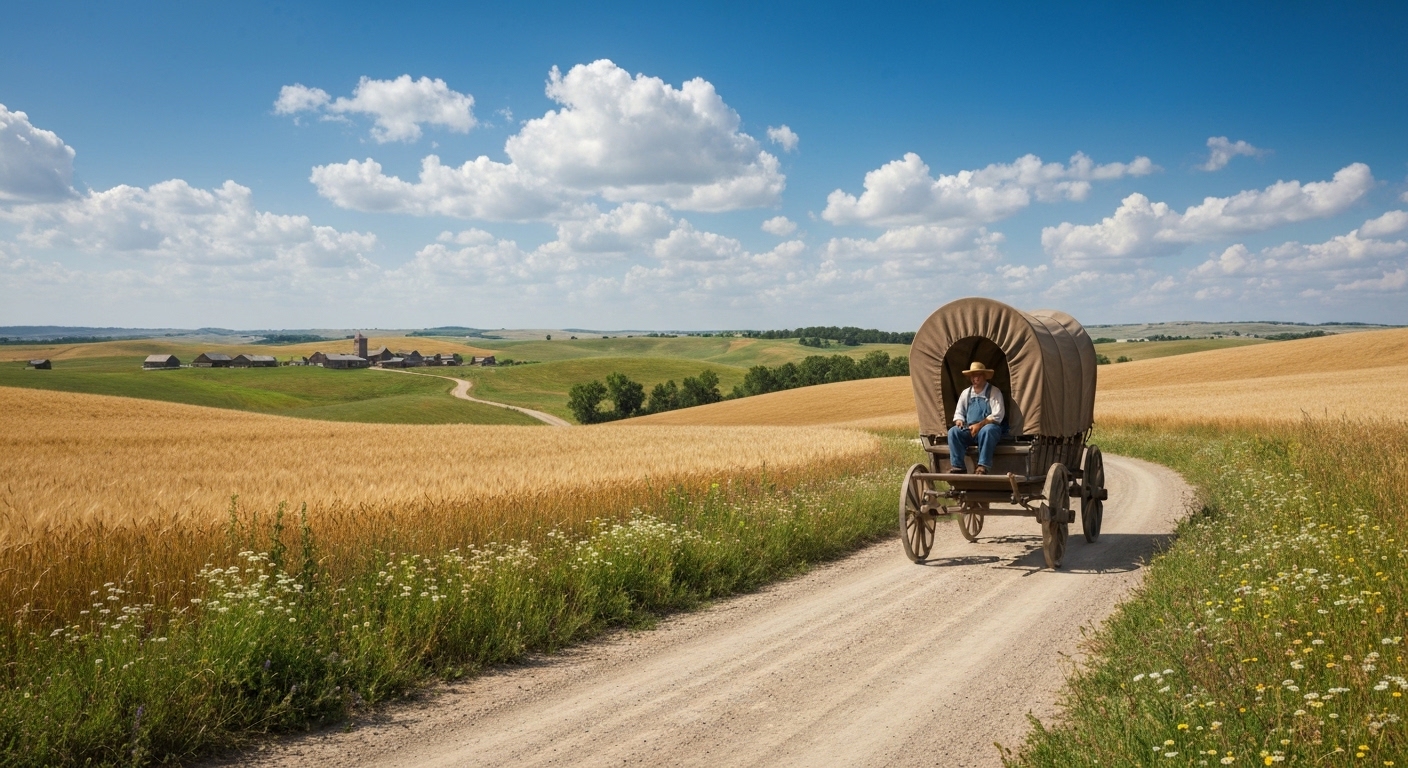
The Great Wagon Road did more to build Western North Carolina than any other piece of infrastructure, and almost nobody around here can point to it on a map. It ran south out of Philadelphia through Pennsylvania, Maryland, and Virginia, down the Shenandoah, and into the Carolina backcountry. At its full length it stretched more than 735 miles, all the way to Augusta, Georgia.
Traffic peaked between 1740 and 1765. Families moved in groups, often whole congregations at once, because a Presbyterian community that had already relocated once knew how to do it again. They took up land in the piedmont first, then kept pushing west as the good bottomland filled in.
By the 1780s, settlement had reached the western counties of North Carolina and spilled over into what is now East Tennessee. That is the generation that put permanent names on these creeks and coves.
Be clear about what that settlement meant. These families were moving into Cherokee homeland, and after 1763 they were doing it in open defiance of a royal proclamation that banned settlement west of the mountains. The Crown drew a line. The backcountry ignored it. That habit of ignoring distant authority turned out to matter quite a bit fifteen years later.
If you have ever wondered why the surnames on old headstones from Macon County to Yancey County run so heavily to Scottish and Ulster origins, the answer is that road. Not a port, not a land grant scheme, not a governor's tax break. A very long dirt track and a decades long stream of people who kept walking down it.
Scottish Traders and the Cherokee
Before the settlers, there were traders. Scottish deerskin and fur men were operating inside Cherokee territory in the early 1700s, decades ahead of permanent white settlement in these mountains, and they did not arrive as conquerors. They arrived as businessmen who needed standing.
In a Native nation, kinship was the framework for everything. A trader with no relations had no protection, no credit, and no reliable partners. Marriage into a Cherokee family solved all three problems at once. Intermarriage was the practical route to living and doing business inside the nation, and it happened extensively.
The consequences run straight through Cherokee history. Principal Chief John Ross, who led the nation through the removal crisis, descended from those unions. So did the Adair family, whose name shows up across Cherokee political and cultural life for generations.
This is the part of the Scottish story that actually happened here, in these valleys, rather than three hundred miles east. The Scottish Tartans Museum in Franklin gives it real exhibit space, and it is the part of the building that means the most to people from here. A visitor from Ohio can look at a wall of clan tartans and feel a mild pleasant curiosity. A visitor whose grandmother was enrolled at Cherokee can look at the same wall and see their own family tree.
Franklin is the right town for that exhibit, too. It sits in the old Nikwasi townsite area of the Little Tennessee valley, in country that was Cherokee homeland long before it was Macon County. The layering is not abstract here. It is under the sidewalk.
Overmountain Men and the Turn at Kings Mountain
In late September of 1780, roughly 1,400 backcountry men mustered at Sycamore Shoals. They were farmers and hunters from western North Carolina, southwest Virginia, and the settlements over the mountains in what is now Tennessee, and they were overwhelmingly Scots-Irish. Colonels William Campbell, Isaac Shelby, John Sevier, and Benjamin Cleveland led them.
They were responding to a threat. Major Patrick Ferguson, commanding Loyalist forces in the Carolina upcountry, had sent word that if the overmountain settlements did not stop resisting, he would march over the ridge and lay their country waste.
That was a serious miscalculation about the audience. These were people whose families had already left Scotland, then left Ulster, then walked seven hundred miles down a wagon road, then settled past a line the King had explicitly drawn. They had spent three generations declining to be governed by people who threatened them from a distance.
They crossed the mountains and caught Ferguson at Kings Mountain on October 7, 1780. The battle lasted about an hour. They killed Ferguson, destroyed his force, and the British southern strategy never recovered its momentum.
It is easy to over romanticize this. These were not disciplined soldiers, and the fighting was brutal in ways that do not fit neatly on a monument plaque. But the strategic result is not in dispute, and the cultural result is that the mountain counties of North Carolina came out of the Revolution with a founding story of their own, one that had nothing to do with Boston or Philadelphia.
MacRae Meadows and the Invention of a Tradition
Jump forward roughly 175 years. In 1954, Donald F. MacDonald, a native of the Cape Fear Highland settlement, attended the Braemar Gathering in Scotland and came home wanting the same thing in Carolina. He found a partner in Agnes MacRae Morton of Linville and Wilmington, who volunteered a mountainside meadow for the attempt.
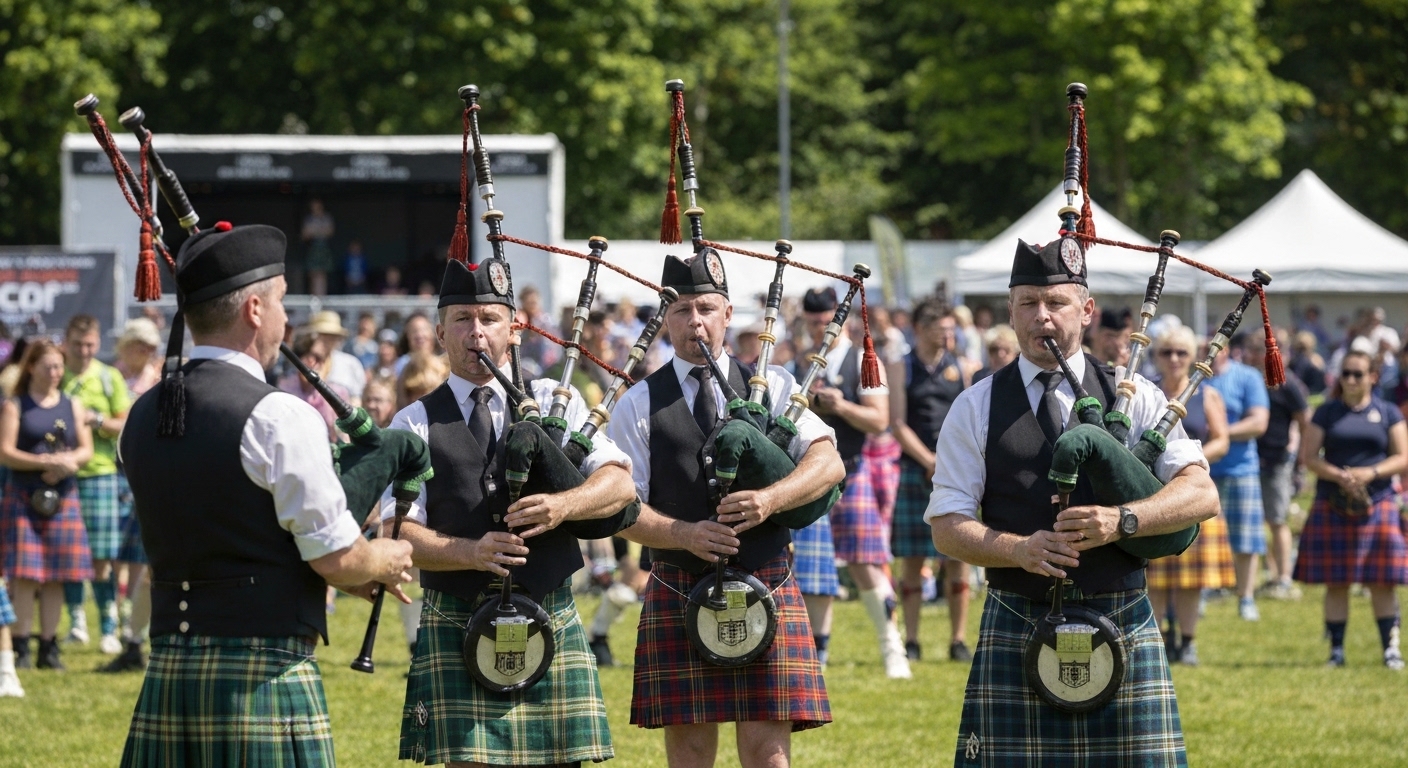
MacRae Meadows hosted the first Grandfather Mountain Highland Games in 1956. They have run every July since, and they have grown into one of the largest gatherings of their kind anywhere outside Scotland.
Stephen Quilling, the current president, describes the appeal in terms that have nothing to do with programming. "It's a magic place and the people that come here feel a deep connection," he said this July. "We have this phenomenon I call Clanship, there's a great vibe here." He is describing something real. People camp on that hillside with the same families in the same spots year after year, and the clan tents function less like exhibits than like reunions.
The family behind it connects Scottish identity to the physical shape of this region. Agnes's father was Hugh MacRae, who developed the resort town of Linville at the foot of Grandfather Mountain. Her son, Hugh MacRae Morton, spent decades promoting both the games and the mountain itself, and did more than anyone to make Grandfather a household name in North Carolina.
A tradition invented in 1956 is still an invented tradition. It is also, seventy years in, entirely genuine to the people who show up for it.
The Scottish Imprint on the Landscape Itself
Some of the Scottish influence here is not in a museum case or a clan tent. It is in the ground.
Donald Ross grew up in Dornoch, in the far north of Scotland, and served as the first golf professional at Royal Dornoch before emigrating to the United States in 1899. He became the most influential golf course architect in American history, and two of his courses are here. He designed Biltmore Forest Country Club in 1922, and he laid out Linville Golf Club in 1924, which opened in 1928.
That Linville connection is not a coincidence. Hugh MacRae was building a Scottish flavored mountain resort at the base of Grandfather, and hiring a Dornoch man to route the golf course was of a piece with the whole project. The links style, with its low running shots and its deference to the existing contours of the land, translated to Blue Ridge terrain better than anyone had a right to expect.
You can see the same instinct in other places once you start looking. Highland names on developments. Tartans in shop windows from Franklin to Highlands. A Carolina Tartan designed by Peter MacDonald of Crieff, Scotland, which now appears on everything from kilts to ball caps at fall festivals.
The America 250 framing that has been running on local news this summer likes to point out that Jefferson, Madison, and Hamilton all traced Scottish ancestry. That is true, and it is national context rather than mountain context. The mountain version of the same idea is quieter and closer to home.
What Survives, and Why It Still Matters
Jim Akins, president of the Scottish Tartans Museum board, gives the shortest version of why this endures. "This is where I found out about my Scottish heritage, and I have been here ever since," he said of the Franklin museum. He credits his great grandmother for planting the seed. "She was always talking about us being Scots-Irish, and she was very, very proud of that."
That is the actual transmission mechanism. Not archives, not academic history. A great grandmother who kept saying it until somebody listened.
Something similar is happening across these counties right now. Somebody in Sylva finds a family Bible. Somebody in Andrews runs a DNA test and gets an unexpected result. Somebody in Brevard drives up to MacRae Meadows for a Saturday and ends up standing in front of a clan tent asking questions they did not know they had.
The Scottish inheritance in Western North Carolina is not costume. It shows up in the Presbyterian churches that anchored the early settlements, in the ballad and fiddle traditions that fed into old time and bluegrass, in a stubborn regional preference for handling things locally, and in surnames on mailboxes from Murphy to Cullowhee.
It also shows up in why people come back. The same instinct that made Donald F. MacDonald want a Braemar in Carolina, and made Stephen Quilling call it Clanship, is what makes visitors turn into repeat visitors and repeat visitors turn into neighbors. Plenty of folks I have worked with over the years started with a July weekend on that hillside and finished with keys to a place forty minutes down the road. When your own version of that story gets to the house hunting part, my door is open.
Frequently Asked Questions
Were the Scottish settlers in the North Carolina mountains Highland Scots?
Mostly no. The Highland Scots who came to North Carolina settled the Cape Fear valley around present day Fayetteville, starting with a group of about 360 encouraged by royal governor Gabriel Johnston in 1739. That is coastal plain country, hours from the Blue Ridge. The families who settled the mountains were largely Scots-Irish, also called Ulster Scots, meaning people of Scottish origin whose families had lived in Ulster since the early 1600s before leaving for the colonies. They arrived through Philadelphia and New Castle and came south overland. Flora MacDonald, the state's most famous Scottish emigrant, belongs to the Cape Fear story, not the mountain one.
What is the Scottish Tartans Museum in Franklin, NC?
It is a museum and heritage center in downtown Franklin dedicated to Scottish tartans, clan history, and Highland dress, with exhibit space devoted to the relationship between Scottish emigrants and the Cherokee. Cara Pace serves as curator, and Jim Akins is president of the museum board. Akins is a good example of who walks through the door, since he first learned about his own Scottish ancestry there and has been involved ever since. For visitors, it works as both a genealogy starting point and a fast education in why so many mountain families carry Scottish surnames. Franklin sits in Macon County, about an hour and a half southwest of Asheville.
When are the Grandfather Mountain Highland Games held?
The games run every July at MacRae Meadows, on the flank of Grandfather Mountain near Linville in Avery County. They were founded in 1956 by Agnes MacRae Morton, who volunteered the meadow for the first gathering, and Donald F. MacDonald, who had attended the Braemar Gathering in Scotland in 1954 and wanted the same thing in Carolina. Current president Stephen Quilling describes the draw as something close to kinship, calling the meadow a magic place where attendees feel a deep connection. Expect clan tents, piping and drumming, Highland dancing, heavy athletics, and a hillside crowd that returns year after year.
How did Scottish settlers connect with the Cherokee in Western North Carolina?
Scottish deerskin and fur traders pushed into Cherokee territory in the early 1700s, well before permanent settlement, and many of them married into Cherokee families. That was the practical route to living and doing business inside a sovereign Native nation, since kinship determined standing and access. The results are visible in Cherokee history: Principal Chief John Ross and the Adair family both descend from those unions. It is the strongest local hook in the whole Scottish story here, because it happened in these mountains rather than on the coast, and the Scottish Tartans Museum in Franklin gives it dedicated exhibit space.
What was the Great Wagon Road?
It was the main overland route that carried Scots-Irish and German families from the mid Atlantic ports into the southern backcountry. Immigrants landed at Philadelphia or New Castle, then traveled south through Pennsylvania, Maryland, and Virginia into the Carolina piedmont and on toward the mountains. At its full extent the road ran more than 735 miles, from Philadelphia to Augusta, Georgia. Traffic peaked between 1740 and 1765, and by the 1780s settlement had spread into the western North Carolina counties and what is now East Tennessee. Most mountain family lines that trace back to Scotland came in along that road.
About the Author
Jon Tharp is a licensed NC real estate broker with Keller Williams. He's helped buyers and sellers across Western North Carolina for over 10 years, specializing in mountain homes, land, and short-term rental investments, with offices throughout WNC covering all mountainous areas. If something in this post has you thinking about a move, he's easy to reach — (828) 347-9055 or smokymountainhomes4sale.com or Jon@jontharphomes.com.
Ready to Make Western NC Your Home Base?
Whether you're looking to buy, considering a short-term rental investment, or ready to sell, the Jon Tharp Team brings deep local knowledge and marketing that puts your home in front of 50,000+ buyers in the first 30 days.
Search available homes across Western NC or call Jon directly at (828) 347-9055.
Talk to JonWhat Our Clients Say
43 five-star Google reviews — read them all on Google
"Jon is hands down the most dedicated and knowledgeable realtor that I have ever worked with. His expertise made the entire process of selling my home and finding a new one a smooth process."
Amy Davis · 2025
"Jon & his team are the greatest! Very professional, friendly like your neighbor, and always get back to your texts, phone calls & emails within minutes or same day, not days or weeks."
Cynthia Oelschlager · 2025
"I can’t say enough good things about Jon and his team. I was looking for investment properties and Jon spent time researching where would be a good place for an Airbnb — he found 2 beautiful properties."
Diane Cogswell · 2025
More from the Blog