By Jon Tharp, Broker · July 15, 2026
At a Glance
Waynesville's Mountain Street Dances return in summer 2026 with free Friday-evening events from 6:30 to 9 p.m. in front of the Historic Haywood County Courthouse. The nearly century-old tradition features live bluegrass, clogging, and square dancing called by Joe Sam Queen, whose family has led these dances for about 100 years. No experience is needed, and everyone is welcome to join in.
Joe Sam Queen fills a bucket with cornmeal and gets to work. It is a small ritual, dusting Main Street so the dancers' feet can shuffle and slide across the pavement, but it is the same thing his family has done here for close to a hundred years. On Friday evenings this summer, that cornmeal signals the same thing it always has. The Mountain Street Dances are back in downtown Waynesville, and everyone is invited.
The Summer Mountain Street Dances return to the heart of Haywood County on three Friday nights in 2026, held from 6:30 to 9 p.m. in front of the Historic Haywood County Courthouse. They are free. There is live bluegrass, there is clogging, there is square dancing you can actually join, and there is a crowd that ranges from lifelong locals to people who wandered up Main Street on vacation and got pulled in. If you have lived in Western North Carolina for any length of time, you already know the sound. If you are new here, this is one of the best ways to understand what the mountains actually feel like.
A Tradition Older Than the Courthouse Behind It
The Mountain Street Dance is often described as having more than 100 years of continuity, and the record backs that up. Families have been gathering in downtown Waynesville to watch traditional dance teams and hear live mountain music for the better part of a century. The courthouse that serves as the backdrop was not even built until 1932. The dancing came first.
The roots trace to the 1930s, when a Haywood County native named Sam Love Queen organized the Soco Gap Dance Team. It was among the very first practiced mountain square dance and clogging demonstration teams anywhere in the country. Queen learned to dance and call from his grandparents, his father, and a local Black caller named Bob Lowe, which is worth pausing on. This tradition, so often flattened into one image of Appalachia, has cross-cultural roots baked into it from the start.
What Sam Love Queen did next shaped the dance form itself. He took Buck Dancing footwork and folded it into square dancing, helping develop what became known as clogging. Today clogging is the most popular of the mountain dances, and its lineage runs directly back through these Waynesville streets. When you watch the Southern Appalachian Cloggers or the Green Valley Cloggers perform this summer, you are watching a tradition that one man helped shape right here.
The Dancing-est Man in the Land
Sam Love Queen was born in 1888 in the Soco Mountain area of Haywood County, and by the time he died in 1969 he had earned a couple of nicknames that stuck. People called him "the dancing-est man in the land." They also called him "The Square Dance King." Both fit.
His reach went far beyond Waynesville. In 1934, his team won the National Folk Festival in St. Louis, putting a Haywood County dance troupe on a national stage. Then came the moment the family still talks about. On June 8, 1939, President and Mrs. Franklin Roosevelt invited the Soco Gap Cloggers to perform at Constitution Hall for the visiting King and Queen of England. The program was built around Americana, and a group of mountain dancers from the hills above Waynesville represented it. They came home celebrities and returned heroes.
Queen was also an early tourism promoter, though he probably would not have used that phrase. He entertained at barn dances and area hotels and inns, and visitors would learn his steps and carry them back home. In 2008, decades after his death, he was inducted into the Blue Ridge Music Hall of Fame. Not bad for a man from Soco Mountain who learned to call from his grandparents.
The Soco Gap Cloggers took their name from the area where most of the dancers lived, which tells you something about how this all worked. It was never an act imported from somewhere else. It grew out of the community, out of neighbors and family, and that is exactly why it has lasted.
The Grandson Who Kept the Beat
Sam Love Queen called Waynesville's street dances for roughly 50 years. His grandson, Joe Sam Queen, has now called them for the past 50 years or so. Add those together and you get close to an unbroken century of one family standing in the middle of Main Street, cornmeal at their feet, telling the crowd where to step next.
Joe Sam Queen is not only a caller. He is an architect, a farmer, and a former North Carolina state legislator who served in the General Assembly. He has directed the Smoky Mountain Folk Festival for more than 30 years and stays involved with Folkmoot USA, the Appalachian Music and Dance Preservation Society, and Friends of Mountain History. The dance tradition in his family reportedly spans at least five generations, and the story goes that a great-grandmother was still dancing at 96.
What comes through most, though, is his philosophy about why any of this matters. "Sociability is the whole point of the Appalachian dance," he has said. He describes mountain dancing as something that "includes everybody in the community. Everyone joins in, young and old, rich and poor." That is not a nostalgic idea for him. It is an instruction for how the dances should run, and it is why the public square dances stay open to anyone who wants to try.
That openness is the reason these events feel different from a concert or a festival where you stand and watch. You are not an audience. You are one cornmeal-dusted step away from being part of it.
What a 2026 Dance Night Actually Looks Like
Picture a warm Friday evening in downtown Waynesville. Main Street in front of the courthouse is blocked off to traffic. The pavement has been dusted with cornmeal so feet can slide and shuffle the way clogging demands. A band tunes up. The crowd starts to ring the open space, and more people drift in along the sidewalks, drinks and ice cream in hand.
The 2026 series runs three nights, each with its own lineup. Friday, June 26 features Whitewater Bluegrass Co. with the Green Valley Cloggers, and break sets from Doug and Emily Trantham. Friday, July 17 brings the Haywood Ramblers and the Southern Appalachian Cloggers, with Sadie Wicker and Friends keeping the tunes going between sets. Friday, August 7 closes the season with Cold Mountain Bluegrass and the Mountain Tradition Cloggers, plus break sets by Loraine Conard and Friends.
The rhythm of the evening is simple. A band plays. Cloggers perform their own choreographed numbers, fast and precise and genuinely impressive to watch. Then Joe Sam Queen calls a public square dance, and the space fills with regular people following his voice through the figures. Between all of it, break-set musicians keep the music alive so the night never goes quiet.
It runs 6:30 to 9 p.m. It is free. No experience is necessary, and that is not a throwaway line. The whole structure is designed to pull you in.
The Courthouse, the Cornmeal, and the Sense of Place
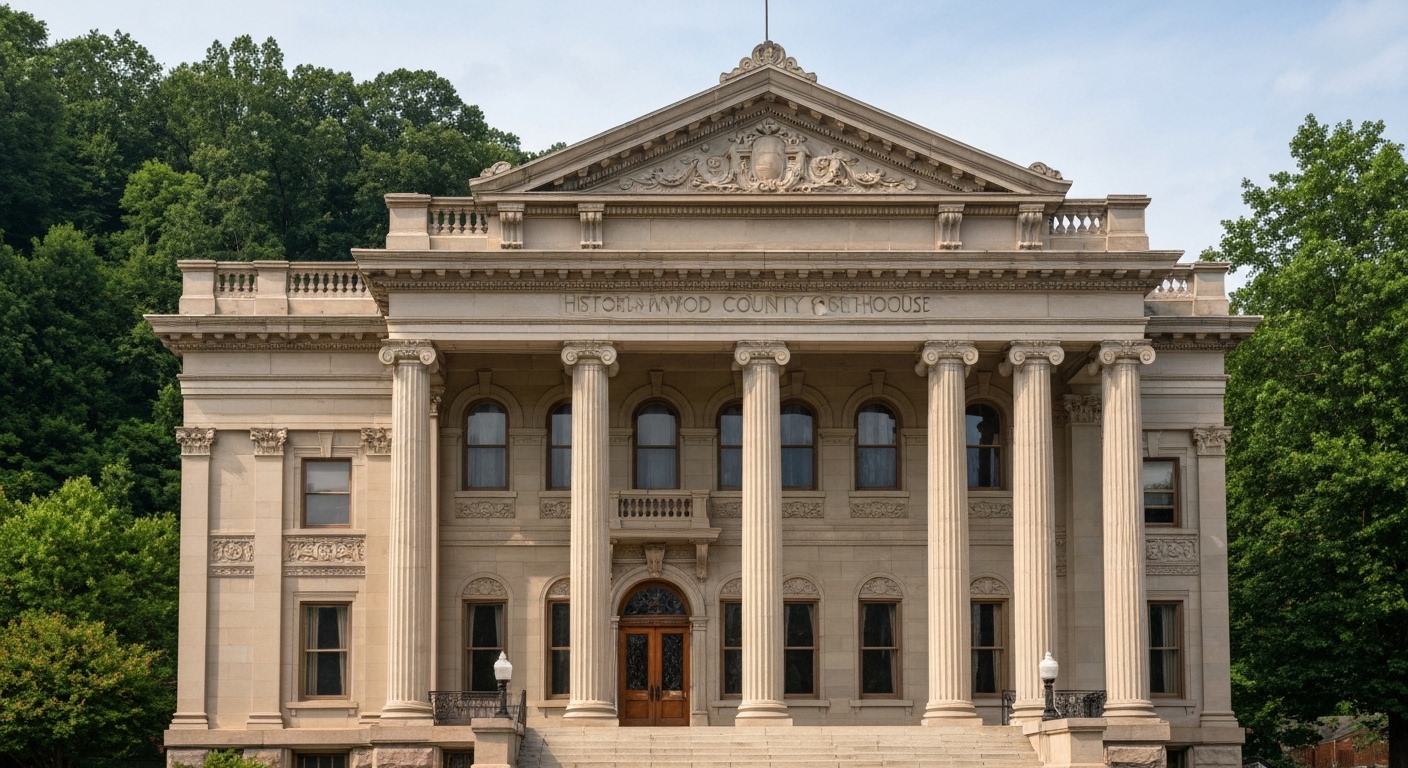
You cannot separate these dances from where they happen. The Historic Haywood County Courthouse sits at 285 N. Main Street, and it gives the whole scene its anchor. Built in 1932, after construction that ran from 1931 to 1932, it is a three-story, ashlar stone-veneered building in the Classical Revival style. Architects William G. Rogers and George N. Rhodes designed it, and its projecting entrance pavilion with a pedimented frontispiece gives Main Street a formal, civic weight.
Set a fiddle and a line of cloggers in front of that building and you get something that feels bigger than an event. You get history stacked on history. The courthouse represents order and permanence. The dance in front of it represents something looser and older, a folk tradition that predates the stone. The two together are the whole story of a mountain town in one glance.
Then there is the cornmeal, which might be the most charming detail of all. Closing the street and dusting it so dancers can slide their feet is a practical old touch that has survived every modern convenience. Nobody needs to do it that way anymore. They do it because that is how it has always been done, and because it works, and because tradition here is not a costume. It is a habit.
Beth Gilmore, Executive Director of the Downtown Waynesville Commission, put it plainly. "These dances are a wonderful reminder of the traditions that make our mountain communities so special," she said. "Whether you're a lifelong resident or visiting Waynesville for the first time, the Mountain Street Dances offer an authentic Appalachian experience that welcomes everyone."
Why This Still Matters in 2026
It would be easy for a tradition like this to fade into a plaque somewhere. Plenty of them have, across the mountains and across the country. Old dances get performed once a year for tourists, then packed away. What makes Waynesville different is that the Mountain Street Dances never became a museum piece. They are still a living, weekly, summertime thing that ordinary people show up for and participate in.
That continuity is rare, and it says something real about Haywood County. When a family calls the same dance for a hundred years and the community keeps turning out to join, you are looking at a place that knows what it values and holds onto it. The Downtown Waynesville Commission sponsors the events, based at 16 S. Main Street, and keeps them free on purpose. Free matters. It is the difference between a tradition that belongs to everyone and one that belongs to whoever can afford a ticket.
For locals, these Fridays are a standing invitation to run into neighbors and let the kids burn off energy in the street. For visitors and people thinking about a move to the mountains, they are a window into daily life here that no brochure can match. This is what community looks like when it is not trying to impress anyone.
If you have ever stood on Main Street on one of these evenings and thought this is the kind of place I would want to call home, I know the feeling, and I am always happy to talk about what living here actually looks like. Mark your calendar for June 26, July 17, and August 7, bring a chair or don't, and get ready to dance a little. The cornmeal is already waiting.
Frequently Asked Questions
When are the Mountain Street Dances in Waynesville in 2026?
The 2026 Summer Mountain Street Dances run on three Friday evenings from 6:30 to 9 p.m. in front of the Historic Haywood County Courthouse on Main Street in downtown Waynesville. The dates are Friday, June 26 with Whitewater Bluegrass Co. and the Green Valley Cloggers, Friday, July 17 with the Haywood Ramblers and the Southern Appalachian Cloggers, and Friday, August 7 with Cold Mountain Bluegrass and the Mountain Tradition Cloggers. The events are sponsored by the Downtown Waynesville Commission. Admission is free, and no dance experience is required. For details, visit www.downtownwaynesville.com/events or call the commission at (828) 456-3517.
Do you need dance experience to join the Mountain Street Dances?
No. The Mountain Street Dances are built around participation, and organizers actively encourage newcomers to step onto the street and try. Joe Sam Queen, who calls the square dances, walks the crowd through the steps as the music plays, so you learn as you go. The whole point, in his words, is sociability, and the dance includes everybody in the community, young and old. Longtime cloggers perform their own numbers, but the public square dances are open to anyone who wants to join. Wear comfortable shoes, show up in front of the courthouse, and follow along. Plenty of first-timers become regulars.
Where exactly do the Mountain Street Dances take place?
The dances are held on Main Street directly in front of the Historic Haywood County Courthouse, addressed at 285 N. Main Street, Waynesville, NC 28786. On dance nights, that stretch of Main Street is closed to traffic and dusted with cornmeal to give the dancers' feet a smooth surface to shuffle and slide across. Crowds ring the dancers and spill along the downtown sidewalks. The setting is central to the experience, with the 1932 Classical Revival courthouse serving as a stone backdrop. Downtown Waynesville offers plenty of parking, restaurants, and shops within walking distance, so most people make an evening of it.
Who is Joe Sam Queen and why is he connected to the dances?
Joe Sam Queen is the organizer and caller of Waynesville's Summer Mountain Street Dances, and he has been calling them for more than 50 years. His grandfather, Sam Love Queen, called Waynesville's street dances for roughly 50 years before him, giving the Queen family close to a century of unbroken calling on Main Street. Beyond the dances, Joe Sam Queen is an architect, a farmer, and a former North Carolina state legislator. He has directed the Smoky Mountain Folk Festival for more than 30 years and works with Folkmoot USA and other preservation groups. His family's dance tradition spans at least five generations.
About the Author
Jon Tharp is a licensed NC real estate broker with Keller Williams. He's helped buyers and sellers across Western North Carolina for over 10 years, specializing in mountain homes, land, and short-term rental investments, with offices throughout WNC covering all mountainous areas. If something in this post has you thinking about a move, he's easy to reach — (828) 347-9055 or smokymountainhomes4sale.com or Jon@jontharphomes.com.
Ready to Find Your Mountain Home Near Waynesville?
Whether you're looking to buy, considering a short-term rental investment, or ready to sell, the Jon Tharp Team brings deep local knowledge and marketing that puts your home in front of 50,000+ buyers in the first 30 days.
Search available homes across Western NC or call Jon directly at (828) 347-9055.
Talk to JonWhat Our Clients Say
43 five-star Google reviews — read them all on Google
"Jon is hands down the most dedicated and knowledgeable realtor that I have ever worked with. His expertise made the entire process of selling my home and finding a new one a smooth process."
Amy Davis · 2025
"Jon & his team are the greatest! Very professional, friendly like your neighbor, and always get back to your texts, phone calls & emails within minutes or same day, not days or weeks."
Cynthia Oelschlager · 2025
"I can’t say enough good things about Jon and his team. I was looking for investment properties and Jon spent time researching where would be a good place for an Airbnb — he found 2 beautiful properties."
Diane Cogswell · 2025
More from the Blog