By Jon Tharp, Broker · June 7, 2026
Quick Answer: Glenville is a small unincorporated community of about 155 year-round residents in Jackson County, North Carolina, wrapped around Lake Glenville, the highest major lake east of the Mississippi River at roughly 3,494 feet. It sits on NC-107 about five miles north of Cashiers, and its market is built on the lake: inexpensive land and lake-view lots at one end, premium lakefront estates well into the millions at the other. Because Glenville is unincorporated, buyers pay no town property tax, only the Jackson County rate plus a small fire-district levy.
Glenville at a Glance
| Year-round population | About 155 (2020 Census); heavily seasonal and second-home |
| The lake | Lake Glenville, ~1,470 acres, 26 miles of shoreline, the highest major lake east of the Mississippi |
| Elevation | Community ~3,500 ft; lake surface ~3,494 ft |
| Median home price | ~$319,000 sold over the past year; mean ~$665,000 (lakefront estates pull it up, to $4.4M+); active median list ~$239,500, up to $7.65M (as of June 2026) |
| On NC-107 | ~5 miles north of Cashiers; ~18 miles south of Sylva |
| Property tax | Jackson County $0.31 per $100 (2025-26), no town tax (unincorporated), plus a small Cashiers-Glenville fire-district levy |
| Locally famous for | Lake Glenville, boat-access waterfalls, and cool-summer high-elevation lake living |
What is it actually like to live in Glenville?
Living in Glenville means living on or around Lake Glenville, a cool, clear, high-elevation reservoir that defines the community, the lifestyle, and the real estate. It is a quiet, heavily seasonal lake place a few minutes north of the Cashiers village scene.
At roughly 3,494 feet, Lake Glenville is one of the highest major lakes in the eastern United States, which means cold, clean water, cool summers, and a boating-and-fishing culture that draws second-home owners, many from Florida and Georgia escaping the heat. The year-round population is tiny, about 155, so this is a place defined by the lake and the seasons rather than a conventional town. The market mirrors that: a wide spread from affordable off-water land to multimillion-dollar lakefront estates (as of June 2026). Because Glenville is unincorporated, there is no town property tax, only the Jackson County rate and a small fire-district levy.
This guide is written for the lake buyer: how lakefront, lake-access, and lake-view really differ, how Duke Energy controls docks and shoreline, the market, the seasonality, and who Glenville fits. Getting the lake details right is the whole game here.
Table of Contents
- What is Lake Glenville? - What kind of place is Glenville? - What is the Glenville real estate market like? - Lakefront vs lake-access vs lake-view: what is the difference? - Can you build a dock on Lake Glenville? - What is there to do in Glenville? - How far is Glenville from Cashiers, Sylva, and the feeder cities? - What internet and utilities can you get in Glenville? - How did Hurricane Helene affect Glenville? - What should out-of-state buyers know about property here? - What are the property taxes in Glenville? - What are the schools and healthcare like? - How does Glenville compare to nearby towns? - Is Glenville right for you? - Frequently Asked Questions
What is Lake Glenville?
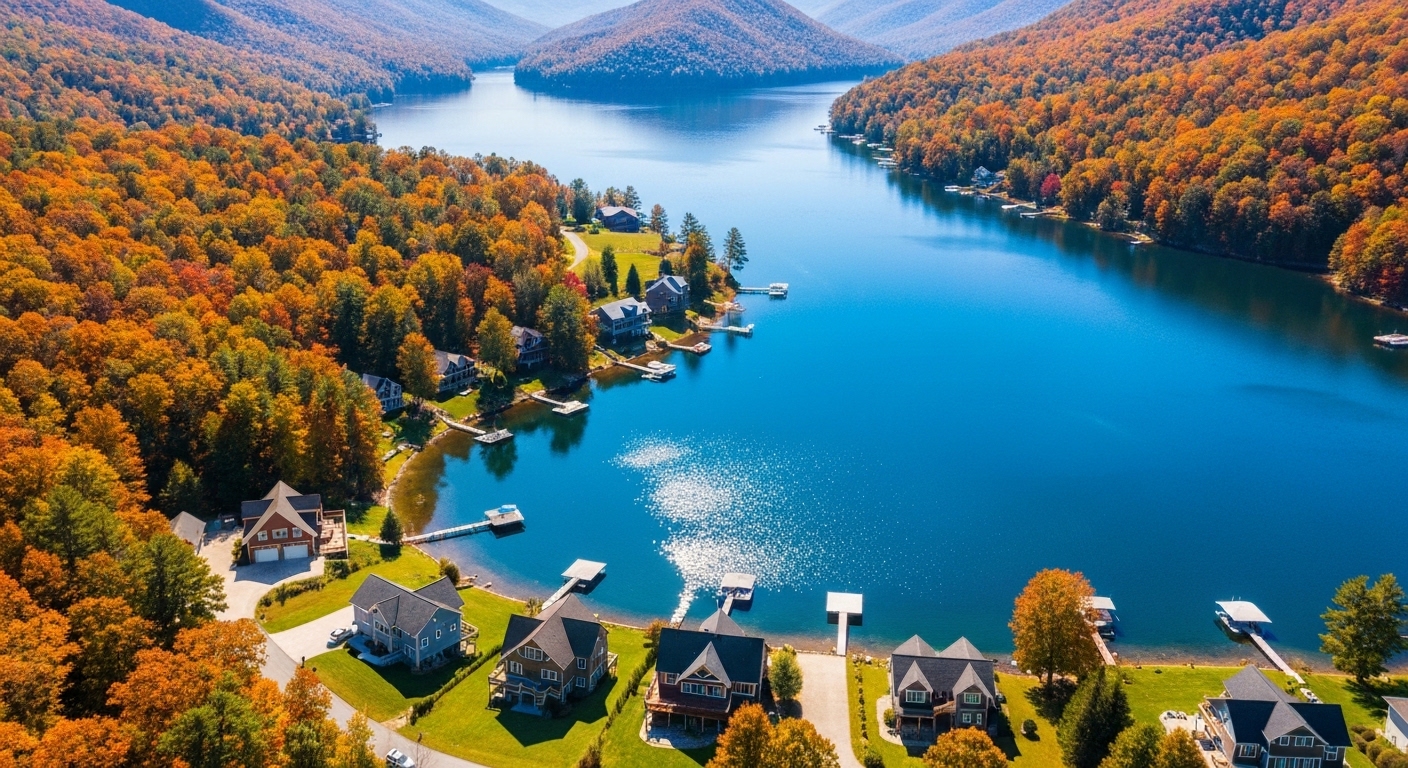
Lake Glenville is a roughly 1,470-acre Duke Energy reservoir with 26 miles of shoreline, sitting at about 3,494 feet, which makes it the highest major lake east of the Mississippi River. That elevation and the clean, cold, deep water are the whole draw.
The lake was completed in late 1941 by damming the West Fork of the Tuckasegee River, originally built by Nantahala Power and Light for hydroelectric power tied to wartime aluminum production; it was officially named Thorpe Reservoir from 1951 until 2002, when it was renamed Lake Glenville, while the dam and hydro project are still called Thorpe. Today Duke Energy operates it. The water is deep, more than 130 feet at its maximum and 80-plus feet a short distance off some shorelines, and cold and clear enough to support bass, lake trout, walleye, and crappie. A signature feature: four waterfalls flow directly into the lake and are reachable only by boat or kayak, Hurricane Falls (the most popular), Mill Creek Falls, Norton Falls, and a hidden cove falls, and guided waterfall cruises run in season.
A bit of history that explains the place: the original settlement here, called Hamburg, was flooded in 1941 when the dam went in, displacing homes and farms, and the area redeveloped as the lake-and-second-home community it is today.
See what is on the market in Glenville
See Homes for Sale in GlenvilleWhat kind of place is Glenville?
Glenville is a small, unincorporated, heavily seasonal lake community, not an incorporated town, strung along NC-107 on the east side of Lake Glenville between Cashiers and the Sylva area. Its character is quiet, scenic, and lake-centered.
With only about 155 year-round residents, Glenville has no town government and no municipal tax, just Jackson County governance and a local fire district. There is no real downtown; the village scene, shops, and dining are about five miles south in Cashiers, while Sylva to the north has the county seat services and the full-service hospital. What Glenville offers instead is the lake, the marinas, the public swim beach and boat ramps at the north end, and a tight seasonal community that swells in summer and quiets dramatically in winter. Public access is genuinely good for a lake this exclusive: the Pines Recreation Area on the north shore has a sandy swim beach, fishing pier, and picnic facilities, plus two public boat ramps, none requiring a permit.
Day to day, life here is boating, fishing, paddling to the waterfalls, and cool-evening lake living from late spring through fall, then a much smaller, quieter community through the winter months.
What is the Glenville real estate market like?
The Glenville market is sharply bimodal: inexpensive off-water land and lots at one end, premium lakefront estates into the millions at the other, with the lake driving everything. That split is why the median and the average diverge so much, and why a single "Glenville price" is misleading.
Over the past year roughly 146 homes sold with a median near $319,000 but an average around $665,000 and a high above $4.4 million, while the active market shows about 186 listings with a median list near $239,500 and a high around $7.65 million (as of June 2026). The low end is mostly raw land and off-water lots; the high end is lakefront and lake-access homes. Days on market run around 100-plus, normal for a seasonal lake market with a lot of land. So what you are really shopping is a position relative to the water, which is the single biggest price driver here.
Because the gap between a true lakefront lot with dock potential and a "lake-view" lot with no water rights can be enormous, the water-rights details matter more than the house. Start with current Glenville listings, and consider nearby Cashiers homes for sale just south on the plateau.
Lakefront vs lake-access vs lake-view: what is the difference?
This is the single most important thing to understand before buying at Lake Glenville, because "lakefront," "lake-access," and "lake-view" mean very different things, carry very different rights, and command very different prices. Confusing them is the most common and costly mistake buyers make here.
Here is the plain-English breakdown. Lakefront means the property runs to the lake (to the Duke Energy project boundary) and may have dock potential, the most valuable and most expensive category. Lake-access means you do not own waterfront but have shared or community access, a slip, or an easement to use the lake, common in lake communities and far less expensive than true lakefront. Lake-view means exactly that, a view of the water with no ownership or rights to it, the most affordable and the easiest to misread from a listing photo. A listing's price often makes sense only once you know which of the three it is, so verify the water rights on every property, because a "lakefront" headline does not by itself guarantee you can put in a dock (that is the next question).
Can you build a dock on Lake Glenville?
Not automatically. Duke Energy controls the shoreline of Lake Glenville, and any dock, boathouse, or shoreline work requires a Duke Energy permit, so owning a "lakefront" lot does not by itself guarantee dock rights. This is essential to confirm before you buy if a dock matters to you.
Duke owns the land inside the project boundary (sometimes called the "3110 line") and administers docks and shoreline activity under its Nantahala Area Shoreline Management Guidelines, so whether a given lot can have a dock, and what kind, depends on Duke's permitting and the project boundary, not just the deed. Some lots have existing permitted docks, some can qualify for one, and some cannot. The practical step: before committing to a lakefront property where a dock is the point, verify the dock status or permit potential with Duke Energy Lake Services, which I help buyers do as part of due diligence. Getting this confirmed up front is the difference between the lake home you imagined and an expensive surprise.
What is there to do in Glenville?
The lake is the headline, but Glenville also puts you minutes from the broader Cashiers-Highlands plateau's hiking, waterfalls, golf, and village scene. It is a compact base for a big slice of the mountains.
On the water, Lake Glenville offers boating, kayaking, paddleboarding, swimming, and strong fishing, with Signal Ridge Marina and other operators for rentals, gas, and launching, plus the boat-only waterfall cruises to Hurricane and Mill Creek falls. Off the water, the village of Cashiers five miles south adds upscale dining, galleries, and shops, and the surrounding plateau brings Whiteside Mountain, Silver Run Falls, Panthertown Valley (the "Yosemite of the East"), and nearby golf. The setting is wrapped in Nantahala National Forest land, and the four-season climate, with cool summers as the regional selling point, drives the whole seasonal lifestyle.
How far is Glenville from Cashiers, Sylva, and the feeder cities?
Glenville sits about five miles north of Cashiers and eighteen miles south of Sylva on NC-107, with Asheville and Greenville-Spartanburg both well over an hour away. Plan for slower-than-the-map travel on the mountain roads.
| From Glenville to | Distance | Drive time |
|---|---|---|
| Cashiers, NC | ~5-7 mi | ~10-15 min |
| Cullowhee / WCU | ~16 mi | ~25-30 min |
| Sylva, NC (Harris Regional Hospital) | ~18 mi | ~30-35 min |
| Highlands, NC | ~15 mi | ~30 min |
| Asheville, NC (and AVL airport) | ~50 mi | ~1 hr 20 min |
| Greenville-Spartanburg, SC (GSP) | ~70 mi | ~1 hr 30 min |
| Atlanta, GA | ~150 mi | ~2 hr 50 min |
| Charlotte, NC | ~155 mi | ~3 hr |
(Distances and times as of June 2026, via mapping calculators; some are approximate.) Greenville-Spartanburg and Atlanta are the major feeder airports for second-home buyers here, with Asheville Regional closer but smaller. The full-service hospital and everyday shopping are about half an hour north in Sylva, while the critical-access Highlands-Cashiers Hospital is closer to the south.
What internet and utilities can you get in Glenville?
Internet in Glenville is rural and uneven: there is no universal fiber, DSL reaches part of the area, and satellite is the dependable fallback, so confirm service at the exact address before counting on it for remote work.
| Provider | Type | Coverage in Glenville | Top speed | Notes (as of mid-2026) |
|---|---|---|---|---|
| Frontier | DSL | ~one-third of area | up to ~115 Mbps | the main wired option in many spots |
| Skyrunner / BalsamWest | Fiber / fixed wireless | limited pockets (~12%) | up to ~1 Gbps | strongest where built; thins fast |
| Viasat | Satellite | available | ~150 Mbps | legacy satellite |
| Starlink | Satellite | anywhere | ~25-100 Mbps typical | the realistic default for most rural lots |
(Coverage from broadband aggregators, mid-2026; treat as directional.) On utilities, many properties are on private wells and septic rather than municipal service, though some communities like Trillium have community systems, so confirm water and sewer per parcel and budget for a well test and septic inspection on non-community lots. As anywhere at elevation, cell coverage varies and power can be vulnerable in major storms.
How did Hurricane Helene affect Glenville?
Glenville sits in the southern part of Jackson County that took the brunt of Hurricane Helene in September 2024, with road closures, power outages, and flooding, though the county overall fared far better than the hardest-hit areas to the east. Lake Glenville's Thorpe Dam held.
When Helene hit early on September 27, 2024, the southern Jackson communities (Cashiers, Sapphire, Glenville, and Blue Ridge) took the worst of it, with around 10,000 power outages and more than 40 road closures countywide, overflowing creeks and rivers, and a boil-water advisory; the Cashiers-Glenville Fire Department served as a community command center with free water. NC-107 north and south was passable again by that Monday, while US-64 near Sapphire stayed closed longer. At the lake itself, the Thorpe Dam's emergency action plan was elevated during the peak and the reservoir receded to normal within about a day; the dam held. For a buyer, the lesson is the same as across the plateau: southern Jackson can temporarily lose road, power, and water access in a major storm, so weigh a property's access-road resilience and plan for backup power and water.
What should out-of-state buyers know about property here?
Six things shape a smart Glenville purchase: the lakefront-versus-access distinction, Duke Energy dock permitting, the seasonal rhythm, steep mountain terrain, well-and-septic realities, and storm access. All reward homework before you offer.
The first two are covered above and are the big ones: confirm exactly what water rights a property has, and confirm dock status or permit potential with Duke Energy before assuming a lakefront lot comes with a dock. Beyond that, expect a strongly seasonal community that quiets in winter (many businesses cut hours November through April), steep lots that bring driveway-grade, grading, and access considerations, and many parcels on private wells and septic, so budget for a well test, a septic inspection, and any recorded Road Maintenance Agreement on shared private roads, which lenders require. Finally, factor the plateau's storm-access reality and the small fire-district tax into your carrying-cost math. None of this should discourage a serious lake buyer; it is simply what buying at Lake Glenville responsibly looks like, and I walk buyers through every piece.
What are the property taxes in Glenville?
Glenville buyers pay only the Jackson County rate of $0.31 per $100 (for 2025-26) plus a small Cashiers-Glenville fire-district levy, with no town tax, because Glenville is unincorporated. That makes the total tax bill modest compared with buying inside an incorporated town.
On the county side, Jackson County completed a revaluation effective January 1, 2025 that raised assessed values significantly and cut the county rate from $0.38 to $0.31 to partly offset it, so bills reflect the new values. Because Glenville lies in the Cashiers-Glenville Fire District, a small fire-district tax (historically a few cents per $100) applies on top of the county rate, so confirm the current fire-district figure for a specific parcel, but there is no municipal layer at all. On a $665,000 home the county portion is roughly $2,060 a year, plus that small fire levy.
On the state side, North Carolina is favorable for retirees: Social Security is not taxed, government and military pensions can be exempt under the Bailey settlement, and there is no estate tax. There is no special $35,000 senior exemption (that is a Georgia benefit, not North Carolina); other retirement income is taxed at the state's flat rate (3.99% in 2026). This is general information, not tax advice, so confirm current rates and the fire-district levy with the county and a CPA.
What are the schools and healthcare like?
Glenville is served by Jackson County Public Schools through Blue Ridge School (a pre-K to 6 elementary between Cashiers and Glenville), with high schoolers attending Smoky Mountain High in the Sylva area, and healthcare anchored by two hospitals on and beyond the plateau. For a small lake community, the essentials are within reach.
For schools, Blue Ridge School is the assigned local public elementary (pre-K through 6), the district's smallest, formed in 1975 by consolidating the Glenville and Cashiers schools; older students continue in the Jackson County system at Smoky Mountain High School near Sylva, and the tuition-free Summit Charter School on the Cashiers-Highlands plateau is an alternative. For healthcare, Highlands-Cashiers Hospital is the critical-access hospital on US-64 between Highlands and Cashiers (24/7 ER, acute inpatient, rehab, and long-term care), while the larger full-service hospital, Harris Regional, is in Sylva about half an hour north, with Mission Hospital in Asheville as the regional referral center. Buyers should expect a drive for medical care, with a closer critical-access option and a fuller hospital within reach.
How does Glenville compare to nearby towns?
Glenville is the lake-life option on the plateau, distinct from the village-and-club scene of Cashiers, the high-end Main Street of Highlands, and the year-round affordability of the Sylva area. Here is the honest head-to-head.
- Why buyers choose Glenville over Cashiers: Glenville is about Lake Glenville, boating, fishing, and waterfront living, and it tends to be a bit quieter and sometimes more attainable than the Cashiers village core five miles south, while Cashiers has the upscale shops, dining, and the marquee golf clubs. Many buyers want both; choose Glenville for the lake, Cashiers for the village and clubs. - Why buyers choose Glenville over Highlands: Glenville offers lake life at high elevation, while Highlands is a walkable, luxury resort town with a developed Main Street and no comparable big lake. Choose Glenville for the water, Highlands for the town scene. - Why buyers choose Glenville over Sylva or Cullowhee: Glenville is a seasonal, second-home lake community, while Sylva and Cullowhee to the north are year-round, far more affordable, working communities with full services and a hospital. Choose Glenville for the lake retreat, the Sylva area for value and year-round practicality.
Is Glenville right for you?
Glenville is a strong fit for a second-home buyer or retiree who wants high-elevation lake living, boating and fishing on clean, cool water, and a quieter base a few minutes from the Cashiers village and club scene. If a dock on one of the highest lakes in the East, cool summers, and waterfall cruises out your back door sound right, and you are comfortable with seasonal quiet and luxury-lake pricing for true lakefront, Glenville is hard to beat.
It is not the right fit for someone who needs an affordable year-round home with services at the doorstep (look to Sylva or Cullowhee), a lively winter community (the lake quiets in the off-season), or a guaranteed dock without verifying Duke Energy permitting and water rights first. And steep-terrain and storm-access homework is part of buying here.
If lake life at Lake Glenville is what you are after, reach out and I will help you decode lakefront versus access versus view, confirm dock potential with Duke Energy, and find the right position on the water for how you actually want to live.
Frequently Asked Questions
Is Glenville, NC a good place to live? For a second-home buyer or retiree who wants lake living, yes. Glenville wraps around Lake Glenville, the highest major lake east of the Mississippi at about 3,494 feet, with cool summers, clean water, boating, fishing, and boat-access waterfalls, five miles north of the Cashiers village and club scene. Because it is unincorporated, there is no town property tax, only the Jackson County rate plus a small fire-district levy. The trade-offs are a strongly seasonal rhythm with a quiet winter, rural internet, and luxury pricing for true lakefront, so it fits seasonal and second-home life better than budget-minded year-round living.
How much does it cost to buy a home in Glenville? It is a sharply bimodal lake market. Over the past year about 146 homes sold with a median near $319,000 but an average around $665,000 and a high above $4.4 million, while active listings show a median list near $239,500 and reach about $7.65 million (as of June 2026). The low end is off-water land and lots; the high end is lakefront and lake-access homes. Your price depends almost entirely on your position relative to the water, so ask me for a current, water-rights-specific read before making an offer.
What is special about Lake Glenville? Lake Glenville is a roughly 1,470-acre Duke Energy reservoir with 26 miles of shoreline, sitting at about 3,494 feet, which makes it the highest major lake east of the Mississippi River. The water is deep (over 130 feet at maximum) and cold and clear, supporting bass, lake trout, walleye, and crappie, and four waterfalls flow directly into the lake reachable only by boat or kayak. It was built in 1941 by damming the West Fork of the Tuckasegee and was named Thorpe Reservoir until 2002. Public access is good, with a swim beach and two boat ramps on the north shore that need no permit.
What is the difference between lakefront, lake-access, and lake-view at Lake Glenville? They mean very different things and prices. Lakefront means the property runs to the lake (the Duke Energy project boundary) and may have dock potential, the most valuable category. Lake-access means you do not own waterfront but have shared or community access, a slip, or an easement, far less expensive. Lake-view means a view of the water with no ownership or rights to it, the most affordable and easiest to misread from a photo. Always verify which category a listing actually is, because the price only makes sense once you know.
Can you build a dock on Lake Glenville? Not automatically. Duke Energy controls the shoreline, so any dock, boathouse, or shoreline work requires a Duke Energy permit under its Nantahala Area Shoreline Management Guidelines, and owning a lakefront lot does not by itself guarantee you can put in a dock. Some lots have existing permitted docks, some can qualify, and some cannot, depending on the project boundary and Duke's permitting. If a dock matters, verify its status or permit potential with Duke Energy Lake Services before buying, which I help buyers do.
Does Glenville have a town property tax? No. Glenville is unincorporated, so buyers pay only the Jackson County rate of $0.31 per $100 (2025-26) plus a small Cashiers-Glenville fire-district levy, with no municipal tax on top. Jackson County completed a 2025 revaluation that raised assessed values and cut the county rate from $0.38 to $0.31. Confirm the current fire-district figure for a specific parcel. North Carolina does not tax Social Security and has a flat income tax (3.99% in 2026); there is no $35,000 senior exemption (that is Georgia), though government and military pensions can be exempt under the Bailey settlement.
How far is Glenville from Cashiers and the airports? Cashiers is about five to seven miles south, roughly 10-15 minutes on NC-107, and Sylva with its full-service hospital is about 18 miles and half an hour north. For air travel, Greenville-Spartanburg is about an hour and a half and Atlanta about two hours and 50 minutes, the major feeder airports, with Asheville Regional closer at about an hour and 20 minutes but smaller. Plan for slower-than-the-map travel on the winding mountain roads.
Is Glenville seasonal or year-round? Strongly seasonal. The year-round population is only about 155, and the community swells with seasonal residents and visitors in summer and fall, then quiets dramatically in winter, when many plateau businesses cut hours from November through April. That rhythm is the appeal for a second-home owner, but anyone considering Glenville as a full-time home should experience a winter on the lake first.
Was Glenville hit by Hurricane Helene? Glenville is in the southern part of Jackson County that took the brunt of Helene in September 2024, with power outages, road closures, and flooding, though the county overall fared far better than the hardest-hit areas to the east. NC-107 was passable again within a few days, and at the lake the Thorpe Dam held and the reservoir receded to normal within about a day. The lesson for buyers is that southern Jackson can temporarily lose road, power, and water access in a major storm, so weigh a property's access-road resilience and plan for backup power and water.
About the Author
Jon Tharp is a licensed NC real estate broker with Keller Williams. He's helped buyers and sellers across Western North Carolina for over 10 years, specializing in mountain homes, land, and short-term rental investments, with offices throughout WNC covering all mountainous areas. If something in this post has you thinking about a move, he's easy to reach — (828) 347-9055 or smokymountainhomes4sale.com or Jon@jontharphomes.com.
Ready to Make Western NC Your Home Base?
Whether you're looking to buy, considering a short-term rental investment, or ready to sell, the Jon Tharp Team brings deep local knowledge and marketing that puts your home in front of 50,000+ buyers in the first 30 days.
Search available homes across Western NC or call Jon directly at (828) 347-9055.
Talk to JonWhat Our Clients Say
43 five-star Google reviews — read them all on Google
"Jon is hands down the most dedicated and knowledgeable realtor that I have ever worked with. His expertise made the entire process of selling my home and finding a new one a smooth process."
Amy Davis · 2025
"Jon & his team are the greatest! Very professional, friendly like your neighbor, and always get back to your texts, phone calls & emails within minutes or same day, not days or weeks."
Cynthia Oelschlager · 2025
"I can’t say enough good things about Jon and his team. I was looking for investment properties and Jon spent time researching where would be a good place for an Airbnb — he found 2 beautiful properties."
Diane Cogswell · 2025
More from the Blog