By Jon Tharp, Broker · June 7, 2026
Quick Answer: Cherokee, North Carolina is the capital of the Eastern Band of Cherokee Indians (EBCI) and sits on the Qualla Boundary, land held in federal trust for the tribe. This is not a normal real estate market. Most land on the Boundary is tribal trust land held as possessory holdings that, by law, can only be held by enrolled EBCI members, so a non-member generally cannot buy a home or land in Cherokee itself. That is by design, protecting Cherokee land for Cherokee people. What you can do is own fee-simple property in the towns that ring the Boundary, Bryson City, Whittier, Sylva, Dillsboro, and Cullowhee, and enjoy everything Cherokee offers as a neighbor: Harrah's Cherokee, the southern gateway to Great Smoky Mountains National Park, the Oconaluftee River and its elk, and one of the richest living Native cultures in the country.
Cherokee & the Qualla Boundary at a Glance
| Who governs it | The Eastern Band of Cherokee Indians (EBCI), a sovereign, federally recognized tribe of about 16,000 enrolled members |
| What the land is | The Qualla Boundary, land the tribe purchased and holds in federal trust, not a government-created reservation |
| Can a non-member buy here? | Generally no. Boundary land is held as possessory holdings limited to enrolled members |
| Where you buy instead | Fee-simple homes and land in Bryson City, Whittier, Sylva, Dillsboro, and Cullowhee |
| National park | Cherokee is the NC gateway to Great Smoky Mountains National Park (Oconaluftee Visitor Center, 2 miles north) |
| Drive to Bryson City / Asheville | ~15 min to Bryson City; ~1.5 hr to Asheville |
| Locally famous for | Harrah's Cherokee, the Museum of the Cherokee People, "Unto These Hills," Oconaluftee elk, and stocked trout waters |
What is it actually like to live near Cherokee?
Living near Cherokee means owning a home in one of the fee-simple towns around the Qualla Boundary and having a sovereign Native nation, a national park, and a major resort as your neighbors. It is one of the most culturally and naturally rich corners of Western North Carolina, and understanding how the land works here is the first step.
The town of Cherokee is the capital of the Eastern Band of Cherokee Indians, the seat of a self-governing nation with its own government, courts, schools, hospital, and police. It sits in the Oconaluftee River valley at the southern doorstep of Great Smoky Mountains National Park, anchored by Harrah's Cherokee Casino Resort, the Museum of the Cherokee People, and the Oconaluftee elk fields. Because the land is held in trust for the tribe, you do not buy property on the Boundary itself; instead you own in the surrounding towns and live minutes from the casino, the museum, the river, and the park. This guide is written to explain that ownership reality honestly, then point you to where you actually buy and what life is like as a neighbor to the Boundary.
It is written for the buyer drawn to this area: the retiree, the second-home owner, and the outdoor and culture lover who wants to be near Cherokee. We will cover why you cannot buy on the Boundary, where you can buy fee-simple nearby, the culture and the casino, the national park and the rivers, and the practical facts on schools, healthcare, and taxes.
Table of Contents
- What are Cherokee and the Qualla Boundary? - Can you buy a home or land in Cherokee? - Where do buyers actually purchase near Cherokee? - What is the culture like in Cherokee? - What outdoor recreation is around Cherokee? - How far is Cherokee from Bryson City, Asheville, and other towns? - What internet and utilities can you get nearby? - How did Hurricane Helene affect the area? - What are the property taxes near Cherokee? - What are the schools and healthcare like? - How does the Cherokee area compare to nearby towns? - Is the Cherokee area right for you? - Frequently Asked Questions
What are Cherokee and the Qualla Boundary?
Cherokee is the capital of the Eastern Band of Cherokee Indians, and the Qualla Boundary is the tribe's homeland, land the tribe purchased and holds in federal trust. Understanding that this is a sovereign nation, not a town in the ordinary sense, is the key to everything else.
The EBCI descends primarily from Cherokee who remained in or returned to the North Carolina mountains rather than being forced west on the Trail of Tears in 1838 and 1839. A core group along the remote Oconaluftee River avoided removal, and together with others who already held land they formed the nucleus of today's Eastern Band, now about 16,000 enrolled members. The Qualla Boundary is not a traditional reservation created by the government; the tribe purchased this land in the 1800s, and it was later placed under federal protective trust. Just to the west, along the Tuckasegee River, sits Kituwah, the Cherokee Mother Town and origin place, which the tribe re-acquired in 1996 after 138 years. Cherokee today is a living capital with its own government, hospital, schools, and newspaper, not a tourist theme.
For anyone considering a move to this area, that sovereignty is the context. You are looking to live alongside a Native nation, and the land rules that follow flow directly from it.
See what is on the market in Bryson City
See Fee-Simple Homes Near CherokeeCan you buy a home or land in Cherokee?
Generally, no. If you are not an enrolled member of the Eastern Band of Cherokee Indians, you cannot buy a home or land on the Qualla Boundary, because the land is held in federal trust for the tribe. This is the single most important thing to understand, and it is by design.
Land on the Boundary is trust land, and interests in it are held as possessory holdings that, by law, only enrolled EBCI members (or the child of a member) may hold. A possessory holding is a right to use and occupy trust land, not fee-simple ownership in the conventional sense, and it stays within the tribal membership through inheritance and transfers among members, administered by the tribe rather than through a county deed sale. Businesses that operate on the Boundary typically lease, they do not buy the land outright. This is why a normal home search in Cherokee turns up almost nothing: over the past year only a tiny handful of properties traded on the open market here, and that reflects the trust-land structure, not a temporary shortage.
The honest way to think about it: if your dream is to own a home on the Qualla Boundary, that is not possible for a non-member, and that protection of Cherokee land for Cherokee people is right and good. What you can do is own fee-simple property in the towns that ring Cherokee and enjoy the Boundary as a neighbor. That is where we go next.
Where do buyers actually purchase near Cherokee?
You buy fee-simple in the towns that surround the Qualla Boundary and live minutes from everything Cherokee offers. Each option has its own character, and any of them puts you at the casino, the museum, or the Oconaluftee elk fields in about fifteen minutes.
| Town | County | Direction | Why buyers choose it |
|---|---|---|---|
| Whittier | Swain/Jackson | adjacent SW | The literal next-door option; rural, affordable, land-heavy |
| Bryson City | Swain | ~15 min W | Walkable Smokies-gateway town with the railroad and a hospital |
| Sylva | Jackson | ~15 min E | Larger year-round county seat with a celebrated Main Street |
| Dillsboro | Jackson | ~15 min E | Small arts-and-crafts village on the Tuckasegee |
| Cullowhee | Jackson | ~25 min SE | College town, home of Western Carolina University |
The pattern is simple: you own in Bryson City, Whittier, or Sylva, and Cherokee is your neighbor, not your address. Whittier sits right against the Boundary line and tends to be the most affordable and most land-heavy of the group, Bryson City gives you a walkable town with a hospital and the national-park gateway, and Sylva offers a larger downtown and more services. I can help you weigh which fits, and each has its own detailed living guide.
What is the culture like in Cherokee?
Cherokee's cultural institutions are real, living, and tribally run, and they are a genuine reason people are drawn to live nearby. This is a culture you visit and respect as a neighbor, not a backdrop.
The Museum of the Cherokee People (established 1948) is one of the oldest tribal museums in the country and the best place to understand the tribe's history in its own words. The Oconaluftee Indian Village is an outdoor living-history village operated by the Cherokee Historical Association, open spring through fall, and each summer the outdoor drama Unto These Hills tells the Cherokee story at the Mountainside Theatre. Qualla Arts and Crafts Mutual, a co-op since 1946, supports Cherokee artists and is the place to find authentic basketry, pottery, weaving, and carving. The tribe's language revitalization work, built on Sequoyah's syllabary and carried forward at the New Kituwah Academy immersion school, is a point of deep pride, and the annual Cherokee Indian Fair each October is the community's signature event. A small, accurate gesture goes a long way here: "Siyo" means hello in Cherokee.
What outdoor recreation is around Cherokee?
Cherokee is the southern gateway to Great Smoky Mountains National Park, and the outdoor access here is exceptional, from elk-filled river fields to some of the most heavily stocked trout water in the Southeast. Living nearby puts all of it minutes away.
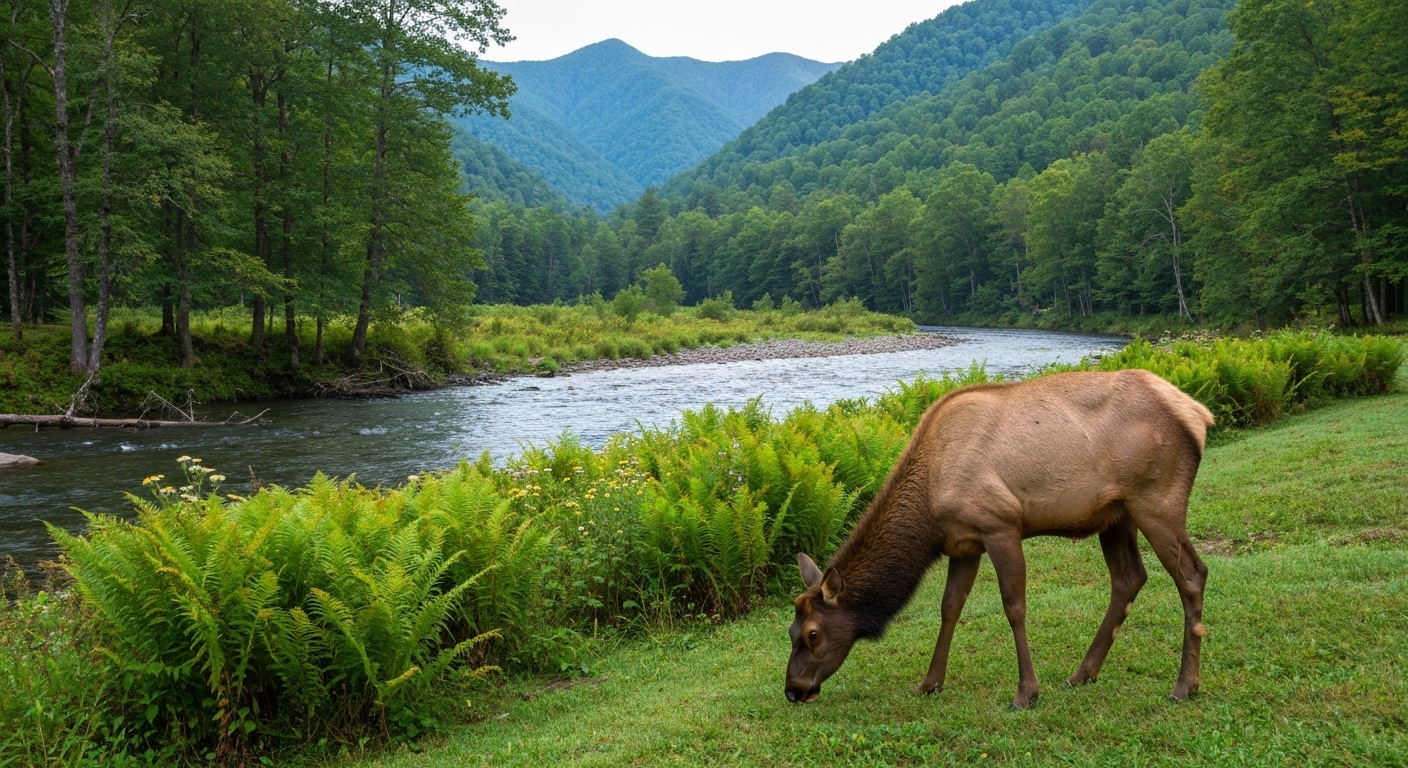
The fields around the Oconaluftee Visitor Center, two miles north of town, are the best place in the region to watch elk graze at dawn and dusk, and the easy riverside Oconaluftee River Trail links the town to the visitor center. The tribe runs its own hatchery and stocks its Enterprise Waters (Raven Fork, the Oconaluftee, and Soco Creek) twice weekly, making this a premier trout destination, but note that a separate tribal fishing permit is required on the Boundary; a North Carolina state license does not cover it, so buy the tribal permit before you fish. Mingo Falls, one of the tallest waterfalls in the southern Appalachians, is a short steep climb near the park's south entrance, and the Fire Mountain Trails offer eleven-plus miles of purpose-built mountain-biking and hiking trails right by the Oconaluftee Indian Village. Beyond all that, the national park itself, Newfound Gap, and the southern terminus of the Blue Ridge Parkway are all within minutes.
How far is Cherokee from Bryson City, Asheville, and other towns?
Cherokee sits in the heart of the Smokies, minutes from Bryson City and the national park, with Sylva, Maggie Valley, and Gatlinburg close by and Asheville about an hour and a half east. Mountain and park roads make some drives slower than the mileage suggests.
| From Cherokee to | Distance | Drive time |
|---|---|---|
| Bryson City, NC | ~10-11 mi | ~15-20 min |
| Sylva, NC | ~15 mi | ~25 min |
| Maggie Valley, NC | ~16 mi | ~25 min (over Soco Gap on US-19) |
| Waynesville, NC | ~21 mi | ~30-35 min |
| Gatlinburg, TN | ~33 mi | ~1 hr (Newfound Gap Road; slows in winter) |
| Asheville, NC (and AVL airport) | ~65-70 mi | ~1 hr 30 min |
| Greenville-Spartanburg, SC (GSP) | ~115 mi | ~2 hr 30 min |
| Atlanta, GA | ~150 mi | ~3 hr |
(Distances and times as of June 2026, via mapping calculators; some are approximate.) The drive over Newfound Gap Road through the national park to Gatlinburg is one of the most beautiful in the East, but it is slow and can close in winter weather. Asheville Regional is the nearest commercial airport at about an hour and a half.
What internet and utilities can you get nearby?
Internet in the fee-simple towns around Cherokee is solid in the town centers and thinner up the coves, where satellite often fills the gap, so confirm service at the exact address before counting on it for remote work.
| Provider | Type | Coverage in the area | Top speed | Notes (as of mid-2026) |
|---|---|---|---|---|
| Spectrum | Cable | broad in Bryson City / Sylva | high | the main in-town wired option |
| Frontier | DSL | partial, thinner rural | up to ~115 Mbps where available | address-specific; fiber buildouts ongoing |
| Fixed wireless | Wireless | patchy pockets | varies | line-of-sight dependent |
| Starlink | Satellite | anywhere | ~25-100 Mbps typical | the realistic default for rural coves |
(Coverage from broadband aggregators, mid-2026; treat as directional and re-check at the address.) In-town addresses in Bryson City and Sylva generally have good cable, while rural cove and ridge parcels often rely on DSL, fixed wireless, or satellite, so any remote-work buyer should verify the specific address and treat Starlink as the rural backstop. In-town homes are typically on municipal water and sewer, while properties outside the town limits are usually on private wells and septic, so budget for a well test and septic inspection on rural land. Cell coverage can drop in the coves and through Newfound Gap.
How did Hurricane Helene affect the area?
The Cherokee, Bryson City, and Sylva area fared comparatively well in Hurricane Helene (September 2024) versus the catastrophic damage to the east, with the worst local impacts confined to the river and creek bottoms. Lower elevation helped.
Helene pushed the Tuckasegee River to a crest near 14.9 feet at Bryson City and flooded low-lying spots along the river corridor, with several dozen households along Swain and Jackson county rivers displaced and historic flooding on Front Street in nearby Dillsboro. But the broader Cherokee, Swain, and Jackson area avoided the scale of destruction seen in Buncombe and the harder-hit counties to the east, and main roads stayed open. The lasting buyer lesson is specific: the Tuckasegee, the Oconaluftee, and the creek bottoms can and do flood, so any river-front or creek-bottom lot or cabin you consider in the fee-simple towns deserves a careful flood-zone check (the FEMA Flood Map Service Center and the North Carolina flood maps are the tools) and a look at flood-insurance cost, while homes up off the water are a different profile.
What are the property taxes near Cherokee?
Because you buy fee-simple in the surrounding towns, your property taxes are set by whichever North Carolina county your home is in, Swain or Jackson, not by the tribe. Both county rates are moderate by national standards.
Swain County's rate is $0.41 per $100 of assessed value for 2025-26, and Jackson County's is $0.31 per $100, so a Bryson City or Whittier-Swain home is taxed at the Swain rate while a Sylva, Dillsboro, or Whittier-Jackson home is taxed at the Jackson rate. Inside a town's limits you also pay that town's municipal rate, and rural parcels may carry a fire-district levy, so confirm the exact figures by parcel. On a $300,000 home, the county levy alone runs roughly $1,230 in Swain and about $930 in Jackson.
On the state side, North Carolina is favorable for retirees: Social Security is not taxed, government and military pensions can be exempt under the Bailey settlement, and there is no estate tax. There is no special $35,000 senior exemption (that is a Georgia benefit, not North Carolina); other retirement income is taxed at the state's flat rate (3.99% in 2026). This is general information, not tax advice, so confirm the current county, town, and fire-district figures with the relevant county, and your situation with a CPA.
What are the schools and healthcare like?
Cherokee operates its own tribal school system and hospital for tribal members, while buyers in the surrounding towns use the county schools and the regional hospitals in Bryson City and Sylva. The area is uncommonly well-served for the mountains.
Cherokee Central Schools is a tribally operated K-12 system serving Boundary families, and Cherokee Indian Hospital, run by the tribe's own health authority, primarily serves EBCI members and other eligible Native patients. For buyers in the fee-simple towns, children attend Swain County Schools or Jackson County Public Schools depending on the address, and healthcare comes from Swain Community Hospital in Bryson City (a critical-access hospital with a 24/7 ER) and the larger Harris Regional Hospital in Sylva, with Mission Hospital in Asheville about an hour away for higher-acuity care. Having two hospitals within roughly fifteen minutes of each other is a real advantage for retirees choosing this area.
How does the Cherokee area compare to nearby towns?
The choice here is not really Cherokee versus another town, since you cannot buy on the Boundary; it is which surrounding fee-simple town you buy in to be near Cherokee. Here is the honest read.
- Why buyers choose Whittier near Cherokee: Whittier is the closest fee-simple option, sitting right against the Boundary line, and it is the most affordable and most land-heavy of the group, ideal for buyers who want to build or hold acreage minutes from Cherokee. Just note that Whittier straddles the Swain/Jackson county line, which affects schools and taxes by parcel. - Why buyers choose Bryson City near Cherokee: Bryson City gives you a walkable downtown, the Great Smoky Mountains Railroad, a hospital, and the national-park gateway, all about fifteen minutes west of Cherokee. Choose it for town life and outdoor access. - Why buyers choose Sylva or Dillsboro near Cherokee: Sylva is a larger year-round county seat with a celebrated Main Street and more services, and neighboring Dillsboro is a small arts village on the Tuckasegee, both about fifteen minutes east. Choose this side for a bigger town and the Jackson County tax rate.
Is the Cherokee area right for you?
Living near Cherokee is a strong fit for a retiree, second-home owner, or outdoor and culture lover who wants to be next to a sovereign Native nation, a national park, and a major resort, and who understands they will own fee-simple in one of the surrounding towns rather than on the Boundary itself. If you are drawn to the Oconaluftee elk, the museum and the drama, the stocked trout waters, and the Smokies gateway, this area delivers a setting few places can match, with affordable, well-served towns ringing it.
It is not the right fit for someone who specifically wants to own a home in the town of Cherokee itself; that is not possible for a non-member, and no loophole exists. And as with any mountain purchase, river-floodplain and well-and-septic diligence is part of buying in the surrounding towns.
If being a good neighbor to the Qualla Boundary, in an affordable, beautiful, well-served corner of the Smokies, is what you are after, reach out and I will help you choose the right town, sort the property types, check flood and well-and-septic on rural parcels, and find the right home near Cherokee.
Frequently Asked Questions
Can you buy a house in Cherokee, NC? Generally not if you are not an enrolled member of the Eastern Band of Cherokee Indians. Cherokee sits on the Qualla Boundary, land held in federal trust for the tribe, and interests in it are held as possessory holdings that by law only enrolled members (or the child of a member) may hold. That is why a normal home search in Cherokee turns up almost nothing. Non-members buy fee-simple property in the surrounding towns, Bryson City, Whittier, Sylva, Dillsboro, and Cullowhee, and live minutes from Cherokee.
What is the Qualla Boundary? The Qualla Boundary is the homeland of the Eastern Band of Cherokee Indians, land the tribe purchased in the 1800s that is held in federal trust. It is not a traditional reservation created by the government; the tribe bought this land back, and it is protected in trust for Cherokee people. Cherokee, the town, is the tribe's capital and sits on the Boundary, in the Oconaluftee River valley at the southern gateway to Great Smoky Mountains National Park.
Where should I buy if I want to live near Cherokee? The fee-simple towns ringing the Boundary. Whittier sits right next door and is the most affordable and land-heavy; Bryson City (about 15 minutes west) is a walkable Smokies-gateway town with a hospital and the railroad; Sylva and Dillsboro (about 15 minutes east) offer a larger downtown and an arts village; and Cullowhee (about 25 minutes southeast) is the Western Carolina University college town. Any of them puts you at the casino, the museum, or the elk fields in about fifteen minutes.
What is Cherokee known for? Cherokee is the capital of the Eastern Band of Cherokee Indians and a center of living Cherokee culture, home to the Museum of the Cherokee People, the Oconaluftee Indian Village, the "Unto These Hills" outdoor drama, and Qualla Arts and Crafts. It is also home to Harrah's Cherokee Casino Resort, the southern gateway to Great Smoky Mountains National Park, the Oconaluftee elk fields, and some of the most heavily stocked trout water in the Southeast.
Do you need a special fishing permit in Cherokee? Yes. To fish the tribe's Enterprise Waters on the Qualla Boundary, you need a tribal fishing permit from the Eastern Band of Cherokee Indians; a North Carolina state fishing license does not cover Boundary waters. The tribe stocks these waters heavily, which is why they are a premier trout destination, so buy the tribal permit before you cast.
How far is Cherokee from Bryson City and Asheville? Bryson City is about 10 to 11 miles and 15 to 20 minutes west, and Asheville (with the region's main airport) is about 65 to 70 miles and an hour and a half east. Sylva is about 15 miles east, Maggie Valley about 25 minutes over Soco Gap, and Gatlinburg, Tennessee, roughly an hour over Newfound Gap Road through the national park (a beautiful but slow, sometimes winter-closed drive).
What are the property taxes if I buy near Cherokee? You pay the rate of whichever North Carolina county your fee-simple home is in. Swain County is $0.41 per $100 of assessed value for 2025-26, and Jackson County is $0.31 per $100, with a town rate added inside city limits and a possible fire-district levy on rural parcels. North Carolina does not tax Social Security and has a flat income tax (3.99% in 2026); there is no $35,000 senior exemption (that is Georgia), though government and military pensions can be exempt under the Bailey settlement.
Is it respectful to move near the Qualla Boundary? Yes, as a good neighbor. People live in the surrounding fee-simple towns and enjoy Cherokee's culture, casino, park, and rivers while respecting that the Boundary is a sovereign nation and its land is protected for tribal members. Learn a little about the Eastern Band's history, support Cherokee-owned businesses and artists, follow tribal rules like the separate fishing permit, and treat Cherokee as the capital of a living nation, which it is.
About the Author
Jon Tharp is a licensed NC real estate broker with Keller Williams. He's helped buyers and sellers across Western North Carolina for over 10 years, specializing in mountain homes, land, and short-term rental investments, with offices throughout WNC covering all mountainous areas. If something in this post has you thinking about a move, he's easy to reach — (828) 347-9055 or smokymountainhomes4sale.com or Jon@jontharphomes.com.
Ready to Find Your Mountain Home Near Cherokee?
Whether you're looking to buy, considering a short-term rental investment, or ready to sell, the Jon Tharp Team brings deep local knowledge and marketing that puts your home in front of 50,000+ buyers in the first 30 days.
Search available homes across Western NC or call Jon directly at (828) 347-9055.
Talk to JonWhat Our Clients Say
43 five-star Google reviews — read them all on Google
"Jon is hands down the most dedicated and knowledgeable realtor that I have ever worked with. His expertise made the entire process of selling my home and finding a new one a smooth process."
Amy Davis · 2025
"Jon & his team are the greatest! Very professional, friendly like your neighbor, and always get back to your texts, phone calls & emails within minutes or same day, not days or weeks."
Cynthia Oelschlager · 2025
"I can’t say enough good things about Jon and his team. I was looking for investment properties and Jon spent time researching where would be a good place for an Airbnb — he found 2 beautiful properties."
Diane Cogswell · 2025
More from the Blog