By Jon Tharp, Broker · August 13, 2026
At a Glance
Asheville has opened a vinyl listening bar, a venue built around high-fidelity sound where full albums play on a serious stereo system and conversation stays low. The format started in postwar Tokyo and has spread through American cities over the past decade. Asheville, in Buncombe County off I-26 and about an hour from Franklin, is the first Western North Carolina town to get one.
Asheville just got a vinyl listening bar, which means somebody in Buncombe County looked at a room full of people shouting over a playlist and decided to build the opposite. The concept is simple. A serious stereo system, a record collection someone put real thought into, albums played front to back, and a volume level that lets you actually hear the thing you came to hear.
If you are coming from outside the city, Asheville sits at the crossing of I-26 and I-40, roughly 30 minutes from Waynesville and about an hour and fifteen from Franklin on US-441 and US-23. That puts it inside evening-trip range for most of Western North Carolina, which is how a lot of people out here treat Asheville already.
What actually happens at a vinyl listening bar?
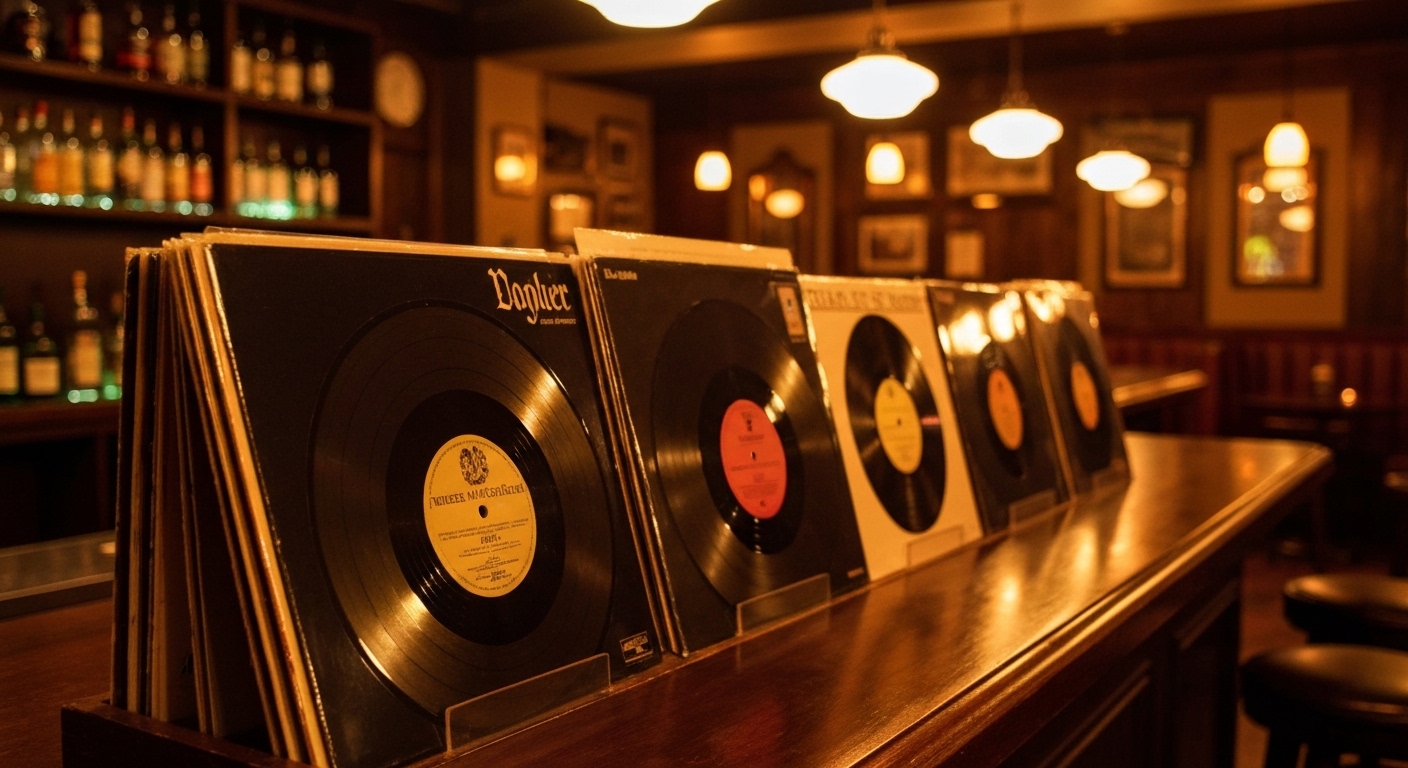
Less than you might expect, and that is the point. There is no band, no dance floor, and usually no television. Instead there is a room built around sound, often with vintage horn speakers, a tube amplifier, and a wall of records someone spent years assembling.
Somebody puts on a record. It plays all the way through. People talk, but they talk quietly, the way you would in a nice restaurant rather than a brewery patio at nine on a Saturday. Drinks lean toward cocktails, wine, and sake rather than pitchers.
For anyone who has spent a decade in Asheville's louder rooms, it is a different kind of night out. Not better, just different, and it fills a gap the city has had for a while.
Why is this showing up in Asheville now?
The format is not new. It started in Tokyo after World War II, where jazz kissa served coffee and played imported records for people who could not afford to buy them. Those rooms were quiet because the music was the whole product. American cities picked the idea back up around 2015, first in New York and Los Angeles, then in Chicago, Nashville, and Charleston.
Asheville was always going to get one eventually. This is a city where music is not a niche interest but part of the civic identity, from the Orange Peel and the Grey Eagle down to the old-time jams that still happen up in Madison County. A room dedicated to listening carefully fits into that.
There is also a demographic piece. Asheville has picked up a lot of transplants over the past ten years who moved here from cities where this kind of bar was normal. Some of them are in their thirties and forties, some are retirees who bought records the first time around. Both groups have been asking for somewhere to go that is not a brewery.
Does a place like this change a town?
More than it sounds like it should. Small venues built around a specific idea tend to pull a specific crowd, and that crowd starts showing up in the neighborhood at hours when it used to be empty. Coffee shops extend their hours. A restaurant two doors down picks up a second seating. The block starts to feel like somewhere rather than just a place you drive through.
That pattern has played out repeatedly in Western North Carolina at smaller scale. Sylva's Main Street turned around partly on the back of a handful of independent businesses that gave people a reason to walk. Waynesville and Brevard have both done versions of the same thing. Asheville has more of everything, but the mechanism does not change.
The other thing worth watching is whether the idea travels. Hendersonville, Waynesville, and Brevard all have the downtown density and the audience for something like this. A listening bar does not need a big space or a stage, which is part of why the format spreads to smaller markets more easily than a music venue does.
What does this have to do with where people are buying?
Buyers moving to the mountains almost always ask some version of the same question, which is what there is to do here on a Wednesday night in February. The honest answer used to be less than in a city, and for the small towns it still mostly is. But the gap has narrowed considerably.
Asheville's density of things to do is the reason a lot of people pay a premium for Buncombe County over the quieter counties west of it. The trade is real money against real convenience. Plenty of buyers decide the opposite way and land in Waynesville or Sylva or Franklin, where the housing goes further and Asheville is still close enough for a night out.
Either way, another good room in Asheville makes the whole region a little easier to sell to someone on the fence.
If reading about what is opening around Western NC has you wondering what living here would actually feel like day to day, Jon Tharp is always glad to talk it through.
Frequently Asked Questions
What is a vinyl listening bar?
A vinyl listening bar is a small venue built around a high-end audio system, usually with horn or vintage speakers, a tube amplifier, and a curated record collection. Records play front to back rather than as background shuffle, and the room is designed acoustically so the sound stays clean at moderate volume. Conversation is allowed but kept low, and there is rarely a dance floor or a live band. Most serve craft cocktails, natural wine, sake, or beer. The idea is that the music is the reason you came, not the soundtrack to something else.
Where did the listening bar concept come from?
Listening bars trace back to Japanese jazz kissa, coffee shops that opened in Tokyo and Osaka after World War II. Imported jazz records were expensive and hard to find, so owners bought them, invested in serious speakers, and charged admission to hear music people could not afford to own. The custom of quiet listening came from that scarcity. The format resurfaced in the 2010s in New York, Los Angeles, and Chicago, and has since reached mid-size cities. Asheville is a natural fit given how much of its identity already runs through music.
How far is Asheville from other Western North Carolina towns?
Asheville sits in Buncombe County at the junction of I-26 and I-40, which makes it the practical hub for most of the region. Waynesville is about 30 minutes west on I-40. Sylva runs roughly 50 minutes, and Franklin is about an hour and fifteen minutes via US-23/US-441. Brevard is 45 minutes south on US-64 or NC-280. Hendersonville is 30 minutes down I-26. Highlands takes closer to two hours on mountain roads. For most people living in the outlying counties, Asheville is a reasonable evening trip rather than an overnight one.
Is Asheville a good place to live if you care about music?
Asheville has one of the deepest music scenes for a city its size anywhere in the Southeast. The Orange Peel, the Grey Eagle, Salvage Station, and Rabbit Rabbit anchor the touring circuit, while smaller rooms and brewery taprooms host local acts most nights of the week. Traditional Appalachian string band music is still played regularly in Madison County and around Marshall. Add a listening bar to that and you get range, from a Tuesday night old-time jam to a full-album sit-down. Music is also one of the most common reasons buyers cite when they choose Asheville over a quieter mountain town.
About the Author
Jon Tharp is a licensed NC real estate broker with Keller Williams. He's helped buyers and sellers across Western North Carolina for over 10 years, specializing in mountain homes, land, and short-term rental investments, with offices throughout WNC covering all mountainous areas. If something in this post has you thinking about a move, he's easy to reach — (828) 347-9055 or smokymountainhomes4sale.com or Jon@jontharphomes.com.
Ready to Find Your Mountain Home Near Asheville?
Whether you're looking to buy, considering a short-term rental investment, or ready to sell, the Jon Tharp Team brings deep local knowledge and marketing that puts your home in front of 50,000+ buyers in the first 30 days.
Search available homes across Western NC or call Jon directly at (828) 347-9055.
Talk to JonWhat Our Clients Say
43 five-star Google reviews — read them all on Google
"Jon is hands down the most dedicated and knowledgeable realtor that I have ever worked with. His expertise made the entire process of selling my home and finding a new one a smooth process."
Amy Davis · 2025
"Jon & his team are the greatest! Very professional, friendly like your neighbor, and always get back to your texts, phone calls & emails within minutes or same day, not days or weeks."
Cynthia Oelschlager · 2025
"I can’t say enough good things about Jon and his team. I was looking for investment properties and Jon spent time researching where would be a good place for an Airbnb — he found 2 beautiful properties."
Diane Cogswell · 2025
More from the Blog