By Jon Tharp, Broker · July 23, 2026
At a Glance
Asheville, North Carolina ranks No. 3 on Southern Living's 2026 South's Best Cities list and No. 9 on Travel + Leisure's 2025 Best Cities in the United States, alongside honors from CNN Travel, The New York Times, and Reader's Digest. The recognition comes less than two years after Hurricane Helene, framing Asheville's mountain culture, craft beer, art, and community resilience as a national comeback story.
The List Asheville Cannot Seem to Stay Off Of
Asheville just landed at No. 3 on Southern Living's 2026 South's Best Cities list, and the only two names ahead of it were Charleston and Savannah. That is rare company. Two cities with centuries of tourism polish, and then a mountain town in Buncombe County holding its own right behind them.
The ranking, announced March 13, 2026, is reader-voted, which matters. This was not a panel of editors picking favorites. It was thousands of Southern travelers naming the places they love, and Asheville kept climbing. Fifth in 2024, third in 2025, third again in 2026. That is not a fluke. That is a pattern.
Southern Living described the city as an artsy mountain town with a penchant for an ice-cold beer, a farm-to-table plate, and an afternoon hike. Anyone who has spent a weekend downtown knows how accurate that is. You can wander from a gallery to a taproom to a trailhead in the same afternoon without ever getting in your car.
The Business Journals and outlets across its network have been carrying a version of this story for a while now, because Asheville keeps giving them a reason to. The city is not on one list. It is on all of them, over and over, and the recognition has kept coming, year after year, faster than most towns see in a decade.
More Than One Trophy on the Shelf
Southern Living is only the headline. Travel + Leisure placed Asheville at No. 9 on its 2025 Best Cities in the United States list, a reader survey that rewards places with a strong sense of character. The magazine cited the trails, the craft beer, and the art galleries, which is roughly the same trio that shows up in every write-up about the city.
Then there is CNN Travel, which named Asheville No. 3 on its America's Best Towns to Visit for 2025. The New York Times folded it into its "52 Places to Go in 2025." Travel + Leisure came back around in 2026 to include Asheville among its 50 best places to travel and its 11 best places for nature lovers. U.S. News & World Report has it on the Best Places to Live rankings. One survey of around 3,000 professionals even ranked Asheville No. 1 for people relocating in pursuit of a career change.
That last one is worth sitting with. People are not just visiting Asheville. They are moving there on purpose, treating it as a place to restart a life rather than a place to spend a long weekend.
The through line in all of these is character. Rankings that measure walkability or hotel counts can be gamed. Rankings that measure whether a place feels like itself cannot. Asheville feels like itself, and readers keep voting accordingly.
The Comeback Underneath the Rankings
Here is what makes the 2025 and 2026 honors hit differently. Less than two years ago, Hurricane Helene tore through the region. Late September 2024, and the French Broad and Swannanoa Rivers, the two waterways that meet right at Asheville, went from scenic to catastrophic in a matter of hours.
The River Arts District took some of the worst of it. Studios that had drawn visitors for years sat underwater. For a while, the question was not whether Asheville would top any lists. It was whether some of these neighborhoods would come back at all.
They came back. People here have treated every reopening in the River Arts District as a milestone, because it is one. And the national press noticed the effort as much as the result. Reader's Digest named Asheville the Nicest Place in America in 2025, an honor tied directly to how neighbors showed up for one another when the water rose and the power went out.
That is why the recent rankings read as a comeback story rather than a tourism brochure. When CNN and The New York Times and Southern Living put Asheville near the top of their lists in the months after Helene, they were not ignoring the storm. They were pointing at how the community answered it.
Vic Isley, who leads Explore Asheville and the Buncombe County Tourism Development Authority, has been the steady voice on the recovery, and the numbers she points to tell the economic side of the same story.
Tourism Is the Backbone, and the Numbers Show It
Tourism is not a side business in Buncombe County. It is the engine. Visitors contribute roughly $3 billion in local spending over a two-year span, which works out to about 20 percent of the county's entire GDP. When people ask why Asheville fights so hard for its reputation, that figure is the answer.
After Helene, that engine sputtered, and the recovery of the rankings tracked closely with the recovery of the visitor economy. Outlets reported a projected economic surge in the fall of 2025, and the momentum has carried into 2026. Fall in the mountains has always been the biggest season, and the leaf-peeping crowds returning was a signal that Asheville was open for business again.
The anchor of it all is Biltmore. George Vanderbilt's estate draws around 1.4 million visitors a year, making it the region's single biggest attraction. It is the largest privately owned home in America, and it has been pulling people to Asheville since it opened on Christmas Eve in 1895.
But the modern draw is broader than one estate. The craft beer scene put Asheville on the national map years ago, and it still anchors a lot of weekend trips. The galleries and working studios give the city an arts identity that most towns its size cannot match. And the food culture, built on Appalachian farm-to-table cooking, keeps earning its own separate write-ups.
Stack those together and you have a visitor economy that does not depend on any one thing. That diversity is exactly what let the city rebound as quickly as it did.
How a Frontier Outpost Became a National Name
Asheville did not start out as a destination. It started as Morristown, settled in 1794 by John Burton, who named it for Robert Morris, the financier of the American Revolution. When the state legislature established it as the seat of the newly created Buncombe County in 1797, it renamed the town to honor Governor Samuel Ashe.
For a long stretch, it was tiny. The population was 38 in 1800. It crept to 500 by 1840. This was a mountain outpost, remote by design, hard to reach and easy to overlook.
The turn came with the railroad and then with Vanderbilt. George Vanderbilt first visited Asheville in the 1880s with his mother and fell for the place. He bought roughly 125,000 acres and set about building something no one had attempted in the American South.
It took six years and a thousand craftspeople. Richard Morris Hunt designed the house. Frederick Law Olmsted, the man behind Central Park, shaped the grounds and gardens. When Biltmore opened in 1895, it did more than give Asheville a landmark. It gave the city an identity as a place of beauty and ambition, a place people traveled to see.
By 2000, the population had passed 65,000. Today it sits around 69,308, still the largest city in Buncombe County, still compact enough to feel like a real community rather than a sprawl. That combination of small scale and outsized culture is the same thing the rankings keep rewarding more than a century later.
What the Rankings Actually Get Right
It would be easy to be cynical about best-cities lists. They come out constantly, they generate clicks, and half of them contradict each other. But the case of Asheville is worth taking seriously, because the same city keeps winning across very different methodologies.
Reader surveys reward it. Editorial panels reward it. Relocation studies reward it. Resilience-based honors reward it. When a place performs that consistently across judges who are measuring different things, the common factor is usually something real rather than something marketed.
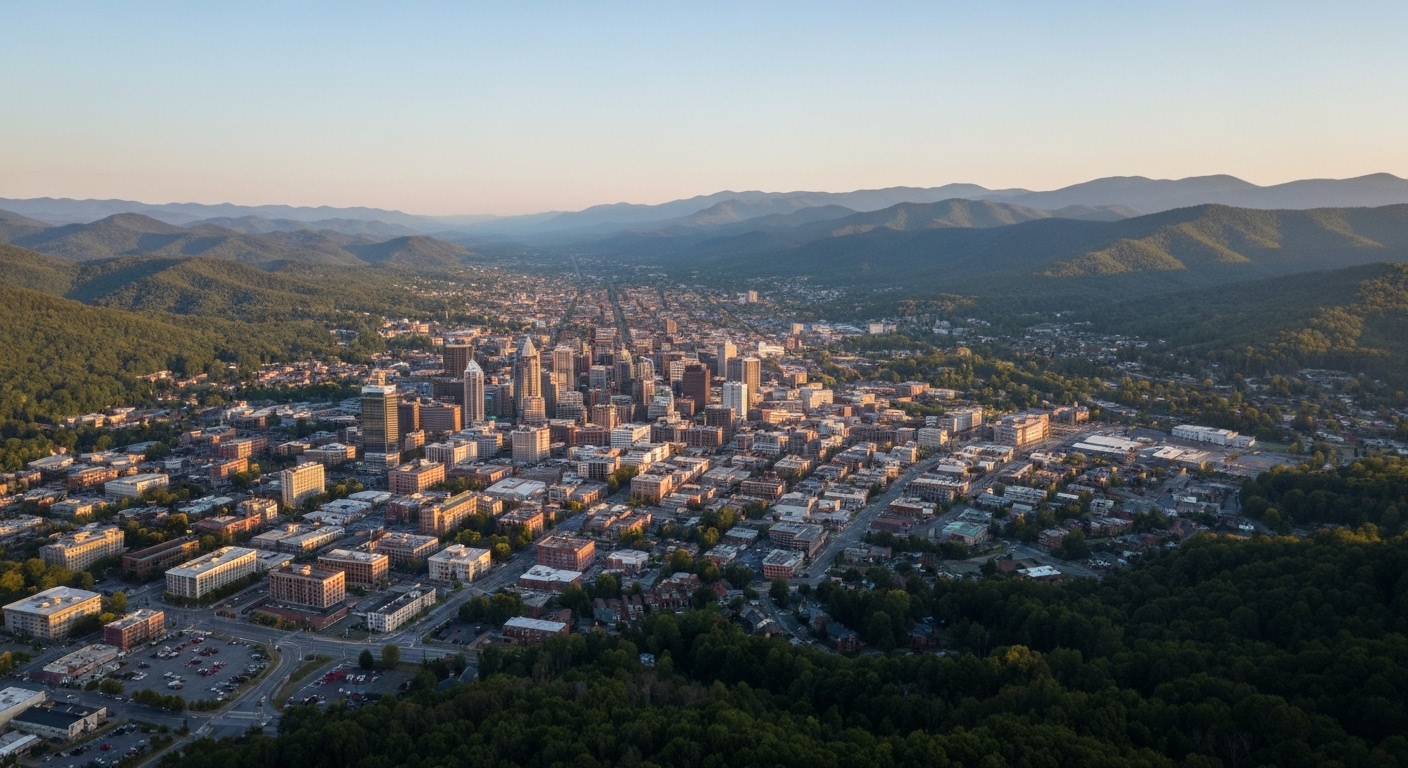
What they are all circling is character. Asheville sits between the Blue Ridge Mountains and the Great Smokies, at the confluence of two rivers, with a downtown that grew up around art, beer, and food rather than around a single industry. It is the kind of place that reads as itself the moment you arrive, and that quality does not fade when the trends change.
The recovery from Helene sharpened all of it. A community that shows up for its neighbors during a disaster is exactly the kind of community these lists are trying, imperfectly, to identify. The storm did not create Asheville's character. It revealed it, and the rankings that followed were the country taking notice.
For readers across Western North Carolina, from Waynesville to Sylva to Franklin, the Asheville story is a familiar one. The mountains have always drawn people who wanted something with more texture than a subdivision and a strip mall.
That pull is also why so many people who come to visit end up wondering what it would take to stay, and the folks who help them make that move know these mountain towns better than any ranking ever could.
Frequently Asked Questions
Why does Asheville keep getting named one of the best cities in the U.S.?
Asheville lands on national lists because it combines mountain scenery, a nationally known craft beer scene, a deep arts culture, and Appalachian farm-to-table food in a walkable downtown. Travel + Leisure's reader survey rewards cities with a strong sense of character, and Asheville has that in abundance. Southern Living highlights its artsy mountain identity, and CNN Travel and The New York Times have added their own nods. The rankings also increasingly point to community resilience after Hurricane Helene, which gave Asheville a comeback narrative that resonated with travelers and voters across the country in 2025 and 2026.
Where did Asheville rank on Southern Living's 2026 South's Best Cities list?
Asheville ranked No. 3 on Southern Living's 2026 South's Best Cities list, announced March 13, 2026. It trailed only Charleston, South Carolina at No. 1 and Savannah, Georgia at No. 2, and finished ahead of Nashville, New Orleans, Lexington, Wilmington, Chattanooga, Greenville, and St. Petersburg. That No. 3 finish continues a strong run for the city, which placed 5th in 2024 and 3rd in 2025 on the same reader-voted list. Southern Living described Asheville as an artsy mountain town with a penchant for an ice-cold beer, a farm-to-table plate, and an afternoon hike, which captures the appeal well.
How has Asheville recovered from Hurricane Helene?
Asheville has recovered steadily since Hurricane Helene struck in late September 2024. The River Arts District, one of the hardest-hit areas, has treated each reopening as a milestone, and tourism has rebounded with a projected economic surge in fall 2025 and continued growth into 2026. Tourism remains the economic backbone of Buncombe County, with visitors contributing roughly $3 billion in local spending over two years, about 20 percent of the county's GDP. The community's mutual-aid response during and after the storm also earned Asheville the Reader's Digest Nicest Place in America designation in 2025.
What is the population of Asheville, North Carolina?
Asheville has a population of roughly 69,308, making it the largest city in Buncombe County. The county itself is home to around 93,716 people, though census figures shift year to year and are worth checking against the latest data. The city sits between the Blue Ridge Mountains and the Great Smokies at the confluence of the French Broad and Swannanoa Rivers. Despite its national profile, Asheville stays relatively compact, which is part of why it feels walkable and personal. That mix of small-city scale and big-city culture is one reason it keeps drawing both visitors and new residents to Western North Carolina.
What are the main attractions that make Asheville a top destination?
Biltmore is the anchor, drawing roughly 1.4 million visitors a year to George Vanderbilt's 1895 estate, still the largest privately owned home in America. Beyond Biltmore, visitors come for the craft breweries, the galleries and studios of the River Arts District, and hiking trails that spill in every direction from the Blue Ridge Parkway. The food scene leans hard into Appalachian farm-to-table cooking, and cultural anchors like the YMI Cultural Center preserve the region's Black Highlander heritage. Add the mountain views, the rivers, and a downtown built for walking, and the appeal becomes clear quickly.
About the Author
Jon Tharp is a licensed NC real estate broker with Keller Williams. He's helped buyers and sellers across Western North Carolina for over 10 years, specializing in mountain homes, land, and short-term rental investments, with offices throughout WNC covering all mountainous areas. If something in this post has you thinking about a move, he's easy to reach — (828) 347-9055 or smokymountainhomes4sale.com or Jon@jontharphomes.com.
Ready to Find Your Mountain Home Near Asheville?
Whether you're looking to buy, considering a short-term rental investment, or ready to sell, the Jon Tharp Team brings deep local knowledge and marketing that puts your home in front of 50,000+ buyers in the first 30 days.
Search available homes across Western NC or call Jon directly at (828) 347-9055.
Talk to JonWhat Our Clients Say
43 five-star Google reviews — read them all on Google
"Jon is hands down the most dedicated and knowledgeable realtor that I have ever worked with. His expertise made the entire process of selling my home and finding a new one a smooth process."
Amy Davis · 2025
"Jon & his team are the greatest! Very professional, friendly like your neighbor, and always get back to your texts, phone calls & emails within minutes or same day, not days or weeks."
Cynthia Oelschlager · 2025
"I can’t say enough good things about Jon and his team. I was looking for investment properties and Jon spent time researching where would be a good place for an Airbnb — he found 2 beautiful properties."
Diane Cogswell · 2025
More from the Blog