By Jon Tharp, Broker · August 21, 2026
At a Glance
About 300 miles of the Appalachian Trail run through North Carolina, and researchers now link the awe it produces to real gains in mood, stress, and social connection. The best access points in WNC include Siler Bald and Albert Mountain near Franklin, Wayah Bald, Cheoah Bald above the Nantahala Outdoor Center, Max Patch, and Hot Springs, where the trail runs down the sidewalk of a working mountain town.
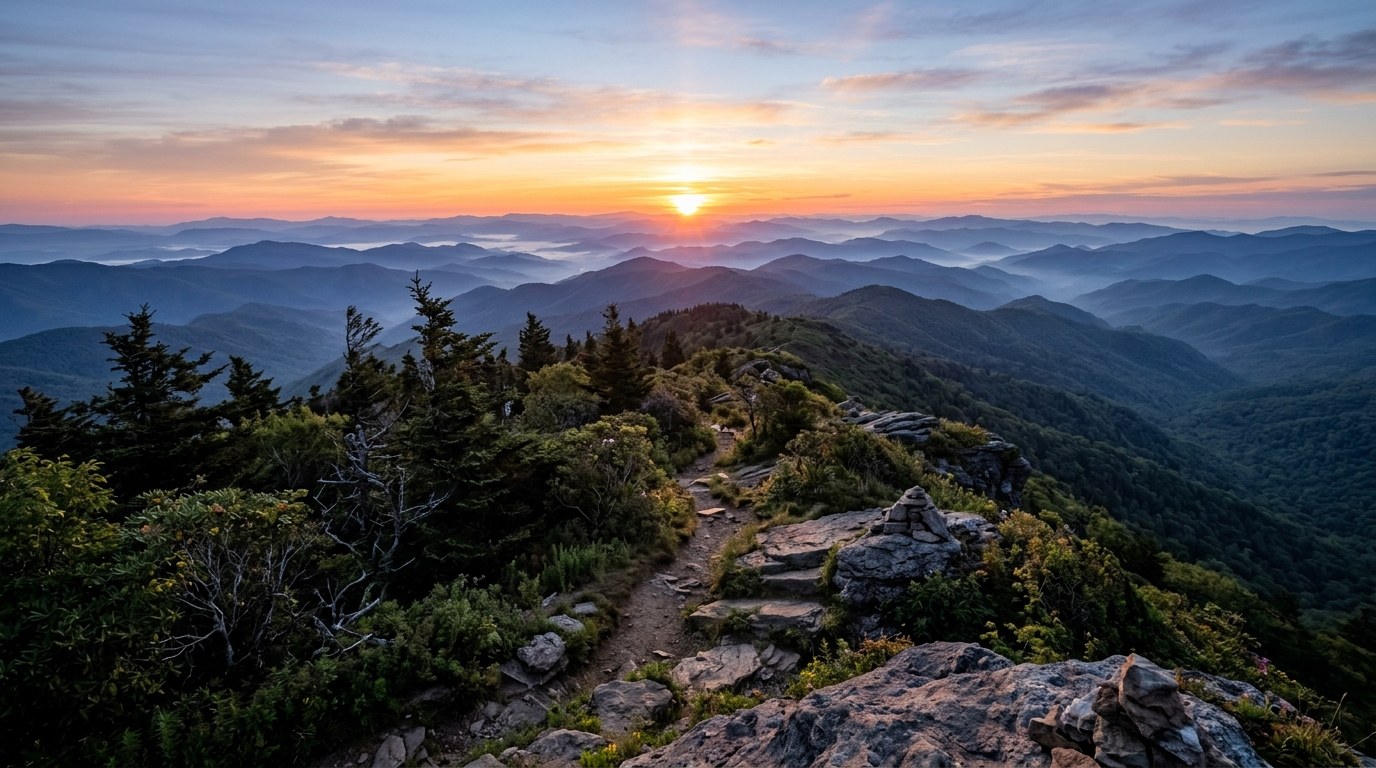
The fog settles into the valleys below Siler Bald at sunrise and sits there like water in a bowl, so that the only things above it are the far ridgelines and whoever happened to walk up that morning. Northbound hikers reach that grassy summit about 110 miles into a roughly 2,200 mile walk, a few miles above Winding Stair Gap on US 64 west of Franklin. A lot of them sit down in the wet grass and say nothing at all for a while.
There is a name for what is happening in that silence, and researchers have started taking it seriously. The feeling is awe, and the Appalachian Trail through this part of the country is a dependable place to run into it.
The Word For What The Mountains Do
Researchers define awe as the feeling of encountering something so large that it stretches your understanding of the world and your place in it. That thing does not have to be a mountain. It can be a landscape, an act of kindness, a piece of music, or the discovery that your own legs will carry you somewhere you doubted they could.
The physical signs are consistent enough that scientists can look for them. Goosebumps. A quiet "wow" that comes out before you decide to say it. Tears that surprise the person crying. A sense of being connected to something bigger, which is the part that turns out to matter most.
A growing body of research suggests awe helps explain something people around here have taken for granted for generations, which is that time outdoors makes you feel better. Not just distracted or tired in a good way, but measurably better in mood, stress levels, and sense of connection to other people.
That reframes what the trail is doing when you walk it. The exercise is real, and so is the fresh air. But the thing that resets a person after a hard week may be the moment the treeline opens and you can see how big the place is.
The Appalachian Trail Conservancy has been making this point to hikers lately, and it is a practical one. You do not have to walk to Maine to get the benefit. You have to get somewhere the view opens up.
Where Beauty Does The Work
Aesthetic beauty is the most common trigger of awe that researchers have identified, and North Carolina's share of the trail has plenty of it.
Start at Bly Gap, where the trail crosses out of Georgia and a gnarled old oak leans sideways over the state line. The climb north from there through the Nantahala National Forest hits Standing Indian Mountain at 5,498 feet, sometimes called the grandstand of the Southern Appalachians because of how far south the view runs on a clear day.
Albert Mountain comes next, a short brutal scramble up bare rock to a fire tower that sits almost exactly at the 100 mile mark. Wayah Bald has a restored stone tower and a walk short enough that people in their seventies do it in sneakers, which is part of why it is the most photographed spot in Macon County.
Farther north, Cheoah Bald looks down on the Nantahala Gorge from more than 5,000 feet. Fontana Dam is 480 feet tall, the highest dam east of the Rockies, with a shelter beside it that hikers have nicknamed the Fontana Hilton for its showers and its view across the lake.
Then the trail climbs into the Smokies and runs the state line ridge to Kuwohi at 6,643 feet, the highest point on the entire Appalachian Trail. The peak was officially restored to its Cherokee name in 2024 after decades as Clingmans Dome.
Past the park, Max Patch is a bald so open and so easy to reach that the Forest Service has had to restrict camping there in recent years to protect it. Check current orders before you plan an overnight.
The Kind of Awe That Comes From People
Awe is not limited to landscape, and the research on this part is the more surprising half. Witnessing kindness, generosity, or courage produces many of the same effects. Studies have found that people who experience awe report feeling less isolated and more aware of belonging to something larger than their own concerns.
Anyone who has spent a March afternoon at a trailhead in Macon or Swain County knows exactly what this looks like. It is called trail magic, and it is one of the odder social customs in American outdoor life.
Someone drives a cooler of sodas to a gap and hands them out to strangers. A local pulls over on a mountain road and gives a ride to a hiker who smells like three days of rain. A church puts on a hiker feed. A shuttle driver waits an extra forty minutes because someone is running late off the mountain.
None of it is transactional. The people doing it will never see most of those hikers again, and the hikers know it, which is why it works on them.
The Appalachian Trail Conservancy asks people to do trail magic responsibly, which mostly means staying with what you bring and packing out everything you carried in. Unattended coolers draw bears, and a habituated bear is a problem for every hiker who comes through after you.
Done right, it is one of the better habits around here. A hiker from Michigan or Germany gets a cold drink from someone in Franklin who wanted nothing back, and that is the story they tell when they get home.
Franklin, and the Towns the Trail Made
Franklin sits close enough to the trail that it functions as the first real resupply stop in North Carolina for northbound hikers, and the town treats them as regulars rather than just tolerating the traffic.
Outfitters downtown handle gear repairs and boot fittings for people who are ten days into discovering their footwear was a mistake. Motels run hiker rates. Shuttle drivers work the gaps along US 64 and Wayah Road. In early spring the whole downtown takes on a particular character, with the trail days celebration and a steady stream of packs leaned against storefronts.
The Nantahala Hiking Club, headquartered in Franklin, maintains the southernmost stretch of the trail in the state. Volunteers do that work, clearing blowdowns, rebuilding steps, and digging water bars in weather most people would not go out in.
Downstream, the Nantahala Outdoor Center at Wesser is one of the few places where the trail walks directly through a working business, crossing the Nantahala River on a footbridge between the rafting outpost and the restaurant. Bryson City picks up hikers heading into the Smokies. Fontana Village serves the dam crossing.
Hot Springs, up in Madison County, is the clearest example of the arrangement. The trail comes down off the mountain and runs along the sidewalk of the main street, past the diner and the outfitter, before crossing the French Broad River. There are only a handful of towns on the entire 2,200 mile route where that happens.
These towns did not become trail towns by accident. They chose it, and you can see the choice in how they run.
The Awe of Finding Out What You Can Do
The third source of awe in the research is the one people talk about least, which is the awe of your own capability.
Something happens when a person who has not walked five miles in twenty years gets to the top of Albert Mountain. It is not pride exactly, and it is not relief. It is closer to meeting a version of yourself you had written off. Researchers call this a self-transcendent experience, and it turns out to be as powerful a driver of wellbeing as any view.
This matters for a specific group of people in Western North Carolina. Retirees who moved here for the mountains and then spent two years learning the grocery stores instead of the trails. People recovering from surgery or grief. Anyone who quietly decided the physical part of their life was behind them.
The trail is unusually good at this because you can take it in whatever size you want. You can do half a mile to a viewpoint. You can do four miles to a bald and back. You can do a section over a weekend with a shuttle at both ends. Nobody at the trailhead is checking your credentials.
The Appalachian Trail Conservancy maintains an interactive map with a vistas layer that marks scenic overlooks along the route, which is a practical way to find a payoff that matches the effort you have available. Pick the view first, then work backward to the hike.
That is not a lesser version of the experience. Plenty of thru-hikers will tell you their best day on the trail was four miles long.
Giving Some of It Back
Volunteers maintain every mile of the Appalachian Trail in this state, which surprises most people the first time they hear it. There is no crew of paid workers keeping the treadway clear.
The Nantahala Hiking Club covers the southern end out of Franklin. The Smoky Mountains Hiking Club handles the park. The Carolina Mountain Club, based in Asheville, works the miles northeast toward Hot Springs and beyond. All three run scheduled work trips throughout the year and all three will take someone who has never held a fire rake.
The work is unglamorous. Clearing drainage so a rainstorm does not carve a gully into the trail. Cutting a blowdown that fell across the path in February. Repainting white blazes that have faded off the rock.
It also happens to be one of the more effective ways to meet people if you are new here. Trail crews skip the small talk entirely, because someone hands you a tool and tells you where to stand, and four hours later you know everyone's name and something about their life.
There is a version of awe available in this too. Standing on a stretch of trail you helped rebuild, watching a hiker walk over it without noticing, is its own quiet thing.
The mountains here have a way of making people want to stay, and if that thought has started keeping you company on the drive home from a trailhead, I am always happy to talk through what living closer to it would actually look like.
Frequently Asked Questions
How many miles of the Appalachian Trail are in North Carolina?
Roughly 300 miles of the Appalachian Trail are in North Carolina, though the number depends on how you count. About 95 miles sit entirely inside the state, running from Bly Gap at the Georgia line north through the Nantahala National Forest to the edge of the Great Smokies. Another 200 or so miles straddle the North Carolina and Tennessee border, including the ridgeline through Great Smoky Mountains National Park and the high country beyond Hot Springs. Trail mileage shifts slightly year to year as relocations and reroutes are completed, so published figures from the Appalachian Trail Conservancy are the ones to trust.
What are the best short day hikes on the Appalachian Trail near Franklin, NC?
Siler Bald is the local favorite, reached from Winding Stair Gap on US 64 west of Franklin, with a climb of a few miles to an open grassy summit and a full circle of ridgelines. Wayah Bald has a restored stone observation tower and a very short walk from the parking area, which makes it the easiest big view in Macon County. Albert Mountain is shorter but steeper, ending in a rock scramble to a fire tower near the 100 mile mark of the trail. Standing Indian Mountain, above Standing Indian Campground, rewards a longer effort with a broad southern overlook.
What is trail magic, and can anyone leave it for hikers?
Trail magic is unexpected generosity offered to long distance hikers, usually food, cold drinks, or a ride into town from someone who is not being paid for it. In Western North Carolina it shows up heavily in March and April as northbound thru-hikers move through Macon, Swain, and Madison counties. The Appalachian Trail Conservancy asks that anyone offering it follow a few rules, mainly that you stay with what you bring, pack out everything, and avoid leaving unattended coolers or food caches, which attract bears and create problems for the next hiker through. Trailhead parking areas and road crossings are the appropriate places.
When do Appalachian Trail thru-hikers come through Western North Carolina?
The northbound wave hits Western North Carolina from roughly early March through late April, peaking in the last three weeks of March. Hikers who start at Springer Mountain in Georgia in late February or early March reach Franklin about a week to ten days later, then move on to the Nantahala Outdoor Center, Fontana Dam, and the Smokies. Franklin leans into it with a spring trail days celebration and hiker friendly outfitters downtown. Southbound hikers arrive much later, typically October and November, in far smaller numbers and often in colder, quieter conditions.
How can I volunteer to help maintain the Appalachian Trail in Western North Carolina?
Three volunteer clubs divide the work across this part of the state. The Nantahala Hiking Club, based in Franklin, maintains the southernmost stretch from the Georgia line north toward the Nantahala Outdoor Center. The Smoky Mountains Hiking Club covers the section through Great Smoky Mountains National Park. The Carolina Mountain Club, based in Asheville, handles the miles northeast of the park past Hot Springs. All three run regular work trips, and none require prior trail building experience or long distance hiking credentials. Most new volunteers start by joining a scheduled crew day and learning tools on site.
About the Author
Jon Tharp is a licensed NC real estate broker with Keller Williams. He's helped buyers and sellers across Western North Carolina for over 10 years, specializing in mountain homes, land, and short-term rental investments, with offices throughout WNC covering all mountainous areas. If something in this post has you thinking about a move, he's easy to reach — (828) 347-9055 or smokymountainhomes4sale.com or Jon@jontharphomes.com.
Ready to Make Western NC Your Home Base?
Whether you're looking to buy, considering a short-term rental investment, or ready to sell, the Jon Tharp Team brings deep local knowledge and marketing that puts your home in front of 50,000+ buyers in the first 30 days.
Search available homes across Western NC or call Jon directly at (828) 347-9055.
Talk to JonWhat Our Clients Say
43 five-star Google reviews — read them all on Google
"Jon is hands down the most dedicated and knowledgeable realtor that I have ever worked with. His expertise made the entire process of selling my home and finding a new one a smooth process."
Amy Davis · 2025
"Jon & his team are the greatest! Very professional, friendly like your neighbor, and always get back to your texts, phone calls & emails within minutes or same day, not days or weeks."
Cynthia Oelschlager · 2025
"I can’t say enough good things about Jon and his team. I was looking for investment properties and Jon spent time researching where would be a good place for an Airbnb — he found 2 beautiful properties."
Diane Cogswell · 2025
More from the Blog