By Jon Tharp, Broker · October 23, 2026
At a Glance
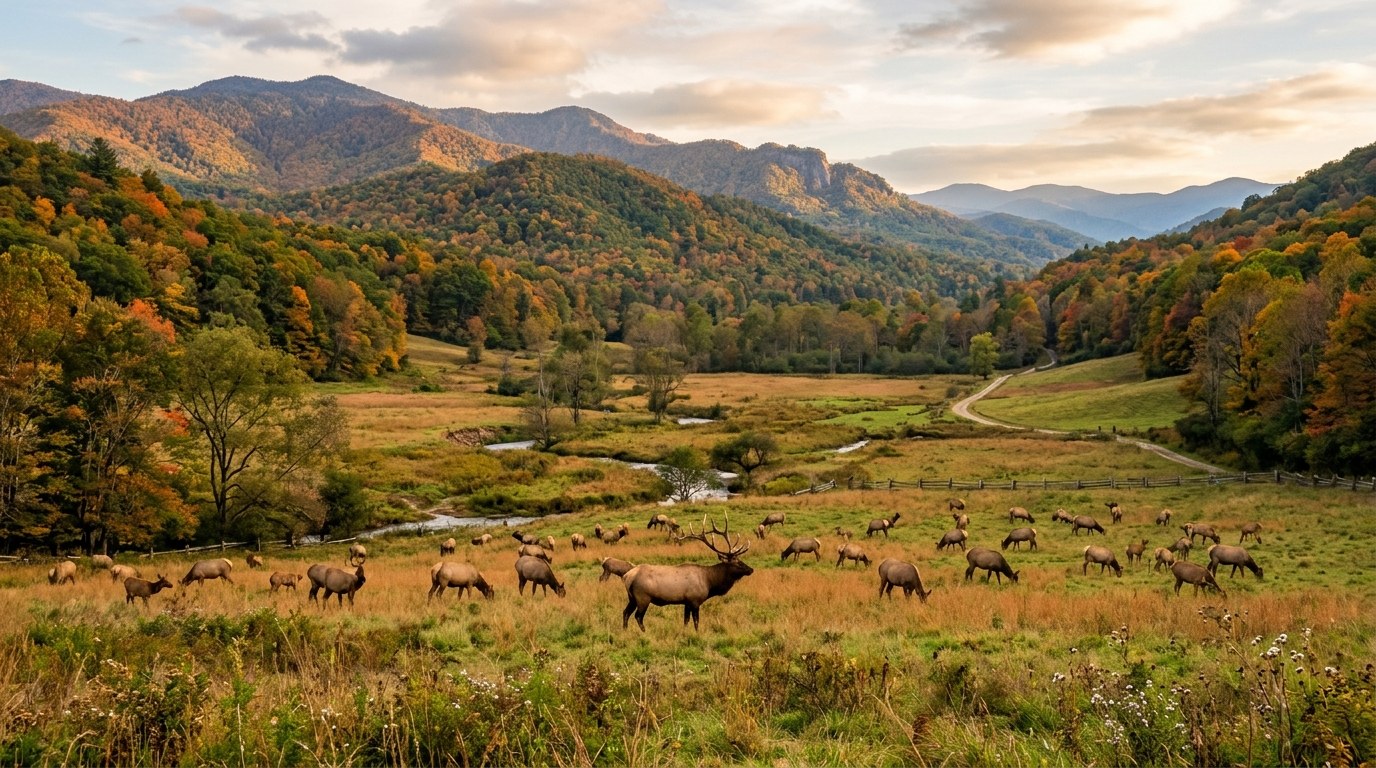
Elk are back in Western North Carolina after vanishing around 1800. The National Park Service released 52 elk into Cataloochee Valley in Great Smoky Mountains National Park in 2001 and 2002, and more than 200 now live around Cataloochee, Cherokee, and Maggie Valley. The rut usually runs early September through late October, when bulls bugle, and elk often graze Cataloochee's open fields early morning and late afternoon.
A bull elk bugle starts as a deep roar, climbs into a high whistle, and ends with several rough grunts. Heard drifting out of the woods just before sunset, it could almost pass for a bird, a wolf, or some mysterious mountain creature.
Elk once roamed much of North Carolina, including Polk County, until hunting and habitat loss drove them from the state by about 1800. Today you can see them in Cataloochee Valley, just a couple of hours west, and fall is when they really put on a show.
How did elk come back to North Carolina?
For nearly two centuries, the mountains went without them. Then in 2001 and 2002, the National Park Service reintroduced 52 elk into Cataloochee Valley in Great Smoky Mountains National Park. Biologists hoped they would survive, but nobody knew what would happen.
The elk did more than survive. They raised calves and slowly spread into other parts of the mountains. Today more than 200 live around Cataloochee, Cherokee, and Maggie Valley.
How big are elk in North Carolina?
Elk are the largest wild animals in North Carolina, larger even than our black bears. A full-grown bull can top 700 pounds, and cows, the females, still weigh several hundred.
Then there are the antlers. Bulls shed them every year and grow a completely new set, and the antlers can grow almost an inch a day. That makes elk antlers the fastest-growing bone in the world.
A soft skin called velvet covers new antlers and carries blood and nutrients to the growing bone. By fall the antlers have hardened, and bulls rub the velvet off against trees and bushes because it gets itchy.
If you come across a shed antler, consider leaving it where it lies. Antlers are rich in calcium, protein, and minerals, and rodents, foxes, opossums, and even bears love them.
When is elk rut season in Western North Carolina?
The rut usually runs from early September through late October. That is when bulls bugle to attract cows and warn other bulls, and two bulls may lock antlers to decide who is in charge.
Elk have plenty more to say, too. They bark, squeal, grunt, and make quiet sounds to one another. Newborn calves have almost no scent, which makes them harder for predators to detect while they hide in tall grass but also makes them harder for their mothers to locate in a big herd. Mothers and calves learn each other's voices, which helps them reunite when separated.
For most of the year, cows stay together in a herd while bulls form bachelor herds or go it alone. The bulls join the cows for mating each fall, but only for a few weeks.
Where can you see elk near Cherokee and Maggie Valley?
Elk often graze the open fields of Cataloochee Valley early in the morning and late in the afternoon. The Oconaluftee Visitor Center near Cherokee is another good choice, and you can sometimes see elk nearby.
Give them plenty of space. Bulls can be unpredictable in the fall, and cows fiercely protect their calves in the spring.
After nearly 200 silent years, elk bugles are echoing through Western North Carolina again. It is one of our mountains' best wildlife success stories.
This post draws on a column by Loti Woods, co-founder of Champions for Wildlife, a local nonprofit whose mission is to inspire and empower kids to learn about and protect wildlife through art and education. Read the original in the Tryon Daily Bulletin.
Frequently Asked Questions
Where can you see elk in Western North Carolina?
Elk often graze the open fields of Cataloochee Valley in Great Smoky Mountains National Park early in the morning and late in the afternoon. The Oconaluftee Visitor Center near Cherokee is another good option, with elk sometimes seen nearby.
When is elk rut season in North Carolina?
The elk rut usually runs from early September through late October. During this time bulls bugle to attract cows and warn other bulls, and rival bulls may lock antlers.
How big are elk in North Carolina?
Elk are the largest wild animals in North Carolina, bigger than black bears. A full-grown bull can weigh more than 700 pounds, and cows weigh several hundred pounds.
About the Author
Jon Tharp is a licensed NC real estate broker with Keller Williams. He's helped buyers and sellers across Western North Carolina for over 10 years, specializing in mountain homes, land, and short-term rental investments, with offices throughout WNC covering all mountainous areas. If something in this post has you thinking about a move, he's easy to reach — (828) 347-9055 or smokymountainhomes4sale.com or Jon@jontharphomes.com.
Ready to Make Western NC Your Home Base?
Whether you're looking to buy, considering a short-term rental investment, or ready to sell, the Jon Tharp Team brings deep local knowledge and marketing that puts your home in front of 50,000+ buyers in the first 30 days.
Search available homes across Western NC or call Jon directly at (828) 347-9055.
Talk to JonWhat Our Clients Say
43 five-star Google reviews — read them all on Google
"Jon is hands down the most dedicated and knowledgeable realtor that I have ever worked with. His expertise made the entire process of selling my home and finding a new one a smooth process."
Amy Davis · 2025
"Jon & his team are the greatest! Very professional, friendly like your neighbor, and always get back to your texts, phone calls & emails within minutes or same day, not days or weeks."
Cynthia Oelschlager · 2025
"I can’t say enough good things about Jon and his team. I was looking for investment properties and Jon spent time researching where would be a good place for an Airbnb — he found 2 beautiful properties."
Diane Cogswell · 2025
More from the Blog