By Jon Tharp, Broker · June 7, 2026
Quick Answer: Waynesville is the Haywood County seat, a town of about 10,000 just 30 miles and 40 minutes west of Asheville, where the median home sold for around $351,000 over the past year (as of June 2026). It is the walkable, year-round "real downtown" alternative to Asheville, a celebrated Main Street, a deep arts and festival scene, Lake Junaluska next door, and a hospital ten minutes away, which is why it is one of Western North Carolina's top retirement towns. The honest caveat is localized flood risk along Richland Creek in the Frog Level and Hazelwood areas; most mountain neighborhoods sit well above it.
Waynesville at a Glance
| Population | About 10,000 (Town of Waynesville, Haywood County seat) |
| Median home price | Around $351,000 over the past 12 months (as of June 2026) |
| Time on market | Roughly 100 days, median (as of June 2026) |
| Elevation | About 2,750 ft downtown, climbing past 4,000-5,000 ft in mountain communities |
| Drive to Asheville | ~31 miles, ~40 minutes east via I-40 |
| County + town tax | Haywood $0.55 per $100 plus Town of Waynesville $0.479, about $1.03 combined in city limits |
| Water and sewer | Town of Waynesville public water and sewer in town; private wells and septic in outlying areas |
| Locally famous for | A Main Street voted among America's best, the Folkmoot international folk festival, Lake Junaluska, and being the walkable, year-round alternative to Asheville |
What does living in Waynesville actually mean for a retiree?
For most buyers, Waynesville means a real, walkable mountain town that functions year-round, near Asheville but more affordable and more livable day to day. It is the county seat, so it has the downtown, the hospital, the arts, and the services that resort villages lack, and it consistently ranks as one of the best places to retire in the North Carolina mountains.
The draw is the combination. You get a historic Main Street that has been voted among the best in America, the Folkmoot international folk festival every July, Lake Junaluska for lakeside walks minutes from downtown, four real seasons with mild summers at elevation, and a town that stays alive in January instead of emptying out. Add North Carolina's retiree-friendly taxes (no tax on Social Security, a low flat income tax), a 178-bed hospital ten minutes away in Clyde, and a 40-minute drive to Asheville's airport and culture, and you can see why retirees and relocation buyers from Atlanta, Charlotte, Greenville, and Florida keep choosing Waynesville.
The honest part: Waynesville is a popular, established market, so it is not the bargain that nearby Canton is, the median home runs around $351,000 (as of June 2026). And while the town largely escaped the worst of the 2021 flooding, Hurricane Helene in 2024 brought record flooding to the low-lying Richland Creek districts of Frog Level and Hazelwood. The mountain neighborhoods sit safely above that, so location within town matters. This guide walks through all of it with real numbers.
Table of Contents
- What is the history of Waynesville? - What kind of town is Waynesville? - What is there to do downtown, and what is the arts scene like? - What is Lake Junaluska and what is it like to live there? - What outdoor recreation is around Waynesville? - How much does it cost to buy a home in Waynesville? - What are the neighborhoods and areas in Waynesville? - How serious is the flood risk in Waynesville? - How far is Waynesville from Asheville and the feeder cities? - What internet and utilities can you get in Waynesville? - What should out-of-state buyers know about mountain property here? - What are the schools like in Waynesville? - What is healthcare like in Waynesville? - What senior living options are in Waynesville? - What are the property taxes in Waynesville and Haywood County? - What are the seasons, weather, and elevation like? - What annual events happen in Waynesville? - How does Waynesville compare to nearby towns? - Is Waynesville right for you? - Frequently Asked Questions
What is the history of Waynesville?
Waynesville has been the Haywood County seat since the county was formed in 1808, and it was founded the next year by a Revolutionary War veteran who named it for his old commander. That courthouse-town role is why Waynesville grew into the full-service hub of the county.
Haywood County was created on December 23, 1808, named for John Haywood, North Carolina's longtime state treasurer. In 1809, Revolutionary War veteran Col. Robert Love donated land for the courthouse, jail, and public square, and named the new town for General "Mad" Anthony Wayne, his wartime commander. Waynesville has been the county seat ever since, and the gold-domed Haywood County Courthouse remains the landmark anchor of Main Street.
The town grew in two waves. The railroad arrived in the late 1800s, and the Frog Level district sprang up along the rail line and Richland Creek as the commercial and depot quarter, with merchants in dry goods, groceries, and timber. To the southwest, Hazelwood developed as a separate manufacturing town and finally merged into Waynesville in 1995. Over recent decades, as timber and manufacturing faded, Waynesville reinvented itself around tourism, the arts, and retirement, leaning into its "Gateway to the Smokies" identity and its historic downtown, which today is one of the most celebrated small Main Streets in the country.
See what is on the market in Waynesville
See Homes for Sale in WaynesvilleWhat kind of town is Waynesville?
Waynesville is a genuine, year-round small town built around one of the best historic downtowns in America, with a deep arts identity and a large retiree population. It is more lived-in and full-service than the resort villages nearby, and more walkable and authentic than a tourist strip.
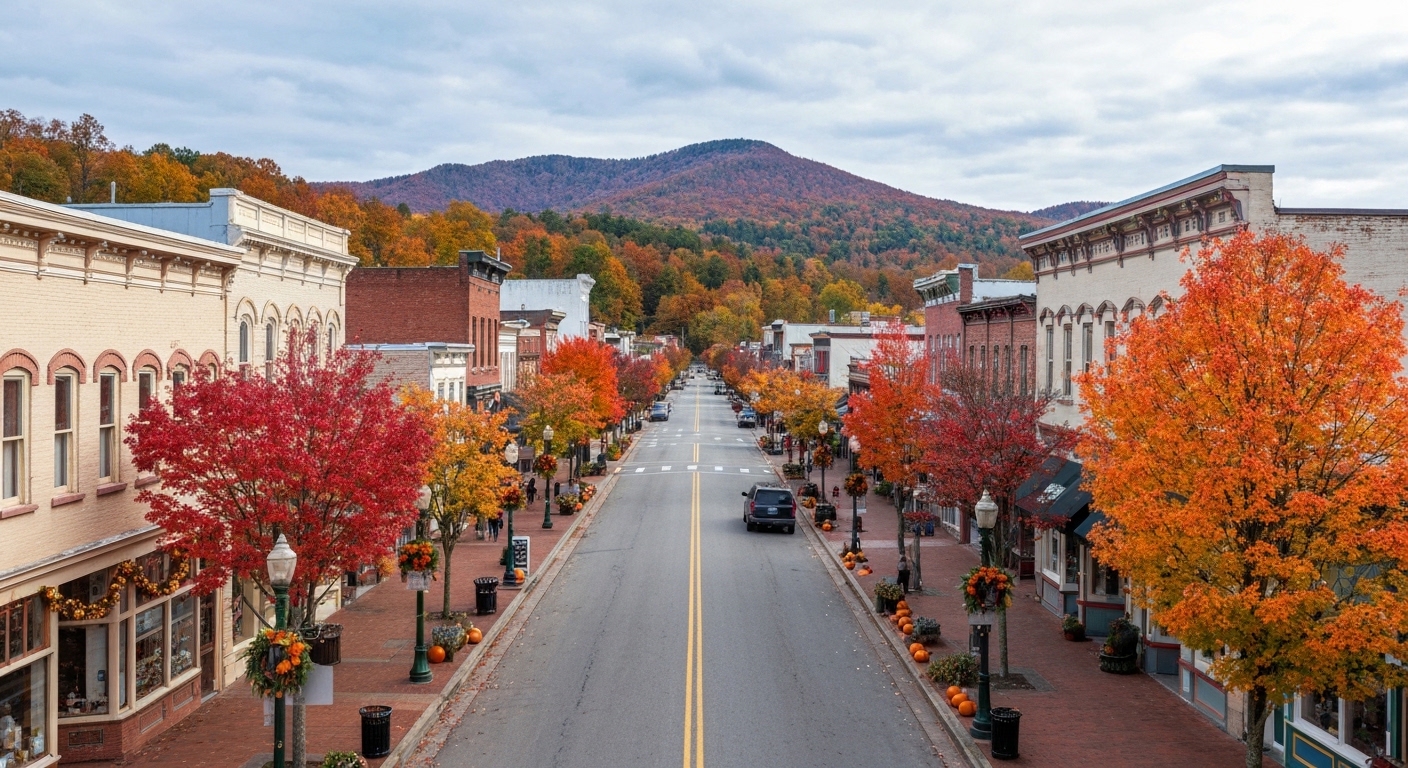
The town has been voted the #2 Best Main Street in America in the USA Today 10Best readers' poll, and it shows: a walkable historic Main Street, the Frog Level brewery-and-shops district along the creek, and the Hazelwood retail strip make three distinct walkable centers. With roughly 10,000 residents, Waynesville holds a real mix of multi-generational locals, a large and growing retiree base, and second-home owners, with a strong galleries-and-theater arts culture running through all of it.
A Saturday in Waynesville looks like coffee and shopping on Main Street, a walk around Lake Junaluska, a show at the regional theater, or a beer at a creekside brewery, and the calendar stays full year-round rather than going quiet after leaf season. What Waynesville is not is a cheap market or a remote escape: it is an established, in-demand town where you pay a bit more for the walkability, the services, and the year-round community. For many retirees, that trade is exactly the point.
What is there to do downtown, and what is the arts scene like?
Downtown Waynesville is the heart of the town: a walkable historic Main Street anchored by Mast General Store, a regional theater, galleries, and a celebrated restaurant and brewery scene. The arts and festival calendar is a big part of why people fall for the place.
The named anchors are easy to rattle off. Mast General Store occupies a restored 1930s storefront on Main with outdoor gear, clothing, and barrel candy. The Waynesville Public Art Trail is a free self-guided walk through Main Street, Frog Level, and Hazelwood. HART, the Haywood Arts Regional Theatre founded in 1985, brings semi-professional theater year-round. For food and drink, locals send you to The Sweet Onion and Frogs Leap Public House for upscale Southern, Bogart's for a casual favorite, Boojum Brewing downtown, and Frog Level Brewing for a creekside beer garden in the historic depot district.
Then there are the festivals, which define the town's calendar. Folkmoot, "The State International Festival of North Carolina," has run since 1984 from its Friendship Center in the old Hazelwood school, drawing folk-dance troupes from around the world each July. Mountain Street Dances bring Appalachian music and clogging to the courthouse lawn on summer evenings, and the Apple Harvest Festival fills Main Street each October. For a buyer weighing quality of life, this is the tell: Waynesville is a town with something going on, in every season.
What is Lake Junaluska and what is it like to live there?
Lake Junaluska is a 200-acre lake and historic Methodist retreat community adjacent to Waynesville, with a beloved walking path around the water and a mix of year-round and seasonal residents. It is one of the most distinctive places to live in the county.
The lake sits at the center of the Lake Junaluska Conference & Retreat Center, a Methodist retreat since 1913, with a dam on Richland Creek begun in 1911. The roughly 1,200-acre property includes the lake, 400-plus lodging rooms, gardens, a golf course, boat rentals, lake cruises, and the popular paved walking trail around the water, with grounds open to the public. Historic structures like the Lambuth Inn and Shackford Hall are on the National Register.
As a place to live, Junaluska is a deed-restricted assembly community of roughly 3,200 residents, prized for its walkable, water-view setting and its quiet, well-kept grounds, especially popular with retirees and Methodist-affiliated buyers. If you are considering it, the one thing to understand up front is the assembly's deed restrictions and community fees, which I will help you review for any specific property.
What outdoor recreation is around Waynesville?
Waynesville sits next to the highest stretch of the Blue Ridge Parkway and the edge of Pisgah National Forest and the largest wilderness area in North Carolina, so the outdoor access is exceptional. You have everything from a lakeside stroll to 6,000-foot peaks within reach.
The Parkway near Waynesville climbs to the highest elevations on its entire length, including Richland Balsam (over 6,000 feet) and Waterrock Knob, with classic stops like Devil's Courthouse and Graveyard Fields. Pisgah National Forest, hundreds of thousands of acres of forest, waterfalls, and trails, is directly accessible to the south, and the Shining Rock Wilderness, North Carolina's largest at about 18,000 acres, holds peaks above 6,000 feet and the white-quartz summit it is named for. Great Smoky Mountains National Park and the elk of the Cataloochee Valley are reachable via the Maggie Valley side, roughly 45 minutes away.
Closer in, the town maintains a greenway, ballfields, and a dog park along Richland Creek (damaged in Helene and being restored), and Lake Junaluska's loop trail is a daily favorite. For hikers, cyclists, and anyone who wants the mountains as a lifestyle, Waynesville offers the rare combination of serious wilderness access and a full-service town to come home to.
How much does it cost to buy a home in Waynesville?
The median home in Waynesville sold for around $351,000 over the past twelve months, with a median of roughly 100 days on market and about 635 active listings at any given time (as of June 2026; aggregated listing data, ask me for a current address-specific read before you offer). With a healthy gap between the median list (~$390,000) and median sold price, this is a buyer's-leaning market with real negotiating room.
Waynesville is an established, in-demand market, so it sits above bargain towns like nearby Canton but below Asheville. The range is wide: in-town starter homes and Hazelwood cottages come in below the median, while gated and golf communities and big-view mountain properties run well above it. What you pay turns on location, walkability to downtown, elevation and view, and whether the property is in or above the Richland Creek floodplain.
For buyers, the appeal is that Waynesville holds its value because it is a genuine year-round town, not a seasonal market, with steady retiree and relocation demand and limited buildable land. That said, the three-plus-month average time on market means you usually have room to inspect carefully and negotiate, which is exactly how I like to work a mountain purchase. You can browse current Waynesville homes for sale any time, or filter to mountain-view homes.
What are the neighborhoods and areas in Waynesville?
Waynesville's areas range from the walkable historic core to gated mountain golf communities, and the right one depends on whether you want walkability, views, privacy, or lakeside living, and on your flood tolerance near the creek.
Downtown Waynesville offers older homes within walking distance of Main Street, at a premium for that walkability and character. Hazelwood, the former mill village southwest of downtown, has its own walkable retail strip and a generally more attainable price point. Frog Level, the low-lying historic district along Richland Creek, is mostly commercial and is the flood-prone zone, important to know before buying there. For mountain living, Eagles Nest Mountain and Eagles Nest Estates offer cabins, contemporary homes, and view lots minutes from downtown, and Laurel Ridge Country Club is the gated golf community on Eagles Nest Mountain, with an 18-hole course, amenities, one-acre-plus lots, and elevations from roughly 2,700 to 5,000 feet, a primary draw for affluent retiree and second-home buyers. Other gated and acreage options include the Villages of Plott Creek, and the Lake Junaluska assembly community covered above.
Across these, the practical advice is consistent: match the area to your priorities and your flood tolerance, and know that the mountain neighborhoods sit safely above the creek. For land and bigger acreage, browse land and homesites around Waynesville. And because Waynesville anchors the whole eastern Haywood cluster, buyers often compare it with nearby Maggie Valley homes for sale and the value market in Canton homes for sale.
How serious is the flood risk in Waynesville?
Flood risk in Waynesville is real but localized: it concentrates along Richland Creek in the Frog Level and Hazelwood districts and the Russ Avenue corridor, while the mountain neighborhoods sit well above it. That localization is the key difference from a town like Canton, where the river runs through the heart of downtown.
The recent record makes the point. Tropical Storm Fred in 2021 devastated eastern Haywood County, Cruso, Canton, and Clyde along the Pigeon River, but Waynesville proper was largely spared the worst of it. Then Hurricane Helene in 2024 produced the worst flooding ever recorded on Richland Creek through Frog Level and Hazelwood: four commercial structures near Depot and Commerce streets were designated substantially damaged, watermarks reached about four feet, the Depot Street bridge was damaged and closed, and town infrastructure and the creekside greenway took serious hits.
For a buyer, the takeaway is precise. Creekside commercial and low-lying lots in Frog Level, Hazelwood, and along Russ Avenue carry genuine flood exposure, while upslope neighborhoods like Eagles Nest and Laurel Ridge are not in the floodplain, which is a real selling point. For any property near Richland Creek, check the FEMA flood zone at the Flood Map Service Center, get a flood-insurance quote, and weigh elevation above the creek. I do this with every buyer here.
How far is Waynesville from Asheville and the feeder cities?
Waynesville is about 31 miles and 40 minutes west of Asheville, close enough for the city's airport, hospital, and culture, far enough to feel like its own mountain town. It also sits at the center of the eastern Haywood cluster, minutes from Maggie Valley and Canton.
| From Waynesville to | Miles | Drive time |
|---|---|---|
| Maggie Valley, NC | ~9 mi | ~16 min |
| Canton, NC | ~11 mi | ~15 min |
| Asheville, NC (and AVL airport) | ~31 mi | ~40 min |
| Greenville-Spartanburg, SC (GSP) | ~97 mi | ~2 hr |
| Charlotte, NC | ~143 mi | ~2 hr 30 min |
| Atlanta, GA | ~177 mi | ~3 hr |
| Jacksonville, FL | ~462 mi | ~7 hr |
(Distances and times as of June 2026, via Google Maps and mapping calculators; GSP, Charlotte, Atlanta, and Jacksonville figures are approximate.) The practical read: you are 40 minutes from Asheville Regional Airport and a major hospital, a couple hours from Charlotte or Atlanta for family visits, and a single day's drive from the Florida markets many retirees are leaving. Waynesville is car-dependent like all of rural WNC, but its downtown is genuinely walkable once you are there.
What internet and utilities can you get in Waynesville?
Internet in Waynesville is solid in town and variable on the ridges: cable and some fiber cover most in-town addresses, with fixed wireless and Starlink filling in for higher and more remote properties. Always confirm the exact address before relying on it for remote work.
| Provider | Type | Coverage in Waynesville | Top speed | Notes (as of mid-2026) |
|---|---|---|---|---|
| Spectrum | Cable / fiber-powered | ~65% of the city | up to 1,000-2,000 Mbps | main option for most in-town addresses |
| AT&T | Fiber | select areas (verify by address) | up to 5,000 Mbps | fiber footprint is patchy in the mountains |
| Fixed wireless | Wireless | ridgeline / rural | varies | good backup where cable stops |
| Starlink | Satellite | anywhere | ~25-100 Mbps typical | ~$120/mo + equipment; default for high/remote lots |
(Coverage from BroadbandNow, mid-2026.) On utilities, the Town of Waynesville provides public water and sewer within town limits, while outlying and higher-elevation homes are often on private wells and septic. Coverage and service quality drop sharply with elevation and distance from the corridor, so a ridge home in Eagles Nest may be a Starlink address even though downtown has gigabit cable, verify for the specific parcel.
What should out-of-state buyers know about mountain property here?
Three things catch out-of-state buyers off guard in Waynesville: localized flood zones, steep-slope rules, and shared private roads on the mountain. Knowing them before you write an offer saves headaches.
Flood zones first, because the 2024 flooding reset expectations: proximity to Richland Creek (Frog Level, Hazelwood, Russ Avenue) drives FEMA flood-zone classification, insurance cost, and financing, while most mountain neighborhoods are clear of the floodplain. Always pull the FEMA zone for a specific parcel near the creek. Second, steep-slope and ridge rules: Haywood County's Mountain Ridge Protection Ordinance (ridges at least 3,000 feet and 500-plus feet above the valley) and its Slope Ordinance (in effect since 2007) set standards for building on high or steep terrain, so a view lot in Eagles Nest or Laurel Ridge may carry extra engineering and permitting.
Third, road maintenance agreements: many mountain homes sit on shared private or gravel roads, and you want a recorded Road Maintenance Agreement, because informal arrangements do not satisfy mortgage lenders and can limit resale. Add the usual mountain-property checks, well and septic on outlying homes, driveway grade and winter access on steep lots, and you have the homework. None of it should scare you off Waynesville; it is simply what buying mountain property responsibly looks like.
What are the schools like in Waynesville?
Waynesville's schools are part of Haywood County Schools, with Tuscola High School as the local high school and a community college in nearby Clyde. For families, Waynesville is a real residential town, not just a retiree or resort market.
Tuscola High School, on Tuscola School Road, serves about 870 students with AP coursework, and Waynesville Middle School feeds it, alongside the area's elementary schools. The district runs four high schools county-wide, including Pisgah on the Canton side. For higher education and workforce training, Haywood Community College in Clyde is well regarded, particularly for its professional crafts, forestry and natural-resources, and fish and wildlife programs. Buyers with school-age children get a settled, established school community here.
What is healthcare like in Waynesville?
Healthcare is a Waynesville strength: Haywood Regional Medical Center, a 178-bed acute-care hospital, is about ten minutes away in Clyde, with an urgent care right in Waynesville and Mission Hospital in Asheville about 35 minutes east. That is strong access for a mountain town and a major reason retirees choose it.
Haywood Regional offers an ER, surgery, orthopedics, spine, cardiology, women's care, and behavioral health, plus a network of multi-specialty clinics and on-campus fitness and outpatient centers. The Haywood Regional Urgent Care on Hazelwood Avenue is open seven days a week, and a second urgent care sits in Canton. For advanced or specialized care beyond the regional hospital's scope, Mission Hospital in Asheville is the tertiary referral center a short drive east. For retirees, a capable hospital ten minutes out plus a major medical center within 35 minutes is about as good as mountain access gets.
What senior living options are in Waynesville?
Waynesville is one of the most senior-friendly towns in the mountains, with multiple named communities and a full continuum of care nearby. Combined with the downtown walkability and the hospital, that makes it a strong choice for retirees planning ahead.
Named options include Givens Great Laurels at 80 Candler Street, an affordable 55-plus rental community of about 100 apartments with mountain and Lake Junaluska views, an on-site community nurse, and a resident services coordinator; Creekside Villa, a senior housing community on Boyd Avenue; and Silver Bluff Village (in nearby Canton on the Pigeon River), which has served the county since 1962 with skilled nursing, assisted living, rehab, and hospice care. Beyond these, directory listings count roughly twenty independent-living and twenty assisted-living options in and around Waynesville, so there is real selection (names and care levels change, so confirm current offerings when the time comes). The common pattern for retirees is to buy a home in or near Waynesville for the walkable lifestyle, with the county's care options close at hand.
What are the property taxes in Waynesville and Haywood County?
Property tax in Waynesville combines the Haywood County rate of $0.55 per $100 (2025-26) with the Town of Waynesville municipal rate of $0.479 per $100, for a combined in-town rate of about $1.03 per $100. On a $351,000 home that is roughly $3,600 a year inside city limits; homes outside town limits pay county tax only (plus any fire-district fee).
North Carolina is favorable for retirees, with two clarifications worth making because misinformation is common. The state does not tax Social Security. It has a low flat income tax (about 4.25% for 2025, scheduled to keep declining), and importantly there is no special $35,000 over-65 retirement-income exemption, a figure some sources still repeat incorrectly, so 401(k), IRA, and pension withdrawals are taxed at the flat rate. Government and military pensions can be fully exempt under the Bailey settlement for those who qualify, and the state has no estate tax. This is informational context, not tax advice, so confirm current rates and your situation with a CPA.
What are the seasons, weather, and elevation like?
Waynesville sits around 2,750 feet downtown and climbs past 4,000 to 5,000 feet in its mountain communities, so the weather, snow, and even the internet vary dramatically by elevation and address. That spread is the single most useful thing to understand before choosing a home.
The four seasons are a major draw: mild summers that escape the Piedmont and Florida heat, spectacular Southern Appalachian fall color (October is peak, and it brings crowds and traffic on Main Street), and winters that bring some snow downtown and considerably more on the high lots in Eagles Nest and Laurel Ridge. Higher properties get bigger views and more weather, including steep, sometimes gravel, driveways where four-wheel or all-wheel drive matters in winter; downtown and valley homes are easier to reach year-round. South-facing parcels melt faster and get more winter sun. Match the elevation and exposure to how you actually plan to live, especially for aging in place, and budget for heating and HVAC sized for altitude.
What annual events happen in Waynesville?
Waynesville has one of the fullest event calendars in the mountains, led by the Folkmoot international folk festival, the Apple Harvest Festival, and summer Mountain Street Dances. The calendar is a real part of the town's appeal, and a reason it stays lively year-round.
Folkmoot, North Carolina's official international folk festival, runs each July from its Friendship Center in the historic Hazelwood school, bringing folk-dance troupes from around the world for performances across the region. Mountain Street Dances put Appalachian music and clogging on the courthouse lawn on summer evenings, a tradition that has run for a century. The Apple Harvest Festival fills Main Street each October with crafts, local apples, and mountain music, and the HART theater and downtown galleries program events all year. (Specific 2026 dates shift, so check the town and Folkmoot calendars when you plan.) For a buyer, the calendar signals what Waynesville is: a town that shows up, in every season.
How does Waynesville compare to nearby towns?
Waynesville is the full-service, walkable, year-round hub of Haywood County, more town than the resort villages around it and more affordable and livable than Asheville, with flood risk that is real but localized. Here is the honest comparison.
Versus Asheville: Asheville offers the city, the airport, the major hospital, and the culture at a significant price premium and with more traffic; Waynesville gives you a genuine walkable downtown and a 40-minute drive to all of it at a lower cost, with a tighter community. Versus Maggie Valley, nine miles west: Maggie is a second-home and short-term-rental resort town built around skiing and tourism, while Waynesville is a full-time, full-service town, choose Maggie for a mountain getaway, Waynesville for a year-round home. Versus Canton, eleven miles east: Canton is the more affordable, blue-collar value play closer to Asheville, while Waynesville is the more established, walkable, arts-and-services town at a higher price. If you want the most complete small-town package in the county and you are comfortable paying a bit more for it, Waynesville is hard to beat.
Is Waynesville right for you?
Waynesville is a strong fit for retirees, relocation buyers, and anyone who wants a walkable, year-round mountain town with real services, a deep arts scene, and excellent healthcare access, and who is comfortable paying a bit more than the county's bargain towns for it. If a celebrated Main Street, Lake Junaluska, four real seasons, a hospital ten minutes away, and a 40-minute Asheville commute sound right, and you choose your elevation and your distance from the creek wisely, Waynesville delivers about as complete a mountain-town life as you will find.
It is not the right fit for someone chasing the lowest price (look at Canton), a turnkey vacation-rental resort (look at Maggie Valley or the Cashiers-Highlands area), or a remote off-grid escape. Waynesville is a real, in-demand town, and it is priced and lived in like one.
If you are thinking about buying in Waynesville, reach out and I will walk you through what is available, which neighborhoods fit how you want to live, and which sit safely above Richland Creek.
Frequently Asked Questions
Is Waynesville, NC a good place to retire? Yes, it is consistently one of the top retirement towns in the North Carolina mountains. Waynesville offers a celebrated walkable Main Street, four real seasons with mild summers, Lake Junaluska, a deep arts and festival calendar, a 178-bed hospital ten minutes away in Clyde, and North Carolina's retiree-friendly taxes (no tax on Social Security). It is a genuine year-round community rather than a seasonal resort, which retirees value. The trade-offs are price (the median home is around $351,000 as of June 2026, above bargain towns like Canton) and localized flood risk along Richland Creek in the Frog Level and Hazelwood areas, most mountain neighborhoods sit well above the floodplain.
How much does it cost to buy a home in Waynesville? The median home sold for around $351,000 over the past year, with a median of about 100 days on market and roughly 635 active listings (as of June 2026). In-town starter homes and Hazelwood cottages come in below the median, while gated golf communities like Laurel Ridge and big-view mountain properties run well above it. The healthy gap between median list (~$390,000) and median sold price points to a buyer's-leaning market with room to negotiate. Ask me for a current, address-specific read before making an offer.
How far is Waynesville from Asheville? Waynesville is about 31 miles and 40 minutes west of Asheville via I-40. Asheville provides the regional airport (about 38 miles away), Mission Hospital, and a full city's worth of shopping, dining, and culture. Closer in, Maggie Valley is about nine miles (16 minutes) and Canton about eleven miles (15 minutes). For feeder-market buyers, Waynesville is roughly 2.5 hours from Charlotte, about 3 hours from Atlanta, and about 7 hours from Jacksonville.
Did Waynesville flood in Hurricane Helene? Yes, in the low-lying Richland Creek districts. Helene (September 2024) caused the worst flooding ever recorded along Richland Creek through Frog Level and Hazelwood, with four commercial structures near Depot and Commerce streets substantially damaged, watermarks up to about four feet, and the Depot Street bridge closed. Importantly, the flooding was localized, the mountain neighborhoods like Eagles Nest and Laurel Ridge sit above the floodplain. Waynesville also fared better than Canton and Cruso, which took the brunt of Tropical Storm Fred in 2021. For any property near the creek, verify the FEMA flood zone and flood-insurance cost before buying.
What is Lake Junaluska? Lake Junaluska is a 200-acre lake and historic Methodist retreat community adjacent to Waynesville, a Methodist conference and retreat center since 1913. The roughly 1,200-acre property includes the lake, 400-plus lodging rooms, gardens, a golf course, and a popular paved walking trail around the water, with grounds open to the public. As a place to live, it is a deed-restricted assembly community of about 3,200 residents, prized for its walkable, water-view setting and especially popular with retirees. Buyers should review the assembly's deed restrictions and community fees for any specific property.
What are the property taxes in Waynesville? Property tax combines the Haywood County rate of $0.55 per $100 (2025-26) with the Town of Waynesville rate of $0.479 per $100, for about $1.03 per $100 combined in town, roughly $3,600 a year on a $351,000 home. Homes outside town limits pay county tax only plus any fire-district fee. North Carolina does not tax Social Security and has a low flat income tax; note there is no $35,000 senior retirement-income exemption (a common myth), though government and military pensions can be exempt under the Bailey settlement. Confirm current rates with a CPA.
What are the best neighborhoods in Waynesville for retirees? It depends on your priorities. For walkability, downtown Waynesville and Hazelwood put you near Main Street and shops. For lakeside living, the Lake Junaluska assembly community is a favorite. For views, privacy, and gated amenities, Eagles Nest Mountain and Laurel Ridge Country Club offer mountain homes and golf at higher elevations. The key planning decision for aging in place is matching elevation and driveway grade to your long-term needs, and staying above the Richland Creek floodplain, which most mountain neighborhoods do.
What is there to do in Waynesville? A lot for a town this size. Downtown offers a celebrated walkable Main Street with Mast General Store, galleries, the HART regional theater, and a strong restaurant and brewery scene (Sweet Onion, Frogs Leap, Boojum Brewing, Frog Level Brewing). Lake Junaluska has a popular loop walking trail. The Blue Ridge Parkway, Pisgah National Forest, and the Shining Rock Wilderness are minutes away for hiking, and the Cataloochee elk are about 45 minutes off. The festival calendar, Folkmoot in July, Mountain Street Dances in summer, the Apple Harvest Festival in October, keeps the town lively year-round.
What is the healthcare like in Waynesville? Strong for a mountain town. Haywood Regional Medical Center, a 178-bed acute-care hospital, is about ten minutes away in Clyde, with an ER, surgery, and specialty clinics, plus an urgent care on Hazelwood Avenue in Waynesville. For advanced or specialized care, Mission Hospital in Asheville is about 35 minutes east. That combination, a capable hospital ten minutes out and a major medical center within 35, is a major reason retirees choose Waynesville.
Is Waynesville better than Maggie Valley or Canton? They serve different buyers. Waynesville is the full-service, walkable, year-round county seat, the most complete town package, at a higher price. Maggie Valley, nine miles west, is a resort and short-term-rental market built around skiing and tourism, better for a mountain getaway or rental investment. Canton, eleven miles east, is the more affordable, blue-collar value play closest to Asheville, with flood considerations. Choose Waynesville for a year-round home with services and walkability, Maggie for a resort getaway, and Canton for value and the shortest Asheville commute.
About the Author
Jon Tharp is a licensed NC real estate broker with Keller Williams. He's helped buyers and sellers across Western North Carolina for over 10 years, specializing in mountain homes, land, and short-term rental investments, with offices throughout WNC covering all mountainous areas. If something in this post has you thinking about a move, he's easy to reach — (828) 347-9055 or smokymountainhomes4sale.com or Jon@jontharphomes.com.
Ready to Find Your Mountain Home Near Waynesville?
Whether you're looking to buy, considering a short-term rental investment, or ready to sell, the Jon Tharp Team brings deep local knowledge and marketing that puts your home in front of 50,000+ buyers in the first 30 days.
Search available homes across Western NC or call Jon directly at (828) 347-9055.
Talk to JonWhat Our Clients Say
43 five-star Google reviews — read them all on Google
"Jon is hands down the most dedicated and knowledgeable realtor that I have ever worked with. His expertise made the entire process of selling my home and finding a new one a smooth process."
Amy Davis · 2025
"Jon & his team are the greatest! Very professional, friendly like your neighbor, and always get back to your texts, phone calls & emails within minutes or same day, not days or weeks."
Cynthia Oelschlager · 2025
"I can’t say enough good things about Jon and his team. I was looking for investment properties and Jon spent time researching where would be a good place for an Airbnb — he found 2 beautiful properties."
Diane Cogswell · 2025
More from the Blog