By Jon Tharp, Broker · July 16, 2026
At a Glance
The Shadow of the Bear is a fall optical phenomenon near Cashiers, NC, where the setting sun casts Whiteside Mountain's silhouette across the valley in the shape of a rising black bear. It appears for about 30 minutes on clear afternoons from mid-October through early November, roughly 5:30 to 6:15 p.m., best viewed from Rhodes Big View Overlook on US Highway 64. A quieter "secret season" runs mid-February through early March.
Twice a year, on clear afternoons, a giant black bear rises out of Cashiers Valley. It does not walk in from the woods. It climbs straight up the mountainside, grows to the size of a ridgeline, and then vanishes inside of half an hour.
That bear is a shadow. Specifically, it is the silhouette of Whiteside Mountain, thrown across the valley by the setting sun, and for a few weeks every October it draws people to a nondescript pull-off on US Highway 64 like moths to a porch light. Locals call it the Shadow of the Bear, and once you have seen it, the name stops sounding like marketing and starts sounding like a plain description of what is in front of you.
If you have lived on the Highlands-Cashiers Plateau for any length of time, you already know the drill. When the calendar turns toward late October and the forecast says sunny, you make sure you are somewhere near Rhodes Big View Overlook by six o'clock. If you are new to the area, or you have been meaning to make the drive for years, this is the season to finally do it.
What You Are Actually Looking At
The whole thing hinges on geometry and light. As the sun sinks low in the western sky during the fall, it strikes Whiteside Mountain from behind and casts the mountain's shape eastward, out over Cashiers Valley. The shadow does not appear all at once. It starts as a small dark smudge near the valley floor, then stretches and elongates as the sun keeps dropping, slowly resolving into the unmistakable outline of a bear that seems to be standing up and rising from the ground.
That growth is the part photographs never quite capture. You are not looking at a static image. You are watching a shadow move and change shape in real time, which is why people who show up gasp a little when it finally clicks into focus. The bear appears to come alive.
Local storytellers have mapped the features onto the landscape itself. The right ear is said to be Devil's Courthouse, the left ear Devil's Pulpit, the broad back is the Whiteside ridge, and the nose points off toward the Chattooga River. Whether you see every one of those details or just the general bear shape, the effect is the same. Something enormous and animal-looking materializes out of thin air and then, within about 30 minutes, dissolves back into ordinary evening light.
It only works when the sun cooperates. A clear, bright afternoon is the entire requirement. Overcast skies, haze, or a bank of clouds parked on the western horizon will cancel the show completely, which is why regulars watch the forecast as closely as the calendar.
When to Go, Down to the Minute
Timing is everything here, and the window is narrow. The primary season runs from about mid-October through early November, tracking closely with peak leaf color across the plateau. The generally agreed-upon peak dates fall around October 21 and 22, when the shadow tends to be at its most dramatic.
On those prime evenings, the bear usually starts taking shape between 5:45 and 6:15 p.m., and most viewers say it looks its best right around six o'clock. Across the wider fall window, you can expect it somewhere in the 5:30 to 6:15 p.m. range. Once daylight saving time ends in early November, the timing drifts later, and some visitors report the best viewing closer to 6:30.
The safe move is to arrive at least 20 to 30 minutes early. That gives you time to park, find a spot with a clear sightline, and settle in before the shadow begins its climb. It also means you are not screeching to a stop on the shoulder at 6:01 while the bear is already halfway up the mountain.
Here is the piece most people never learn. The Shadow of the Bear has a second act. During what tourism folks call the "secret season," from mid-February through early March, the exact same phenomenon returns. The valley is bare and cold and the crowds evaporate, but the shadow forms just as reliably on a sunny afternoon. If you would rather have the overlook to yourself, a clear weekday in late February is your answer.
Where to Stand: Rhodes Big View Overlook
The viewing spot is a scenic pull-off called Rhodes Big View Overlook, on US Highway 64 West between Cashiers and Highlands. It sits a few miles west of Cashiers village and roughly five miles east of Highlands, set in Jackson County along one of the prettiest stretches of mountain highway in the state.
Do not expect a visitor center or a big brown sign pointing the way. The overlook is essentially unmarked, and there is no dedicated parking lot. You pull off onto the shoulder along a curving two-lane highway, which is exactly why every local source repeats the same warning: be careful. On a peak October evening, dozens of cars line the road and photographers set up tripods close to moving traffic.
If you go on a busy night, treat the roadside like the working highway it is. Pull as far off the travel lanes as you safely can, keep kids and dogs close, and watch for cars easing back onto the road after dark. The show is worth the trip, but it is not worth standing in a lane of US 64 to get one more frame.
For anyone coming from Asheville, plan on about 68 miles and roughly two and a half hours. The usual route runs down I-26 to exit 40 and Highway 280, then over to US 64. It makes a fine day trip, though plenty of visitors turn it into an overnight so they are not driving mountain roads home in the dark after the light fades.
The Mountain Behind the Magic
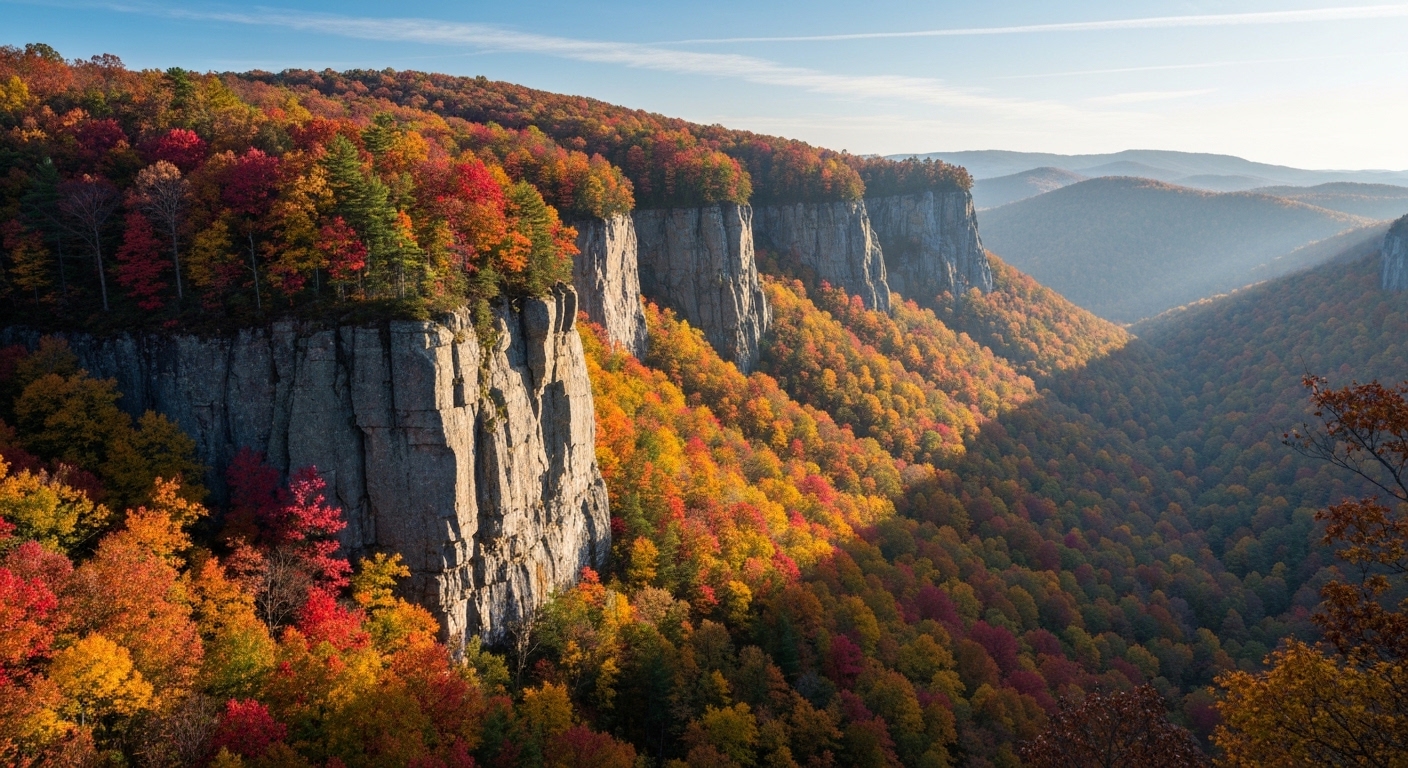
None of this happens without Whiteside Mountain, and Whiteside is a landmark in its own right. It rises to nearly 4,930 feet, and its sheer rock cliffs are among the highest in the eastern United States, with faces dropping more than 700 feet in places. A roughly two-mile loop trail runs along the summit for hikers who want to stand on top of the thing that makes the shadow.
The mountain's pale, light-reflecting rock is where it gets its name. Geologically, Whiteside is a pluton, a body of igneous rock that formed when magma cooled slowly beneath the surface long ago. Over immense stretches of time that granite was metamorphosed into granitic gneiss, then gradually exposed as the softer rock and soil around it eroded away. What is left is the bright, bare cliff face you see today.
That geology is not just trivia. The height and shape of Whiteside are precisely what allow it to throw a shadow big enough and defined enough to look like an animal from miles off. A smaller or rounder mountain would not do it. You need those cliffs and that ridgeline sitting in exactly the right spot relative to the autumn sun.
Local lore adds another layer to the fun. According to the Highlands Historical Society, the bear is only one of several shapes that appear across the season. Historian Ran Shaffner is often cited for the idea that as many as five different animal silhouettes show up over the weeks, including a duck-shaped shadow said to arrive around mid-December. Whether you buy the full menagerie or not, it gives regulars a reason to keep coming back through the colder months.
Bears, Cherokee Heritage, and a Word on the Story
Bears run deep in the identity of this plateau, and not by accident. The Highlands-Cashiers area has a well-known black bear population, and bear imagery shows up everywhere from shop signs to trail names. So a mountain that literally casts a bear across the valley fits the place perfectly.
Be careful about the history, though, because the story gets embellished online. The shadow itself is a natural phenomenon. It is not a documented Cherokee legend, and there is no recorded moment when someone "discovered" it or gave it its name. What later writers have done is pair the sight with Cherokee bear folklore because the two resonate so well together, and that pairing is meaningful as long as we are honest about what it is.
The folklore it draws on is real and rich. The 19th-century ethnologist James Mooney recorded Cherokee myths including "Origin of the Bear: The Bear Songs." In those accounts, bears are descended from the Ani'-Tsa'guhi clan. A boy gradually transforms into a bear, his people follow him into the woods, and they become the yanu, the bears, promising to give their own flesh so the Cherokee would never go hungry.
The Cherokee word for bear is yona, and the animal stands for strength and courage, a guardian of the forest. Cherokee presence on this plateau long predates European settlement, near the convergence of North Carolina, South Carolina, and Georgia along the Chattooga River. Knowing that heritage sits underneath the landscape makes the evening light feel a little heavier, in the best way.
Making a Weekend of It
The shadow lasts half an hour, so the smart play is to build a longer visit around it. Cashiers is an unincorporated community in Jackson County, which means no town hall and no municipal tax, but a surprising density of good food, inns, and mountain shops for its size.
The plateau gives you plenty to fill the daylight hours before six o'clock. Silver Run Falls is an easy roadside waterfall stop. Lake Glenville offers boating and swimming. The Village Green in Cashiers is a lovely place to stretch your legs, and the Whiteside Mountain trailhead in Nantahala National Forest lets you hike the very ridge you will watch cast its shadow that evening. Highlands, about five miles west, adds another cluster of restaurants and galleries.
The whole experience is free. There is no admission, no gate, and no facilities, which is part of its charm and part of why the roadside safety matters so much. This is a raw, unmanaged natural spectacle, the kind of thing that would be behind a ticket booth almost anywhere else.
Time your trip for the third week of October and you get a double feature, peak fall color across the plateau and the bear at his best, which is exactly why those weekends are the busiest. If you want the quiet version, come in late February and let the secret season work its magic.
Watching a mountain turn into a bear tends to leave people daydreaming about what it would be like to call these ridges home, and if that daydream ever gets serious, I am always happy to talk about what living on the plateau actually looks like.
Frequently Asked Questions
Where is the best place to see the Shadow of the Bear near Cashiers?
The Shadow of the Bear is viewed from Rhodes Big View Overlook on scenic US Highway 64 West, between Cashiers and Highlands in Jackson County. It sits a few miles west of Cashiers and about five miles east of Highlands. The overlook is unmarked and has no dedicated parking lot, so you pull off along the highway shoulder. That makes caution important, especially on busy October evenings when photographers and leaf-lookers crowd the roadside. Arrive early, park well off the travel lanes, and keep children close. From Asheville, plan on roughly 68 miles and about two and a half hours by way of I-26 and US 64.
What time and date is best to see the Shadow of the Bear?
The prime fall season runs mid-October through early November, with peak viewing usually around October 21 and 22. On those evenings the shadow appears roughly between 5:45 and 6:15 p.m., and the bear looks its best near 6:00 p.m. Across the broader fall window it generally shows up between 5:30 and 6:15 p.m., though timing shifts later after daylight saving time ends, closer to 6:30 p.m. for some viewers. The one non-negotiable requirement is sunshine. A clear, bright afternoon produces the shadow, while cloudy or overcast skies produce nothing at all.
What actually causes the Shadow of the Bear?
The Shadow of the Bear is a natural optical effect, not a trick or an installation. As the sun drops low in the western sky, it throws the silhouette of Whiteside Mountain out across Cashiers Valley. The shadow begins as a small dark shape near the valley floor, then stretches and grows as the sun sinks, taking on the outline of a black bear appearing to rise from the ground. Local lore assigns features to the form, with Devil's Courthouse as one ear and Devil's Pulpit as the other. The whole show lasts only about 30 minutes before the light fades and the bear dissolves.
Is there a less crowded time to see the Shadow of the Bear?
Yes. Most visitors only know the fall season, but the same phenomenon returns during a quieter "secret season" from mid-February through early March. The valley is colder and the trees are bare, but the shadow forms exactly the same way when the afternoon is sunny. Crowds are far thinner, parking along the overlook is easier, and you can often have the view nearly to yourself. Weekdays offer the most solitude. It pairs well with a slower off-season visit to the plateau, when the inns and restaurants of Cashiers and Highlands are calmer and easier to book on short notice.
About the Author
Jon Tharp is a licensed NC real estate broker with Keller Williams. He's helped buyers and sellers across Western North Carolina for over 10 years, specializing in mountain homes, land, and short-term rental investments, with offices throughout WNC covering all mountainous areas. If something in this post has you thinking about a move, he's easy to reach — (828) 347-9055 or smokymountainhomes4sale.com or Jon@jontharphomes.com.
Ready to Find Your Mountain Home Near Cashiers?
Whether you're looking to buy, considering a short-term rental investment, or ready to sell, the Jon Tharp Team brings deep local knowledge and marketing that puts your home in front of 50,000+ buyers in the first 30 days.
Search available homes across Western NC or call Jon directly at (828) 347-9055.
Talk to JonWhat Our Clients Say
43 five-star Google reviews — read them all on Google
"Jon is hands down the most dedicated and knowledgeable realtor that I have ever worked with. His expertise made the entire process of selling my home and finding a new one a smooth process."
Amy Davis · 2025
"Jon & his team are the greatest! Very professional, friendly like your neighbor, and always get back to your texts, phone calls & emails within minutes or same day, not days or weeks."
Cynthia Oelschlager · 2025
"I can’t say enough good things about Jon and his team. I was looking for investment properties and Jon spent time researching where would be a good place for an Airbnb — he found 2 beautiful properties."
Diane Cogswell · 2025
More from the Blog