By Jon Tharp, Broker · July 30, 2026
At a Glance
The Haywood Tourism Development Authority awarded a tourism promotion grant to The Shelton House, Museum of North Carolina Craft and History, to create a Haywood County Craft & History Trail. The trail will connect museums, galleries, artist studios, theaters, historic sites, public art and festivals across the county into one visitor route. Plans begin with a printed listing and brochure, then a website, then signage for participating sites. Organizers want longer overnight stays and more local awareness.
Haywood County has more hiking miles than most people could cover in a lifetime, and now it is getting a trail with no elevation gain, no trailhead and no need for boots. The Haywood Tourism Development Authority has awarded a tourism promotion grant to The Shelton House, Museum of North Carolina Craft and History, to develop a Haywood County Craft & History Trail. The idea is to take the county's scattered museums, galleries, studios, theaters and historic sites and string them together into one route a visitor can actually follow.
It sounds simple. It is not, and that is exactly why it has not happened before.
A Trail You Drive, Not Hike
The word trail carries a specific meaning in these mountains. Say it in Waynesville and people think Shining Rock, the Blue Ridge Parkway overlooks, the Mountains-to-Sea route threading through the high country. That association is the whole point of borrowing the word.
What the Craft & History Trail proposes is a cultural route rather than a footpath. Jerry Jackson, board chair of The Shelton House, described it as connecting the county's museums, galleries, historic sites, artist studios, theaters, public art, festivals, cultural organizations and heritage destinations into a unified visitor experience. That is a long list, and the length is deliberate.
The reasoning behind it is practical. A family that drives up from Charlotte for a weekend will find the Shelton House on Pigeon Street if they go looking. They will probably not also find the potter working out of a studio ten minutes away, the theater production running that same weekend, or the historic home in Clyde that predates almost everything around it. Each of those places is doing its own marketing with its own small budget, competing for the same attention.
Jackson's argument is that the individual pieces are strong and the presentation is fragmented. Put them on one map, and the visitor who came for a single afternoon at a museum suddenly has a two-day itinerary. That shift, from an afternoon to a weekend, is the economic argument behind the project.
By encouraging visitors to explore multiple sites throughout the county, Jackson said, the initiative aims to increase overnight stays, strengthen the local economy and highlight the remarkable cultural assets found across Haywood County.
What the Grant Actually Buys
Tourism grants often disappear into consultants and glossy campaigns that nobody remembers a year later. This one comes with a sequence attached, and the sequence starts with something almost old-fashioned.
Phase one is a comprehensive listing and a printed brochure. Before anyone builds a website or orders signs, someone has to sit down and inventory what Haywood County actually has. That means calling every gallery, every studio, every historic site, every arts nonprofit, and confirming hours, contacts and whether they want to participate at all. It is unglamorous work and it is the part that determines whether the rest holds up.
A website follows. That is where the trail becomes usable in real time, with maps, current hours and event listings that a visitor can pull up from a phone in a parking lot on Main Street.
Signage comes last. Physical markers for participating businesses turn the trail from a document into something visible on the ground, and they are also the step that requires the most coordination. Signs mean sign ordinances, property owners, downtown districts and in some cases local government approval. Doing that step last is the right call.
The order matters because each stage validates the next. If the listing phase reveals that forty organizations want in, the website scales accordingly. If it reveals that fifteen are ready and twenty-five are maybes, the project adjusts rather than committing to infrastructure that outruns its participants.
Jackson plans to partner with Tonya Harwood, executive director of the Haywood County Arts Council, on the artisan side. Harwood works closely with local craftspeople, which means she has the relationships that a cold-call inventory would never reach. That partnership is probably worth more than the grant dollars.
The Craft Culture People Drive Past
There is a version of Haywood County that exists in the minds of most first-time visitors. Mountains, a scenic drive, lunch in a walkable downtown, maybe elk in Cataloochee if the timing works. That version is accurate and incomplete.
"A lot of people come to Haywood County for the mountains, but they don't realize how deep our craft culture runs," Harwood said. "This trail helps them see that art and craftsmanship are really woven into who we are as a community. It gives visitors a fuller picture of Haywood County and why creativity mattered here for generations."
She is describing something anyone who has lived here a while understands without needing it explained. Craft in these mountains was not a hobby that arrived with the tourists. It was how households furnished themselves, clothed themselves and traded before there was much cash economy to speak of. Woodworking, weaving, pottery, quilting and blacksmithing were survival skills that turned into art because the people doing them had generations to get good at it.
Haywood Community College in Clyde has carried that forward in a formal way for decades through its professional crafts training, turning out working artisans in clay, fiber, wood and jewelry. Graduates of that program stayed in the region and opened studios. Some of them are teaching now. That kind of continuity is rarer than it sounds, and it is the reason Haywood can credibly claim craft as an identity rather than a marketing angle.
The Shelton House itself is the anchor for this argument. A 19th century home in Waynesville that houses the Museum of North Carolina Craft and History is not a generic county museum. It is a statewide craft collection sitting in a mountain town, which is precisely the kind of asset people undervalue when nothing puts a wider frame around it.
Trails Already Exist. That Is Part of the Problem.
Haywood is not starting from zero, and that is the harder situation.
The Quilt Block Trail already sends people down back roads looking for painted squares mounted on barns and outbuildings. The downtown Waynesville Public Art Trail already puts sculpture and installations within a walkable loop of Main Street. Haywood Community College maintains an outdoor Art Trail on its Clyde campus. Each one works. People who cared about a specific thing built each one.
What none of them do is hand off to each other. A visitor who finishes the Public Art Trail has no obvious reason to learn that a quilt block route exists twenty minutes north, or that a museum with a statewide craft collection sits a few blocks off the square they just walked.
Jackson wants the larger picture. He talked about organizing a broad network of community partners, including museums, galleries, nonprofits, downtown districts, artist studios, historic sites, educational institutions, festivals, public art installations, restaurants, lodging providers and local businesses, and putting forward that combination of craft and history so people can look at the whole thing at once.
"I'm trying to bring all of it together to have as many quality components as we can emphasizing the whole county," he said.
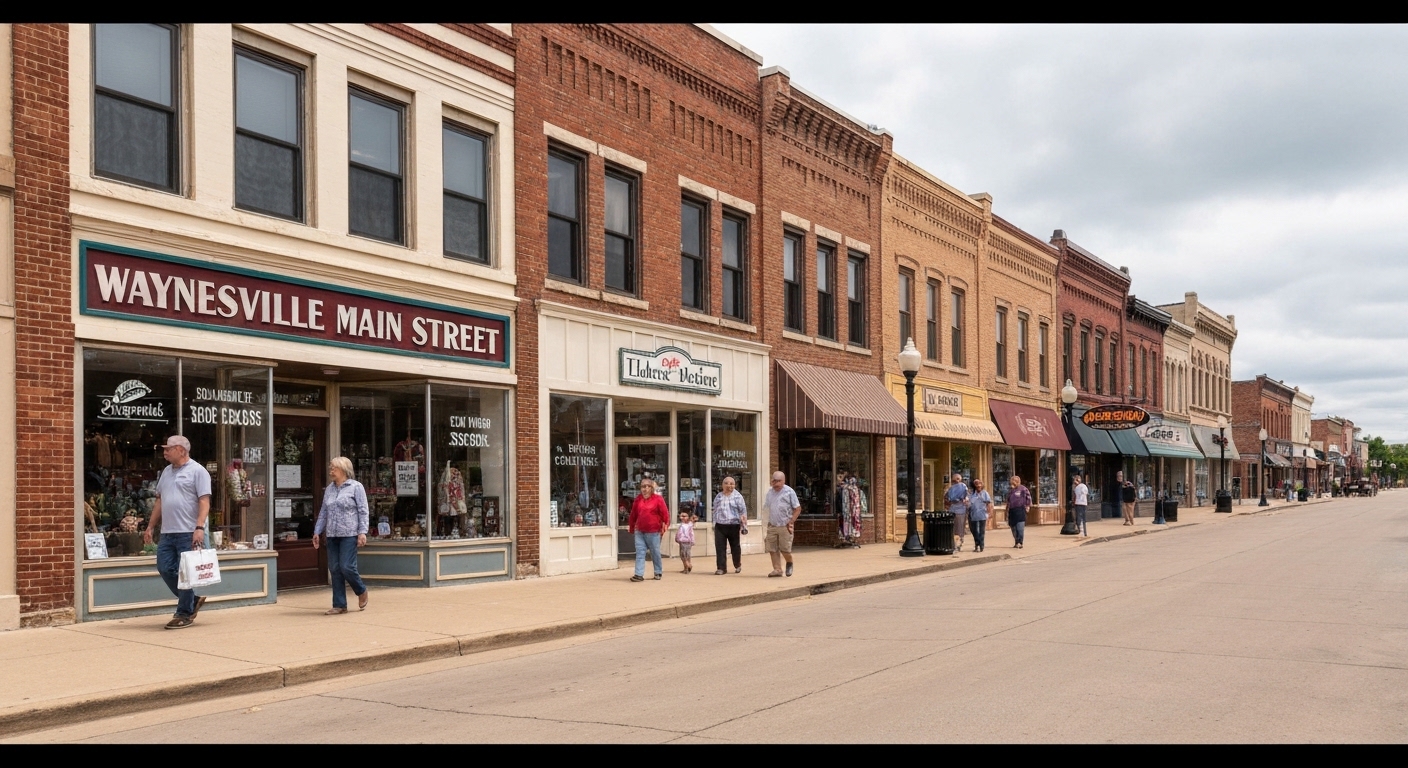
The phrase doing the work there is "the whole county." Waynesville has the density and will anchor any route drawn on a map. But Canton has mill-town history and a downtown that has worked hard for its comeback. Clyde has the community college and the Shook House. Maggie Valley has its own museum draw and a mountain music lineage. A trail that stops at the Waynesville town limits would be easier to build and would miss the point entirely.
The Overnight Stay Is the Whole Game
Tourism math in a mountain county comes down to one distinction. A day-tripper buys lunch and maybe a gift. An overnight visitor buys lunch, dinner, breakfast, a room and usually more than one gift, and then does it again the next day.
That gap is where occupancy tax revenue lives, which is why a Tourism Development Authority is funding this at all. TDA money comes from lodging taxes. Spending it on something meant to extend stays is the cleanest possible use of those dollars, and the return shows up in the same fund that paid for it.
Whether it works depends on execution details that nobody has settled yet. A brochure listing forty places is a phone book. A brochure that suggests three coherent routes with realistic timing is an itinerary, and itineraries are what turn a Saturday into a weekend.
There is also a shoulder-season argument that nobody in the story made but that anyone running a business in Haywood understands. October fills itself. Nothing in Waynesville needs help finding customers when the leaves turn. February, March and the wet stretches of summer are a different story. Indoor cultural destinations are exactly what a county needs when the weather takes the mountains off the table, and a trail that gives people a reason to come when the overlooks are socked in is doing more for the local economy than one more peak-season campaign.
Jackson's list of partners names restaurants and lodging providers, which suggests the organizers understand this. Craft and history do not generate revenue in isolation. They generate reasons to be in town at dinnertime.
The Part That Is Aimed at Us
The most quietly interesting line in this whole project is the one about locals.
"It's not just for visitors," Jackson said. "Even locally, there are many people in the county who have never been to Shelton House or Shook House and who may not realize the local economic impact of craft."
Anyone who has lived in a place with a museum knows this instinct. The thing that is always there is the thing you never get around to. You will drive to Asheville for an exhibit and never walk into the museum eight minutes from your kitchen, because it will still be there next month and it has been still-there for years.
A trail changes that framing in a small but real way. Framing something as a route invites completion. People who would never plan a trip to a single historic home will work through a list of nine sites over a year because a list creates its own momentum.
There is a second layer to what Jackson said, and it is about economic literacy. Craft in Haywood is not decorative. It is studio rent, supply orders, festival booth fees, class tuition, gallery commissions and a meaningful number of households making some or all of their income from it. Residents who see it as a pleasant local color miss that it is an actual sector, and sectors need customers who live here year-round, not just in October.
That local buy-in matters for a practical reason too. Residents are the ones who tell visiting family where to go. A county full of people who have been to the Shelton House is a county with a few thousand informal tour guides. That is a distribution network no brochure budget can buy.
What This Says About Haywood Right Now
Step back from the grant and the phases and what remains is a county making a statement about what it is.
Plenty of mountain towns across the Southeast have decided that scenery is the product. Scenery is a fine product and it is also the one thing every mountain county has. It does not differentiate anybody, and it does not build much that stays after the season ends.
What Haywood is proposing is harder and more durable. It says the region's value includes the people who have made things here for generations, the buildings they made them in, and the institutions that kept the skills alive when nobody was watching. That is a story a competitor county cannot simply copy, because it took a hundred years to accumulate.
It also happens to describe why a lot of people end up staying. Visitors who come back a third and fourth time are rarely coming back for a view they have already photographed. They come back because a place felt like it had substance underneath the postcard, because they met a woodworker or sat in a small theater or walked through a house that had been standing since before the county had paved roads.
The trail is still in its early stages. Someone has to build the listing, the partners have to sign on, the website and the signs are further out. Projects like this succeed or fail on whether the coordination holds after the initial enthusiasm fades, and that is a fair thing to watch for.
But the direction is right, and it is the kind of slow, unshowy investment that tends to hold its value. Anyone who has spent time comparing mountain towns knows the ones with real cultural depth feel different to live in, and if that is the kind of place you have been picturing for yourself, I am always happy to talk through what the different corners of Haywood and the surrounding counties are actually like.
Frequently Asked Questions
What is the Haywood County Craft & History Trail?
It is a planned countywide route connecting Haywood County's museums, galleries, historic sites, artist studios, theaters, public art, festivals, cultural organizations and heritage destinations into one unified visitor experience. The project is led by The Shelton House, Museum of North Carolina Craft and History in Waynesville, and funded through a tourism promotion grant from the Haywood Tourism Development Authority. Rather than a hiking path, it is a marketing and wayfinding effort designed to help visitors and residents find cultural sites they might otherwise drive past. The stated goals are increasing overnight stays, strengthening the local economy and raising the profile of Haywood's craft heritage.
When will the Haywood Craft & History Trail open?
No launch date has been announced. The project is rolling out in stages rather than opening all at once. The first phase is a comprehensive listing of participating sites and a printed brochure, which is the piece most likely to appear first since it requires the least infrastructure. A website follows, giving the trail a searchable home with maps, hours and event listings. Signage for participating businesses comes last, because that step requires coordination with property owners, downtown districts and in some cases local governments. Anyone wanting current progress should contact The Shelton House in Waynesville or the Haywood County Arts Council directly.
Who is behind the Haywood Craft & History Trail?
Jerry Jackson, board chair of The Shelton House, is spearheading the project. He plans to partner with Tonya Harwood, executive director of the Haywood County Arts Council, who works directly with local artisans and knows the studio and gallery landscape across the county. Funding comes from the Haywood Tourism Development Authority through a tourism promotion grant. Beyond those three entities, the trail is designed as a broad partnership involving museums, galleries, nonprofits, downtown districts, artist studios, historic sites, educational institutions, festivals, public art installations, restaurants, lodging providers and local businesses. Jackson has described the effort as a community engagement project as much as a tourism one.
What craft and history trails already exist in Haywood County?
Haywood already has several themed routes operating independently. The Quilt Block Trail features painted quilt squares mounted on barns and buildings around the county, a tradition that spread across Southern Appalachia and became a rural driving route. The downtown Waynesville Public Art Trail highlights sculpture and installations within walking distance of Main Street. Haywood Community College in Clyde maintains an outdoor Art Trail on its campus. The new Craft & History Trail is not meant to replace these. Jackson's intent is to tie them together with museums, studios, theaters and historic homes so visitors see the county's full cultural picture instead of encountering pieces of it.
Which Haywood County towns will the trail cover?
The initiative is explicitly countywide, which means Waynesville, Canton, Clyde, Maggie Valley and the Lake Junaluska area all fall within its scope. Waynesville holds the densest concentration of galleries, studios and the Shelton House itself, so it will likely anchor the route. Canton brings mill-town history and a restored downtown theater. Clyde is home to Haywood Community College and the Shook House, one of the oldest standing structures in the county. Maggie Valley contributes its own museum and mountain-music heritage. Jackson has said the goal is emphasizing the whole county rather than concentrating attention on a single downtown.
About the Author
Jon Tharp is a licensed NC real estate broker with Keller Williams. He's helped buyers and sellers across Western North Carolina for over 10 years, specializing in mountain homes, land, and short-term rental investments, with offices throughout WNC covering all mountainous areas. If something in this post has you thinking about a move, he's easy to reach — (828) 347-9055 or smokymountainhomes4sale.com or Jon@jontharphomes.com.
Ready to Make Western NC Your Home Base?
Whether you're looking to buy, considering a short-term rental investment, or ready to sell, the Jon Tharp Team brings deep local knowledge and marketing that puts your home in front of 50,000+ buyers in the first 30 days.
Search available homes across Western NC or call Jon directly at (828) 347-9055.
Talk to JonWhat Our Clients Say
43 five-star Google reviews — read them all on Google
"Jon is hands down the most dedicated and knowledgeable realtor that I have ever worked with. His expertise made the entire process of selling my home and finding a new one a smooth process."
Amy Davis · 2025
"Jon & his team are the greatest! Very professional, friendly like your neighbor, and always get back to your texts, phone calls & emails within minutes or same day, not days or weeks."
Cynthia Oelschlager · 2025
"I can’t say enough good things about Jon and his team. I was looking for investment properties and Jon spent time researching where would be a good place for an Airbnb — he found 2 beautiful properties."
Diane Cogswell · 2025
More from the Blog