By Jon Tharp, Broker · May 24, 2026
At a Glance
Western North Carolina is home to one of the most extraordinary natural light shows on the planet. Great Smoky Mountains National Park alone hosts 19 species of fireflies, including the synchronous firefly (Photinus carolinus) — an insect so unusual that scientists once believed it could only exist in Southeast Asia. Three major managed firefly events run in WNC and the surrounding mountains each summer, all with limited capacity and lottery or advance ticket systems: the GSMNP Elkmont synchronous firefly event, the Grandfather Mountain "Grandfather Glows" event, and the Cradle of Forestry Blue Ghost Firefly Tours near Brevard. If you are planning a trip to WNC in late May or June, understanding which event to pursue — and how to get in — is the starting point.
Firefly Events in Western North Carolina: The Complete Guide (2026)
By Jon Tharp, Broker · May 24, 2026
Every spring, something happens in the forests of Western North Carolina that draws people from across the country and, increasingly, from abroad. It happens for roughly two weeks, after dark, in the understory of old cove hardwood forests between 2,500 and 4,500 feet of elevation. And until 1990, most of the scientific world did not believe it was possible.
Firefly events in Western North Carolina have become some of the most sought-after outdoor experiences in the Southeast — rationed by lottery, limited by biology, and governed by the same natural variables that have governed them for millions of years. This guide covers everything: the history of how the synchronous firefly was discovered in WNC, the science of how and why they flash in unison, the biology of the different species you might encounter, the three major managed viewing events in the region, and the practical information you need to plan a trip.
I have lived in Western North Carolina for more than 20 years. I have been on the trails at Deep Creek when the fireflies come up, and I have talked to clients who drove eight hours just for a chance at a two-hour window in the dark. This is a genuine natural phenomenon and it is in our backyard.
The Woman Who Changed What Science Thought It Knew
The story of how Western North Carolina's synchronous fireflies became known to the world begins not with a scientist but with a woman who grew up watching fireflies from her family's cabin porch.
Lynn Frierson Faust spent her summers as a child at a remote family cabin in the Great Smoky Mountains — in the Elkmont area, a community of summer cabins that would eventually become part of the national park. Every June, she watched the fireflies in the hollow below the cabin do something that she had always assumed was normal: they flashed together. All of them. At the same time. The forest would pulse with light and then go completely dark, and then pulse again.
She grew up and the world moved on. But in 1989, she read a news article claiming that synchronous fireflies — fireflies that coordinate their flashes — were known to exist only in Southeast Asia. The article was emphatic on this point. There were no synchronous fireflies in North America.
Faust recognized immediately that what she had been watching her entire childhood was exactly the phenomenon the article claimed could not exist in the Western Hemisphere. She wrote to Jonathan Copeland, a biology professor at Georgia Southern University who studied fireflies, and told him what she had seen. He came to Elkmont. He observed what she had described. He published his findings in 1995.
The synchronous fireflies of Elkmont in Great Smoky Mountains National Park became the first documented case of synchronous firefly behavior in the entire Western Hemisphere.
A behavior that locals had been watching from their cabin porches for generations, that was simply part of the seasonal rhythm of Appalachian summer, turned out to be one of the rarest natural phenomena on the planet.
That is the origin story of the firefly event that draws tens of thousands of lottery applicants each spring.
What Makes the Smokies a Firefly Capital
Great Smoky Mountains National Park hosts 19 documented species of fireflies — and scientists believe there may be more. No other location in North America has a comparable density and diversity of firefly species in a single protected area.
Why here?
The answer is habitat. The southern Appalachians are one of the most biodiverse temperate regions on Earth, a consequence of their age, their lack of glaciation during the last ice age, and the vertical compression of multiple ecological zones across a relatively small geographic footprint. A hike from the valley floor at Bryson City to the summit ridgeline of the Great Smokies covers the ecological equivalent of a drive from Georgia to Canada.
Fireflies are specialists. Each species has evolved to exploit a specific combination of elevation, forest type, moisture level, prey availability, and timing. The Smokies offer all of those combinations, layered within the same protected landscape. A species that needs the leaf litter of a moist cove hardwood forest at 3,000 feet finds it. A species that needs the drier ridge environments at 5,000 feet finds that. A species that needs the streamside meadow at the valley floor has that too.
The national park's strict protection means those habitats have remained intact. No development. No agricultural pesticide applications. No significant light pollution inside the park boundaries at night. For an insect that uses light signals to find mates, a dark sky is not a luxury — it is a survival requirement.
The result is a firefly refuge of a kind that simply does not exist anywhere else in North America.
Photinus carolinus: The Synchronous Firefly
*Photinus carolinus* is the species at the center of the Smoky Mountains firefly phenomenon. It is a medium-sized beetle — 11 to 15 millimeters long, with dark wing covers edged in pale yellow and a distinctive rectangular dark mark on its pale yellow head shield. If you were handed one in daylight, it would look unremarkable, like a typical firefly.
At night, it is something else entirely.
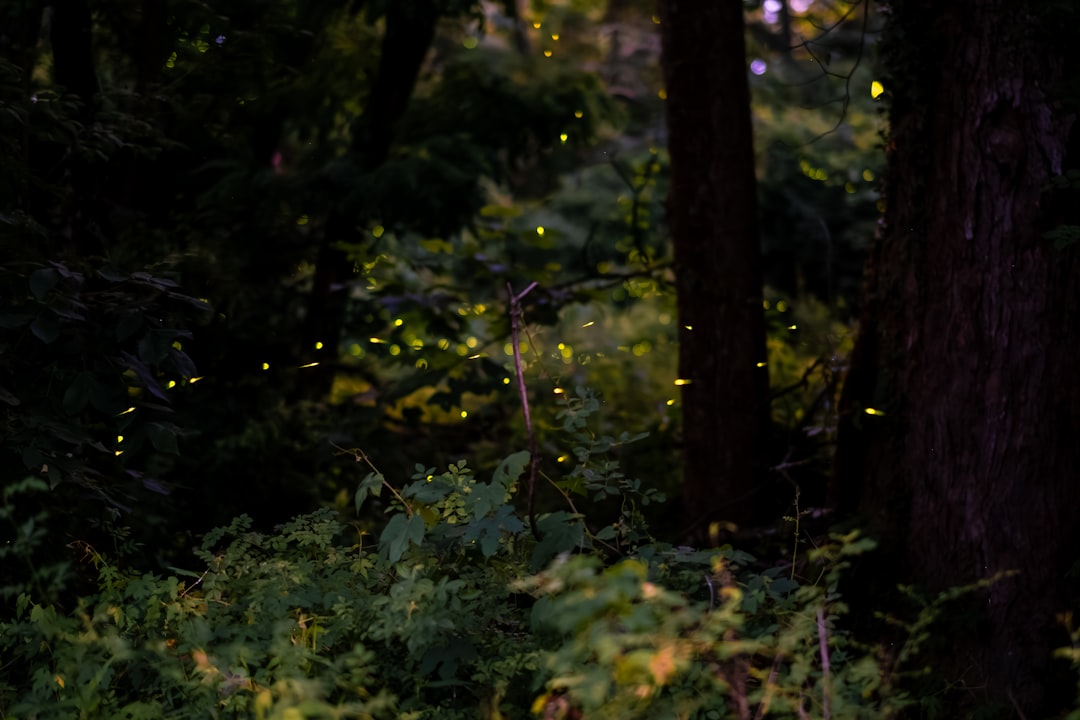
The male *P. carolinus* produces a flash pattern unique to its species: typically five to eight pulses of yellow-green light in rapid sequence, followed by a dark pause of six to eight seconds, followed by the same sequence again. The female, perched in the vegetation below, waits for that specific pattern and responds with her own two-pulse reply, timed precisely to fall in the dark interval after the male's sequence ends.
What makes *P. carolinus* extraordinary is not the pattern itself but what thousands of males do with it simultaneously.
In a forest full of displaying males, they begin to synchronize. The effect builds over the first hour of darkness, starting with scattered flashes, moving through loosely correlated pulses, and arriving at a state where the entire forest lights up in a single coordinated burst and then goes completely dark. The synchrony is not perfect — there is variation at the edges and between groups — but within a given area of forest, the coordination is startling. A hillside will pulse. The hollow will answer. The ridge above will respond. And then everything goes dark together before the next sequence begins.
This is not random. It is not a perceptual trick. The synchrony is real, it is biological, and understanding why it happens required a mathematical model.
The Science of Synchrony: Why They Flash Together
The question of why *P. carolinus* males synchronize their flashes puzzled scientists for years after the behavior was documented. The leading hypothesis draws on work by mathematicians Renato Mirollo and Steven Strogatz, who in 1990 developed a mathematical model of what they called pulse-coupled oscillators.
The model begins with a simple observation: when you have a large group of biological oscillators — things that produce a signal on a regular rhythm, like a heartbeat or a firefly flash — and those oscillators can influence each other each time they fire, the mathematics predict that the group will spontaneously converge on synchrony under almost all starting conditions.
The firefly version works like this: each male has an internal flash rhythm. When a male sees another male flash near him, it adjusts its own rhythm slightly — nudging itself toward synchrony with that signal. Each firefly is making thousands of these tiny adjustments per minute, responding to the males nearest it, which are also responding to the males nearest them.
The result is a wave of synchrony that emerges not from any single leader or central coordination but from the accumulated effect of millions of pairwise interactions. The forest organizes itself.
This mechanism — synchrony as an emergent property of local interactions, without central control — turns out to be one of the fundamental organizing principles in biology. It is the same mechanism behind the synchronized beating of cardiac pacemaker cells in the human heart, the coordinated firing patterns of neurons, and the oscillation of biological clocks. The fireflies in the hollow at Elkmont are, in a sense, demonstrating the same mathematical principle that keeps your heart beating in rhythm.
The reason the synchronization benefits the males is thought to be this: by flashing together, all the males in a group create a unified dark period. During that dark window, any female response — a two-pulse flash from the vegetation below — is clearly visible against the darkness. Without synchrony, with males flashing independently on slightly different rhythms, a female's response would be lost in the ambient noise of constant background flashing. Synchrony creates silence, and silence makes the female's signal legible.
The males are not putting on a light show for observers. They are solving a signal-to-noise problem. The fact that the solution is one of the most visually spectacular events in the natural world is a byproduct.
The Blue Ghost: A Different Kind of Fire
While the synchronous firefly draws the biggest crowds and the most lottery applications, it is not the only extraordinary firefly species in WNC. The blue ghost firefly, *Phausis reticulata*, offers a completely different kind of show — quieter, stranger, and in some ways more unsettling.
The blue ghost is named for the color and quality of its light. Where *P. carolinus* produces a warm yellow-green flash, *P. reticulata* males produce a sustained, slow-moving blue-white glow with no flashing at all. The males drift through the forest at low elevation — rarely more than two feet off the ground — trailing their continuous light through the leaf litter and undergrowth. They move slowly, purposefully, following chemical signals from the wingless females below.
The females are flightless. They glow from the ground, a steady blue-white light visible through the leaf litter. The male descends toward her glow. She rises to meet him if the signals are right.
The effect of hundreds of blue ghost males moving silently through a darkened forest is genuinely otherworldly in a way that is hard to describe and harder to photograph. There is no pulse. No synchrony. No moment of collective illumination. Just slow-moving blue-white lights drifting through the darkness like the lights of something that has been there for a very long time and does not notice you watching.
*P. reticulata* occupies different habitat and peaks at a slightly different time than the synchronous fireflies. Blue ghosts appear from roughly late April through June at mid-elevations across the southern Appalachians, generally on moister south-facing slopes with deep leaf litter. Their range is centered on WNC, western SC, and adjacent portions of Tennessee and Georgia.
DuPont State Recreational Forest near Brevard, the Cradle of Forestry in Pisgah National Forest, and Grandfather Mountain are the three best-managed locations for blue ghost viewing in WNC. Each has a different access model, described below.
Glowworms: The Third Light in the Forest
There is a third bioluminescent organism in WNC's mountain forests that most visitors do not know to look for: the glowworm, *Orfelia fultoni*. It is not a firefly at all — it is the larva of a fungus gnat, distantly related to the famous glowworms of New Zealand's Waitomo Caves.
The WNC glowworm produces a steady, cold blue-green glow and lives in moist rock faces, stream banks, and shaded overhangs — typically near waterfalls or seeps. Unlike fireflies, glowworms do not move their light through the forest. They glow from fixed points, the tiny pinpricks of light visible in the darkness of a rocky overhang or wet cliff face.
The experience of finding a glowworm colony in the dark — a constellation of fixed blue lights on a rock face above a mountain stream — is one of the quieter natural discoveries in WNC. Most people walking past it in daylight would never guess what that rock face becomes after dark.
Grandfather Mountain has documented glowworm presence alongside its firefly species and includes them in the Grandfather Glows educational programming. They are also observable in parts of GSMNP and along wet rock faces in Pisgah National Forest, particularly near waterfalls.
The Biology: What a Firefly Actually Is
Before the events and the logistics, the biology is worth understanding. It changes the way you watch.
Fireflies are beetles — members of the order Coleoptera, family Lampyridae. They are not flies. The name is a misnomer carried forward from centuries of informal use. There are approximately 2,000 described species worldwide, with the highest diversity in the tropics. North America has roughly 170 species. Western North Carolina, in a protected area covering roughly 800 square miles, has 19.
The adult firefly is the stage most people recognize, but it is the shortest and most precarious part of the insect's life. The life cycle runs like this:
Egg: A female deposits her eggs in moist soil or leaf litter. The eggs of some species are themselves bioluminescent — tiny glowing dots in the dark soil.
Larva: The hatched larvae are often called glowworms. They live in the soil and leaf litter for one to two years (longer in some species), feeding primarily on soft-bodied invertebrates including snails, slugs, and earthworms. They are hunters. They inject a digestive enzyme into their prey and consume the liquefied tissue. They glow throughout the larval stage, a behavior thought to serve as a warning to predators — many lampyrid larvae produce defensive chemicals that make them unpalatable or toxic.
Pupa: The larva pupates in the soil, transforming over several weeks into the adult form.
Adult: The adult firefly lives for only two to three weeks. It does not eat — its only biological purpose in the adult stage is reproduction. The light organ in its abdomen is the primary tool for finding a mate. After mating, the female deposits her eggs and dies. The male may continue displaying and mating until he too dies.
The light itself is produced in specialized cells in the abdomen called photocytes. The chemistry is precise: the enzyme luciferase catalyzes the oxidation of a compound called luciferin in the presence of oxygen, ATP, and magnesium ions. The reaction produces light with almost no heat — it is nearly 100% efficient at converting chemical energy to light. For comparison, an incandescent bulb converts roughly 10% of its energy to light; the rest is heat. A firefly's lantern converts close to 100%.
The color of the light varies by species and encodes species identity. Yellow-green, amber, orange, blue-white — each wavelength corresponds to a specific chemical variant of luciferin. Males and females of the same species recognize each other's signals by color, timing, and pattern. An amber flash at the wrong interval does not attract a *P. carolinus* female. The code is specific.
This chemistry, particularly the luciferin-luciferase system, has become one of the most widely used tools in molecular biology and medical research. The same reaction that lights up a meadow in Swain County is used in hospitals worldwide to detect infections, measure enzyme activity, and track gene expression in living cells. The firefly's light is simultaneously one of nature's oldest courtship tools and one of biotechnology's most useful borrowed mechanisms.
The Three Events: How to Get In
Three major managed firefly viewing events operate in and around Western North Carolina each summer. Each has different species, different access rules, and different logistics.
1. Great Smoky Mountains National Park — Elkmont Synchronous Firefly Event
This is the flagship event — the most famous, the most competitive, and the most logistically complex to attend.
Species: Synchronous firefly (*Photinus carolinus*) Location: Elkmont Historic District, GSMNP, Gatlinburg, Tennessee side of the park Typical Dates: Eight nights in late May (2026: May 20-27) Capacity: 120 vehicle reservations per night (960 total) Access: Lottery only via recreation.gov
The lottery opens for four days in late April ($1 entry fee, one application per household). Applicants are notified approximately ten days before the event window opens. Winners purchase a vehicle pass ($1 per vehicle) for a specific assigned night. Each pass admits one vehicle with up to seven occupants. Vehicles park at a designated lot and proceed on foot to the viewing area.
No white lights are permitted in the viewing area. Red lights only. Phones and cameras must have screens dimmed or covered. The rationale is not aesthetic — artificial white light disrupts the fireflies' ability to signal and can interfere with the mating display, which is a real biological risk during the brief annual window.
The event has grown dramatically since GSMNP formalized the lottery system in 2016. Before the lottery, traffic jams on the access roads stretched for miles and the experience was often chaotic. The lottery system was implemented to protect both the fireflies and the experience.
Important note for WNC visitors: Elkmont is on the Tennessee side of the park near Gatlinburg, approximately 45 minutes from Bryson City via US-441 through Cherokee. It is the primary managed synchronous firefly event but is not located in Swain County or the North Carolina portion of the park.
Alternatives if you do not win the lottery: Guided firefly tours operate during the same window from multiple outfitters. Asheville Hiking Tours runs nightly synchronous firefly experiences from May 28 through June 6. Blue Ridge Hiking Company offers synchronous firefly backpacking trips (overnight, May 26-27 and June 10-11) that access the park from the North Carolina side. These guided experiences require no lottery and can offer more intimate conditions than the managed Elkmont event.
2. Grandfather Mountain — Grandfather Glows
The Grandfather Glows event is the premier firefly experience on the North Carolina side of the mountains, and it is the only managed event in the state that features synchronous fireflies, blue ghost fireflies, and glowworms in the same viewing area.
Species: Synchronous firefly (*Photinus carolinus*), blue ghost firefly (*Phausis reticulata*), glowworm (*Orfelia fultoni*) Location: Grandfather Mountain State Park, Linville, NC (Avery/Caldwell/Watauga counties) Typical Dates: Three nights during mid-June to mid-July (exact dates announced after monitoring confirms peak) Capacity: Limited (strict maximum per event) Access: Lottery at grandfatherglows.com, then ticket purchase
The lottery runs for approximately one week in late May ($5 to enter, one entry per email address). Winners receive notification and a link to purchase up to six tickets. Adult tickets are $50; children ages 3-12 are $40; Bridge Club members receive discounted rates; children under 3 are free.
Each event runs from 7 to 11 PM and begins at MacRae Meadows with educational programming led by Grandfather Mountain's naturalists. The naturalist-led format sets this event apart from Elkmont — attendees learn to identify the three species present, understand the biology, and develop a context for what they are watching that makes the viewing itself more meaningful. After the educational session, the group moves to the designated viewing area before full dark.
Grandfather Mountain's firefly population benefits from the mountain's position in the Blue Ridge — a northward extension of the Appalachian chain that reaches elevations above 5,900 feet, providing the northern hardwood forest habitat that *P. carolinus* uses as its primary range.
Getting there: Linville, NC is approximately 90 minutes northeast of Bryson City, accessed via US-19 east through Maggie Valley and US-221 north. From Asheville, it is roughly an hour north on US-221. This is a destination that warrants an overnight stay in the High Country rather than a same-day drive from the Bryson City corridor.
3. Cradle of Forestry Blue Ghost Firefly Tours — Pisgah National Forest
The Cradle of Forestry event is the most accessible of the three — no lottery, tickets purchasable online in advance, and focused on a species that many WNC visitors have never heard of.
Species: Blue ghost firefly (*Phausis reticulata*) Location: Cradle of Forestry in America, 11250 Pisgah Hwy, Pisgah Forest, NC 28768 Typical Dates: May 9-24 and June 6-8 (2026) Capacity: 150 participants per night Access: Advance ticket purchase online only (no walk-up sales)
Tickets are $55 per adult and $27 for youth ages 4-12. Gates open at 8 PM. The program runs from 8:45 PM to 10:30 PM. Each evening begins with an educational presentation at the outdoor amphitheater, followed by a guided hike on a paved trail through the forest with special flashlights designed to minimize disruption to the fireflies.
The Cradle of Forestry is itself a historically significant site — it is where the American conservation forestry movement began, on land managed by Gifford Pinchot in the late 1800s as the first managed forest in the United States. The forest surrounding it is now part of Pisgah National Forest, and the mature second-growth woodland provides exactly the moist, leaf-litter-rich habitat that blue ghost fireflies require.
What to expect: The blue ghost experience is not the synchronized light show of Elkmont. It is slower, quieter, and in some ways more intimate. You are watching individual male fireflies drift through the forest floor at eye level and below, each producing its continuous blue-white glow, looking for wingless females glowing up through the leaf litter. Guides help attendees find females and explain what they are seeing in real time.
Getting there: Pisgah Forest is approximately 45 minutes east of Bryson City via US-74 east and US-276 north through Brevard. It is roughly 30 minutes southwest of Asheville and makes a natural combination with a stop in Brevard, one of WNC's more charming small towns.
Important note: All tickets are non-refundable and non-transferable. You cannot purchase tickets at the site. Plan accordingly.
What Self-Guided Viewing Actually Looks Like
The managed events are not the only way to see fireflies in WNC. They are the most structured and the most certain, but the mountains here are full of firefly habitat, and a significant portion of it is accessible without a reservation.
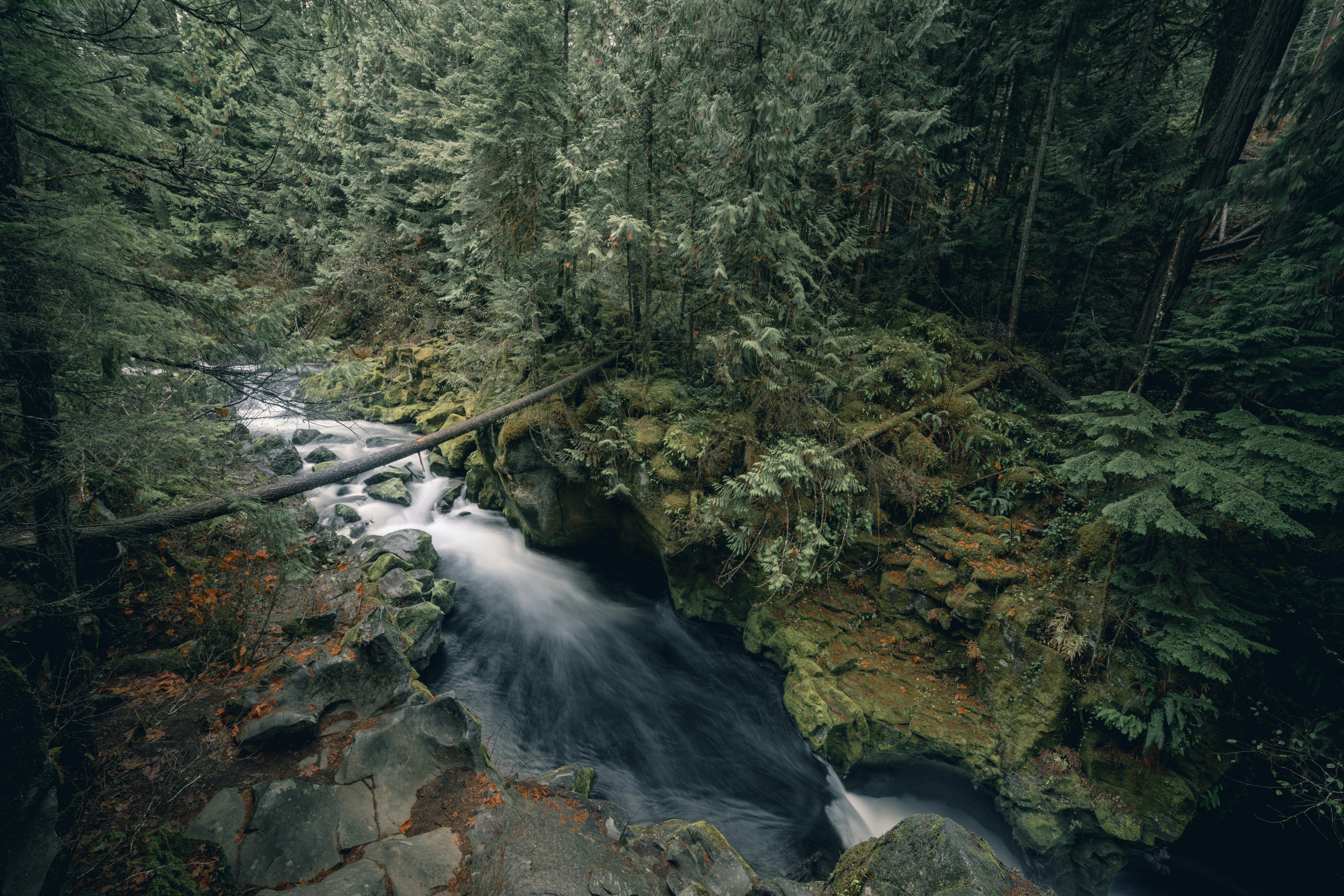
Deep Creek Road, Bryson City: The corridor north of downtown Bryson City into the national park along Deep Creek Road is one of the most accessible self-guided options in WNC. During late May and early June, synchronous fireflies are active in the wooded sections above the swimming holes. The experience is informal — you arrive, you walk the trail as it gets dark, and you watch. There is no organized event and no capacity limits. Parking at the Deep Creek trailhead fills early on peak nights. Arrive before 7 PM or expect to walk in from further down the road.
DuPont State Recreational Forest: The forest near Brevard is one of the best-known blue ghost firefly locations in WNC, accessible without any permit during the viewing season. Specific access areas get crowded, and the parking situation at peak times requires some planning, but the forest itself is extensive and there is viewing to be found away from the most trafficked spots. Stay on trail, use red lights only, and leave before the parking lots close.
Max Patch and Harmon Den Area: Higher elevation meadows and the surrounding cove hardwood forests near the Tennessee line west of Hot Springs offer synchronous firefly viewing without the Elkmont crowds. This area requires more planning to access effectively but rewards visitors who do the work with solitude.
Cataloochee Valley: The most remote major valley in GSMNP is accessible via a winding gravel road from Waynesville. The meadows and forest edge habitat in Cataloochee support significant firefly populations across multiple species. The relative difficulty of access keeps crowds manageable even at peak times.
Why the Lottery System Exists: Conservation at Scale
The lottery systems at Elkmont and Grandfather Mountain, and the strict ticket limits at Cradle of Forestry, are not bureaucratic inconveniences. They are conservation tools, and understanding why they exist changes how you think about the events.
The synchronous firefly display is a mating event. The two to three week window when *P. carolinus* adults are active and displaying is the entirety of the adult firefly's reproductive life. A female who fails to mate during that window does not get another chance. A male who exhausts himself chasing the artificial lights of a phone screen rather than genuine female responses is a male who is not contributing to the next generation.
Before GSMNP implemented the lottery system in 2016, the Elkmont viewing event attracted thousands of unmanaged visitors per night. Parking lots overflowed. People walked off trail. White lights — phone screens, flashlights, headlamps — lit the forest throughout the viewing area. The disruption to the mating display was measurable. The park service implemented the lottery to reduce attendance to a level where the fireflies could function normally.
The 120-vehicle limit at Elkmont is not arbitrary — it is an estimate of human presence that the firefly population can absorb without significant disruption to mating success. Whether that estimate is exactly right is an ongoing research question, but the principle is sound.
For visitors, this means that winning a lottery ticket is not just a recreational privilege. It carries a corresponding responsibility. The rules about white lights, staying on trail, and leaving the vegetation undisturbed exist to protect the event's biological foundation. A firefly event that damages its own firefly population is not a sustainable attraction. The lottery system is how WNC tries to have both — the experience and the ecosystem that makes it possible.
Why Firefly Populations Are Threatened Everywhere Except Here
The WNC firefly events happen against a backdrop of global firefly decline. Firefly populations worldwide are decreasing, in some cases dramatically, driven by a convergence of threats that are straightforward to describe and difficult to reverse.
Habitat loss is the primary driver. Most firefly species require moist habitats — streamside meadows, wetlands, forest edges with deep leaf litter. Residential and agricultural development fragments and eliminates those habitats. Lawn maintenance practices that remove leaf litter eliminate the larval stage's habitat and food supply. Development that drains or fills wetlands eliminates the moisture conditions that larval fireflies require.
Light pollution disrupts courtship communication directly. Male fireflies navigating by their own flash signals in a sky illuminated by shopping centers, parking lots, and suburban street lighting cannot find females responding with signals that are invisible against the ambient glow. A firefly needs darkness the way a whispered conversation needs quiet.
Pesticide use affects primarily larvae and flightless adult females, who cannot disperse away from treated areas. The broad-spectrum insecticides applied to lawns, agricultural fields, and roadsides kill firefly larvae along with their target insects. A firefly larva spends one to two years in the soil before emerging as an adult. One pesticide application can eliminate multiple year classes from a given area.
Climate change creates cascading disruptions: altered emergence timing, drought conditions in habitats that require moisture, and phenological mismatches between firefly adults and their prey.
The Great Smoky Mountains are largely protected from all four of these threats within the park boundary. No development. No agricultural pesticide use. Strict management of visitor light. Climate change is the one threat the park cannot buffer against, and researchers are beginning to observe shifts in the timing of firefly emergence in the Smokies consistent with documented warming trends in the region.
The WNC firefly events are not just entertainment. They are a window into what much of North America looked like before the landscape was reorganized around human use, and they are increasingly rare as a result.
Planning a Firefly Trip to WNC: What to Know
If you are planning to come to WNC specifically for a firefly event, here is the practical information that makes the difference between a frustrating and a successful trip.
Book lodging first, then pursue the event. Bryson City, Gatlinburg, Brevard, and Linville fill up during firefly season, particularly on weekends. Lodge reservations for the Elkmont viewing window should be made months in advance. Do not count on winning the lottery before booking lodging — book lodging speculatively and adjust if you do not win.
Know the lottery windows. The GSMNP lottery opens in late April for a four-day window. Grandfather Glows lottery runs for approximately a week in late May. The Cradle of Forestry does not use a lottery — tickets go on sale in advance and sell out quickly. Mark the calendars now.
Enter every lottery you qualify for. The GSMNP and Grandfather Glows lotteries are separate systems. If you want to see synchronous fireflies and blue ghosts, enter both. If you do not win either managed event, guided tours offer an alternative that does not require lottery success.
Dress for conditions. Firefly viewing happens after dark in the mountains, often at elevations above 3,000 feet. Late May nights in the Smokies can be genuinely cold. Layer accordingly. Rain gear is essential — mountain weather is unpredictable, events may proceed in light rain, and standing in the dark in wet clothes is miserable.
Red lights only. Every managed event requires this, and you should observe it even on self-guided viewing. A good red-beam headlamp costs $15 and makes the difference between experiencing the fireflies in natural conditions and disrupting what you came to see. Do not use your phone screen as a flashlight.
Arrive early. For self-guided locations, parking at popular spots like Deep Creek and DuPont fills well before dark. Plan to be parked and on trail by 7 PM at the latest.
Be patient. The firefly display does not begin the moment you step onto the trail. The peak of the synchronous display typically occurs between 90 minutes and two hours after full dark, which varies by season but generally runs between 9:30 and 11 PM in late May. The early part of the evening shows scattered activity that builds gradually. Leave before the peak and you will have missed the point.
For Buyers and Residents: What Firefly Season Means in WNC
If you live in Western North Carolina — or are thinking about buying here — the firefly season is not a tourist amenity you hear about and visit once. It becomes part of the rhythm of where you live.
Clients who buy near Deep Creek Road in Bryson City, or in the cove hardwood valleys around Waynesville or Brevard, often mention the June fireflies as part of what drew them to the specific area rather than another part of WNC. A porch in the right hollow, facing the right wooded slope, becomes its own firefly viewing platform. No lottery required.
Properties at mid-elevation in moist cove settings — the kind of terrain that also tends to have mountain views, creek access, and the old-growth character that buyers are looking for in this market — are the same properties most likely to have active firefly populations on the land itself. It is not the primary reason buyers choose those properties, but once they have lived through a June evening with the synchronous display happening in the hollow below the house, it tends to become part of how they describe why they love where they live.
The fireflies are also a useful reminder that the ecosystems WNC buyers are purchasing proximity to are functional and intact in a way that increasingly few places are. The presence of 19 firefly species in the national park, and the ability to observe them from private properties throughout the adjacent counties, is a consequence of land management decisions made over more than a century — the creation of the national park, the designation of national forests, the protection of river corridors.
That protected landscape is the reason WNC is worth what it is, and why the value of living here is not just financial.
Frequently Asked Questions
How do I get tickets to the synchronous firefly event in the Smoky Mountains?
The Great Smoky Mountains National Park synchronous firefly event uses a lottery system via recreation.gov. The lottery opens for approximately four days in late April and costs $1 to enter. Winners receive the opportunity to purchase a vehicle pass for a specific night during the viewing window (120 vehicles per night, up to seven occupants per vehicle). The 2026 viewing dates ran May 20-27. The lottery is competitive — enter as soon as it opens and pursue guided tour alternatives as a backup.
Are there firefly events in Bryson City NC specifically?
The main managed synchronous firefly event is at Elkmont on the Tennessee side of the park, approximately 45 minutes from Bryson City. The North Carolina side of GSMNP, accessible via Deep Creek Road north of Bryson City, offers self-guided firefly viewing without a reservation during the same late May and early June window. Guided tours depart from the Bryson City area during the season. Bryson City is an excellent base for attending the Elkmont event.
What is the Grandfather Mountain firefly event?
The Grandfather Mountain "Grandfather Glows" event runs three nights per year during mid-June to mid-July, accessible by lottery at grandfatherglows.com ($5 entry, late May). Winners purchase tickets at $50 per adult. It is the only managed event in NC featuring synchronous fireflies, blue ghost fireflies, and glowworms in the same area. Events run 7-11 PM, beginning with naturalist-led educational programming at MacRae Meadows.
What is the difference between synchronous fireflies and blue ghost fireflies?
Synchronous fireflies (*Photinus carolinus*) flash in coordinated pulses — the famous light show where the entire forest flickers in unison and goes dark simultaneously. Blue ghost fireflies (*Phausis reticulata*) produce a continuous, slow-moving blue-white glow rather than a flash. Male blue ghosts drift silently through the forest floor. The effect is completely different: one is a pulse of collective light, the other is individual slow-moving hauntedness. Both are extraordinary. Both are present in WNC.
When is the best time to see fireflies in Western North Carolina?
Blue ghost fireflies appear from roughly late April through June. Synchronous fireflies peak in late May through early June for approximately two weeks. The exact window shifts year to year based on spring temperatures. Grandfather Mountain's event, targeting both species, typically runs mid-June to mid-July. The Cradle of Forestry Blue Ghost tours run May 9-24 and June 6-8. Common backyard firefly species are visible throughout the summer at lower elevations.
Can I see fireflies without a lottery ticket?
Yes. Deep Creek Road in Bryson City, DuPont State Recreational Forest near Brevard, Cataloochee Valley in GSMNP, and many other locations offer self-guided firefly viewing during the season without a reservation. Guided tours from Asheville Hiking Tours and Blue Ridge Hiking Company provide structured viewing without requiring lottery success. Arrive early, use red lights only, stay on trail, and be patient.
How do I get tickets to the synchronous firefly event in the Smoky Mountains?
The Great Smoky Mountains National Park synchronous firefly event near Elkmont uses a lottery system run through recreation.gov. The lottery opens for approximately four days in late April and costs $1 to enter. Applicants are notified by email about two weeks later. Winners receive the opportunity to purchase a vehicle reservation (one vehicle, up to seven occupants) for a specific night during the viewing window, which runs for about eight nights in late May. The viewing takes place at the Elkmont Historic District near Gatlinburg, Tennessee — on the Tennessee side of the park. In 2026, the lottery opened April 24 and the viewing dates ran May 20-27. The park issues 120 vehicle reservations per night for a total of 960 reservations across the full event. Competition is intense. If you do not win the lottery, guided tours operated by private companies including Asheville Hiking Tours and Blue Ridge Hiking Company offer alternative access during the same window.
Are there firefly events in Bryson City NC specifically?
Bryson City sits on the North Carolina side of Great Smoky Mountains National Park, which contains more than 40% of the park's acreage including significant firefly habitat around Deep Creek. The main managed synchronous firefly event is at Elkmont on the Tennessee side, but the NC side of the park — accessible via Deep Creek Road — offers self-guided firefly viewing during the same late May and early June window without requiring a lottery. The trails off Deep Creek Road into the park provide some of the most accessible backcountry firefly viewing in WNC. Additionally, guided firefly tours depart from the Bryson City area during the season. Bryson City is also an ideal base for attending the Elkmont event, as it is roughly 45 minutes from the Elkmont viewing area via US-441 through Cherokee.
What is the Grandfather Mountain firefly event?
The Grandfather Mountain "Grandfather Glows" event takes place three nights per year during mid-June to mid-July at Grandfather Mountain State Park near Linville, NC. It is the only managed firefly event in North Carolina that includes both synchronous fireflies and blue ghost fireflies in the same viewing area, plus glowworms. Entry is by lottery (held in late May at grandfatherglows.com, $5 to enter). Winners can purchase up to six tickets at $50 per adult and $40 per child. Each event runs approximately four hours (7-11 PM), beginning with educational programming from park naturalists at MacRae Meadows before moving to the viewing area. Capacity is strictly limited.
What is the difference between synchronous fireflies and blue ghost fireflies?
Synchronous fireflies (Photinus carolinus) are the famous "flashing" fireflies of the Smoky Mountains. Males produce a distinctive six-pulse flash pattern roughly every five to eight seconds, and the magic is that thousands of males flash in near-perfect unison, creating a pulse of light across the entire forest that goes dark simultaneously. This synchronized behavior is the mating display males use to attract females. Blue ghost fireflies (Phausis reticulata) are a completely different species with a completely different behavior. Males produce a continuous, slow-moving glow rather than a flash — a blue-white light that drifts through the forest floor like a tiny hovering lantern. Female blue ghosts are wingless and glow from the ground. The effect of thousands of blue ghosts moving silently through a dark forest is otherworldly in a different way than the synchronous show — quieter, stranger, more eerie. Both species are found in the southern Appalachians, but they peak at slightly different times and elevations.
When is the best time to see fireflies in Western North Carolina?
The firefly season in WNC runs roughly from late April through mid-July, depending on species and elevation. Blue ghost fireflies (Phausis reticulata) appear first, typically late April through June at mid-elevations in the southern Appalachians. Synchronous fireflies (Photinus carolinus) peak in late May through early June, typically during a two-week window that can shift by a week or more depending on spring temperatures. The exact peak year to year is difficult to predict — the park announces viewing dates only after monitoring confirms the timing. Common firefly species (the backyard-flashing kind familiar to anyone who grew up in the Southeast) are visible throughout the summer at lower elevations. The Grandfather Mountain event, targeting both synchronous and blue ghost species, typically runs mid-June to mid-July, later in the season than the Elkmont event.
Can I just drive to the Smokies and see fireflies without a lottery ticket?
Yes, with some caveats. The managed Elkmont event restricts vehicle access to lottery winners during the viewing window. However, the Deep Creek corridor off Bryson City, the Cataloochee area, and many other trailheads within and adjacent to GSMNP offer self-guided firefly viewing during the same season without requiring a reservation. The experience is different — you may encounter fewer fireflies per square foot than at a peak Elkmont viewing, but you also will not be sharing the experience with 120 other vehicles. Blue ghost fireflies are viewable without any permit at the Cradle of Forestry during its ticketed tours, and the DuPont State Recreational Forest near Brevard is a well-known blue ghost viewing location accessible without permits, though parking fills quickly at peak times.
Ready to Make Western NC Your Home Base?
Whether you're looking to buy, considering a short-term rental investment, or ready to sell, the Jon Tharp Team brings deep local knowledge and marketing that puts your home in front of 50,000+ buyers in the first 30 days.
Search available homes across Western NC or call Jon directly at (828) 347-9055.
Talk to JonWhat Our Clients Say
43 five-star Google reviews — read them all on Google
"Jon is hands down the most dedicated and knowledgeable realtor that I have ever worked with. His expertise made the entire process of selling my home and finding a new one a smooth process."
Amy Davis · 2025
"Jon & his team are the greatest! Very professional, friendly like your neighbor, and always get back to your texts, phone calls & emails within minutes or same day, not days or weeks."
Cynthia Oelschlager · 2025
"I can’t say enough good things about Jon and his team. I was looking for investment properties and Jon spent time researching where would be a good place for an Airbnb — he found 2 beautiful properties."
Diane Cogswell · 2025
More from the Blog