By Jon Tharp, Broker · July 8, 2026
At a Glance
Great Smoky Mountains National Park reintroduced elk in 2001 after the animals had been absent from the southern Appalachians for more than 150 years. Twenty-five elk were released in Cataloochee Valley that February, followed by 27 more in 2002. The founding herd of 52 has grown to roughly 250 to 260 animals today, managed cooperatively by the National Park Service, the state, and the Eastern Band of Cherokee Indians.
On the morning of February 2, 2001, roughly 900 people stood in the cold at a historic farmstead in Cataloochee Valley and watched something the southern Appalachians had not seen in more than 150 years. Twenty-five elk poured out of a release enclosure and back into the mountains where their ancestors once roamed.
For Kim DeLozier, the park's chief wildlife biologist, it was the moment everything came together. "When we released the elk, it hit me. This is the fruit of our labor," he said. "All those meetings. All those phone calls. It's worth it."
That single sentence carries the story. The elk are the part everyone remembers. The meetings and phone calls are the part that made them possible.
A Species Gone for a Century and a Half
Elk belonged here long before anyone drew a park boundary. The Cherokee called them awi egwa, big deer, and the animals ranged across the southern Appalachians for thousands of years. Bulls the size of horses moved through these valleys and along these ridges as a normal part of the landscape.
Then the settlers came. Overhunting and habitat loss took the elk apart piece by piece. The last of them in North Carolina were gone by the late 1700s. By the mid-1800s the species had vanished from the broader region entirely. What followed was roughly 150 years without elk, a span long enough that generations of mountain families lived and died without ever seeing one in the wild.
The National Park Service operates under a mission that includes restoring species that historically lived in a park but were lost over time. Great Smoky Mountains National Park had already put that mission to work more than once. The park brought back peregrine falcons and northern river otters successfully, proving it could do this kind of careful, patient restoration well.
Elk were a bigger animal and a bigger question. A falcon or an otter moves through the world quietly. A 700-pound bull does not. Bringing elk back would mean bringing them back into a landscape full of farms, roads, small towns, and people who would have opinions about a large animal reappearing next to their fields. That reality shaped everything that followed.
The Idea That Had to Wait
The story did not start in 2001. It started in the 1980s, when members of the local chapter of the Rocky Mountain Elk Foundation approached DeLozier with a simple pitch. Bring the elk back.
The timing was wrong. The park was already deep into an effort to reintroduce red wolves, and DeLozier could not take on a second major predator or large-mammal project while the first was still underway. He told the foundation members that elk would have to wait.
They waited a decade. The red wolf program, as DeLozier put it, "fizzled out" because the wolf pups did not survive. In 1998, the park service relocated the remaining red wolves to Alligator River National Wildlife Refuge in eastern North Carolina, closing that chapter.
With the wolf project ended, DeLozier picked the phone back up and called the Rocky Mountain Elk Foundation representatives to start the process they had first raised years earlier. That call set in motion the planning that would lead to the 2001 release.
That timeline is worth sitting with. The people who first floated the idea had to be patient for roughly ten years before the park was even in a position to say yes. Restoration work runs on a clock most of us are not used to. The founding herd we see today traces back to a conversation that happened before some of the biologists monitoring the herd now were even out of school.
The National Park Service had actually begun consulting with other agencies about reintroduction possibilities around 1990, working through the environmental review and formal planning process that any project of this scale demands. None of it was quick, and none of it was guaranteed.
Not an Elk Project, a People Project
DeLozier has a line about the whole effort that lands better than any official summary. "I thought this was going to be an elk project, but this was a people project," he said.
The list of who had to be brought on board is long. Local communities. The general public. Wildlife biologists and elk experts from other regions. State and local politicians. Funding sources willing to pay for animals, enclosures, collars, and years of monitoring. Every one of those groups needed information, reassurance, or a seat at the table.
DeLozier held meeting after meeting, gathering public input and answering the same hard questions again and again. What happens when an elk wanders onto a farm. Who is responsible if one gets hit on the road. What this means for hunting, for fences, for gardens, for the daily life of people who actually live next to the park rather than visit it on weekends.
This is the part of the story that rarely makes the postcard. The elk are photogenic. The community meetings were not. But without the second, the first never happens. A large animal cannot be dropped back into an inhabited landscape by biologists alone. It takes the buy-in of the people who share the ground.
That partnership model did not end at release. Today the herd is managed cooperatively by the National Park Service, the North Carolina Wildlife Resources Commission, and the Eastern Band of Cherokee Indians. Three separate entities, one shared animal, and an ongoing conversation about how to keep it all in balance as the elk push into new territory.
A Five-Year Experiment With No Guarantees
The park did not launch the reintroduction as a done deal. It ran as a five-year experiment from 2001 to 2006, and the outcome stayed an open question the entire time.
The first 25 elk came from Land Between the Lakes National Recreation Area on the Kentucky and Tennessee border. The 27 added in 2002 came from Elk Island National Park in Alberta, Canada. That brought the founding herd to 52 animals, drawn from two very different places and expected to build a single population in the Smokies.
The early numbers were not encouraging. Calf recruitment sat at a low 0.306, and the population growth rate hovered near flat. The herd was barely holding steady, and a project that barely holds steady can slide backward with one bad season.
The culprit turned out to be something the elk had never encountered. These animals came from places without black bears in their calving grounds, so they had no experience with them and none of the instinctive calf-protection behavior that experience builds. Black bear predation became the single largest source of calf mortality. Coyotes, a parasite called meningeal worm, and human-caused deaths took their share too, but the bears were the main problem.
Biologists did not simply watch it happen. From 2006 to 2008 they trapped and relocated 49 black bears, 30 of them radio-collared, out of the primary calving areas. The intervention worked. Average calf survival climbed from 0.592 in the 2001 to 2005 window up to 0.690 in 2006 to 2008. Bears remained the top predator, but the herd finally had room to grow. When the experimental period closed, the park declared the effort a success and moved it to full reintroduction.
Slow, Steady, and Spreading
Twenty-five years on, the founding 52 have become roughly 250 to 260 elk. More than a fourfold increase, and biologists are careful to describe the growth as slow and steady rather than explosive.
The hard data backs that up. A DNA study using fecal samples across three winters counted 179 elk in 2020, 220 in 2021, and 240 in 2022. That last count included 178 females, a female-heavy ratio that tells researchers the herd still has capacity to expand. Between 40 and 50 elk wear radio collars, giving the cooperative management team a steady stream of information on where the animals go and how they fare.
Where they go has been changing. For years the elk concentrated in Cataloochee and Oconaluftee, both on the North Carolina side. Since around 2022, more of them have been dispersing toward Cherokee, and large bulls now show up regularly at the Oconaluftee Visitor Center, close enough that visitors barely have to leave the parking lot to see one.
That expansion is exactly why the management conversation never really ends. As elk move beyond park boundaries, they meet working farms and hobby farms and people trying to grow beans, pumpkins, and hay. Balancing a growing wild herd against the needs of those landowners is the current chapter of the same people project DeLozier described in 2001. In February 2016, the North Carolina Wildlife Resources Commission even approved a framework for a possible permitted elk hunting season down the road, a sign of how seriously the region is thinking about long-term management.
Nature threw its own curveball too. When Hurricane Helene tore through in September 2024, some of the worst park damage landed on the northeast side, including Cataloochee Valley. The valley closed and only partially reopened around July 4 of last year. The elk, for their part, came through it.
Why the Story Still Matters Here
This year marks the 25th anniversary of that cold February morning in Cataloochee, and it is worth asking why the elk still draw crowds a quarter century later.
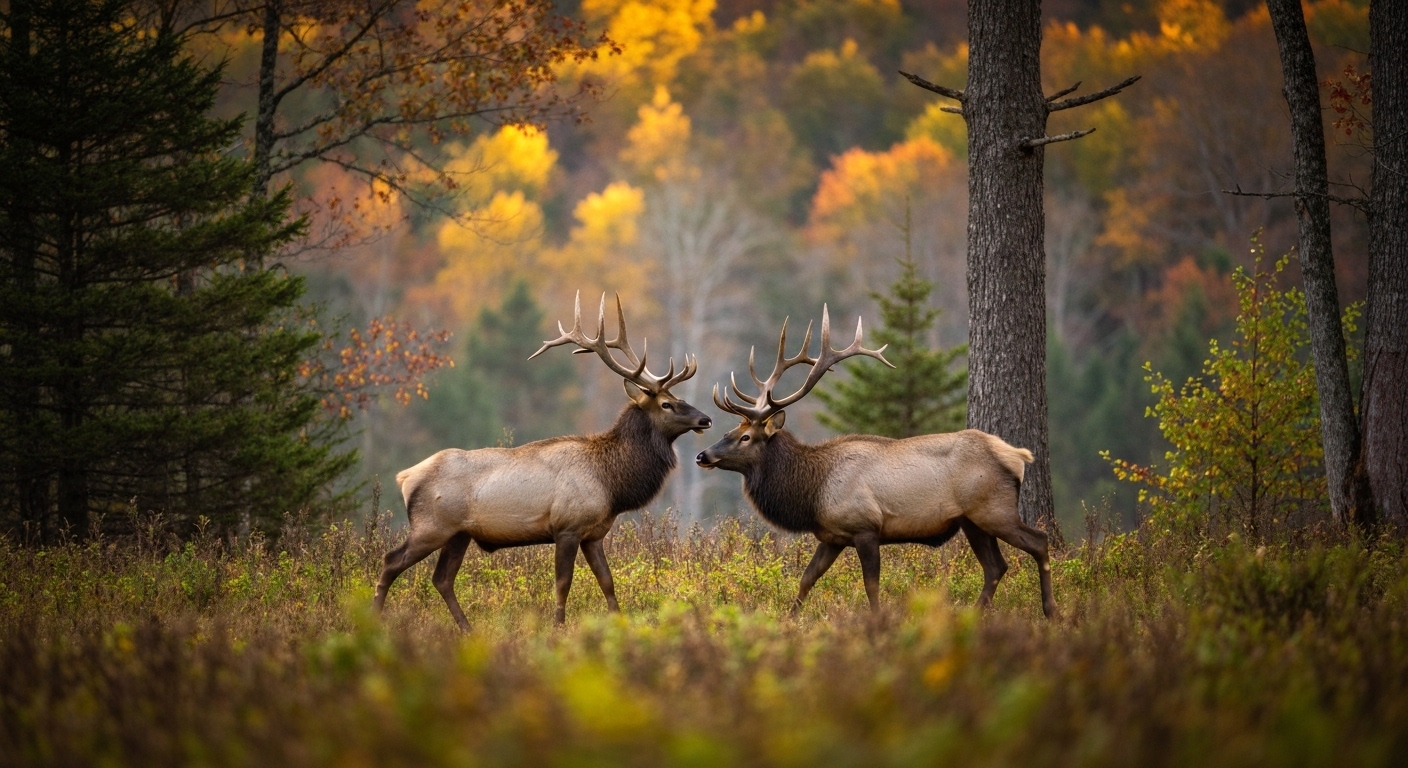
Part of it is simple wonder. A bull elk at 700 or 800 pounds, some topping 1,000, standing five feet at the shoulder with a dark mane across its neck, is a genuinely arresting thing to come across in a mountain meadow at first light. People drive hours to Cataloochee and Oconaluftee for exactly that moment.
The deeper part is what the elk represent. They are proof that something lost can be brought back, that a decade of patience and years of meetings can put a native species back on native ground. Every elk in the Smokies today descends from 52 animals and from the people, DeLozier chief among them, who spent years making the case that they belonged here.
DeLozier retired in 2010 after a 32-year career and later became lands program manager for the Rocky Mountain Elk Foundation, the same organization whose local members first knocked on his door in the 1980s. Joe Yarkovich has coordinated the elk monitoring program since 2006 and carries the science forward. The work outlasts any one person, which is fitting for a project measured in generations.
For anyone who already lives in these mountains or is thinking about calling them home, the elk are a reminder of what makes this corner of North Carolina worth putting down roots in, and I am always happy to talk mountains with folks weighing the move. Come fall, when the bulls start bugling in Cataloochee, you will understand why the phone calls were worth it.
Frequently Asked Questions
Where can you see elk in the Great Smoky Mountains?
The two most reliable spots are Cataloochee Valley on the North Carolina side of the park and the Oconaluftee area near Cherokee. Cataloochee is where the first elk were released in 2001, and the open fields of the old farmstead make for easy viewing at dawn and dusk. Oconaluftee has become just as dependable in recent years, with large bulls grazing near the visitor center. Since around 2022, elk have been dispersing toward the town of Cherokee as well. Fall is the best season to visit, when bulls bugle during the rut. Keep your distance and never approach the animals.
When were elk reintroduced to Great Smoky Mountains National Park?
The first release happened on February 2, 2001, when 25 elk were let loose at a historic farmstead in Cataloochee Valley. Around 900 people showed up to watch. A second group of 27 elk followed in 2002, bringing the founding herd to 52 animals. The project was structured as a five-year experiment running from 2001 through 2006, since success was not guaranteed. After the experimental period ended and the herd stabilized, the National Park Service declared the effort a success and moved it to full reintroduction status.
How many elk are in the Smokies now?
The park estimates the current population at roughly 250 to 260 elk, more than four times the original founding herd of 52. A detailed DNA study using fecal samples across three winters put the numbers at 179 elk in 2020, 220 in 2021, and 240 in 2022. That 2022 count included 178 females, a female-heavy ratio that suggests the herd still has room to grow. Biologists describe the growth as slow and steady. Between 40 and 50 elk currently wear radio collars so researchers can track movement, survival, and range expansion across the park.
Why did elk disappear from the southern Appalachians in the first place?
Elk were native to the southern Appalachians for thousands of years. The Cherokee called them awi egwa, or big deer. As European settlers moved into the region, overhunting and habitat loss wiped the animals out. The last elk in North Carolina were gone by the late 1700s, and the species was eliminated from the broader region by the mid-1800s. That left roughly 150 years with no elk anywhere in these mountains. The National Park Service has a mission to restore species that historically lived in a park but were lost, which is what set the reintroduction in motion.
Can you hunt elk in North Carolina?
Not at this time within the park, and elk hunting remains a subject of ongoing discussion in the surrounding region. In February 2016, the North Carolina Wildlife Resources Commission approved a framework for a potential permitted elk hunting season as the herd continues to grow and expand its range beyond park boundaries. Any hunting would be tightly managed and involve significant community input. For now, the elk are protected inside Great Smoky Mountains National Park, and the conversation centers on how to balance a growing population with the needs of nearby farmers and landowners.
About the Author
Jon Tharp is a licensed NC real estate broker with Keller Williams. He's helped buyers and sellers across Western North Carolina for over 10 years, specializing in mountain homes, land, and short-term rental investments, with offices throughout WNC covering all mountainous areas. If something in this post has you thinking about a move, he's easy to reach — (828) 347-9055 or smokymountainhomes4sale.com or Jon@jontharphomes.com.
Ready to Make Western NC Your Home Base?
Whether you're looking to buy, considering a short-term rental investment, or ready to sell, the Jon Tharp Team brings deep local knowledge and marketing that puts your home in front of 50,000+ buyers in the first 30 days.
Search available homes across Western NC or call Jon directly at (828) 347-9055.
Talk to JonWhat Our Clients Say
43 five-star Google reviews — read them all on Google
"Jon is hands down the most dedicated and knowledgeable realtor that I have ever worked with. His expertise made the entire process of selling my home and finding a new one a smooth process."
Amy Davis · 2025
"Jon & his team are the greatest! Very professional, friendly like your neighbor, and always get back to your texts, phone calls & emails within minutes or same day, not days or weeks."
Cynthia Oelschlager · 2025
"I can’t say enough good things about Jon and his team. I was looking for investment properties and Jon spent time researching where would be a good place for an Airbnb — he found 2 beautiful properties."
Diane Cogswell · 2025
More from the Blog