By Jon Tharp, Broker · July 10, 2026
At a Glance
Western North Carolina offers some of the darkest, clearest night skies in the eastern United States. High elevations along the Blue Ridge Parkway, low light pollution around towns like Franklin and Brevard, and thousands of acres of protected forest make the region ideal for viewing stars, the Milky Way, meteor showers, and even occasional northern lights year round.
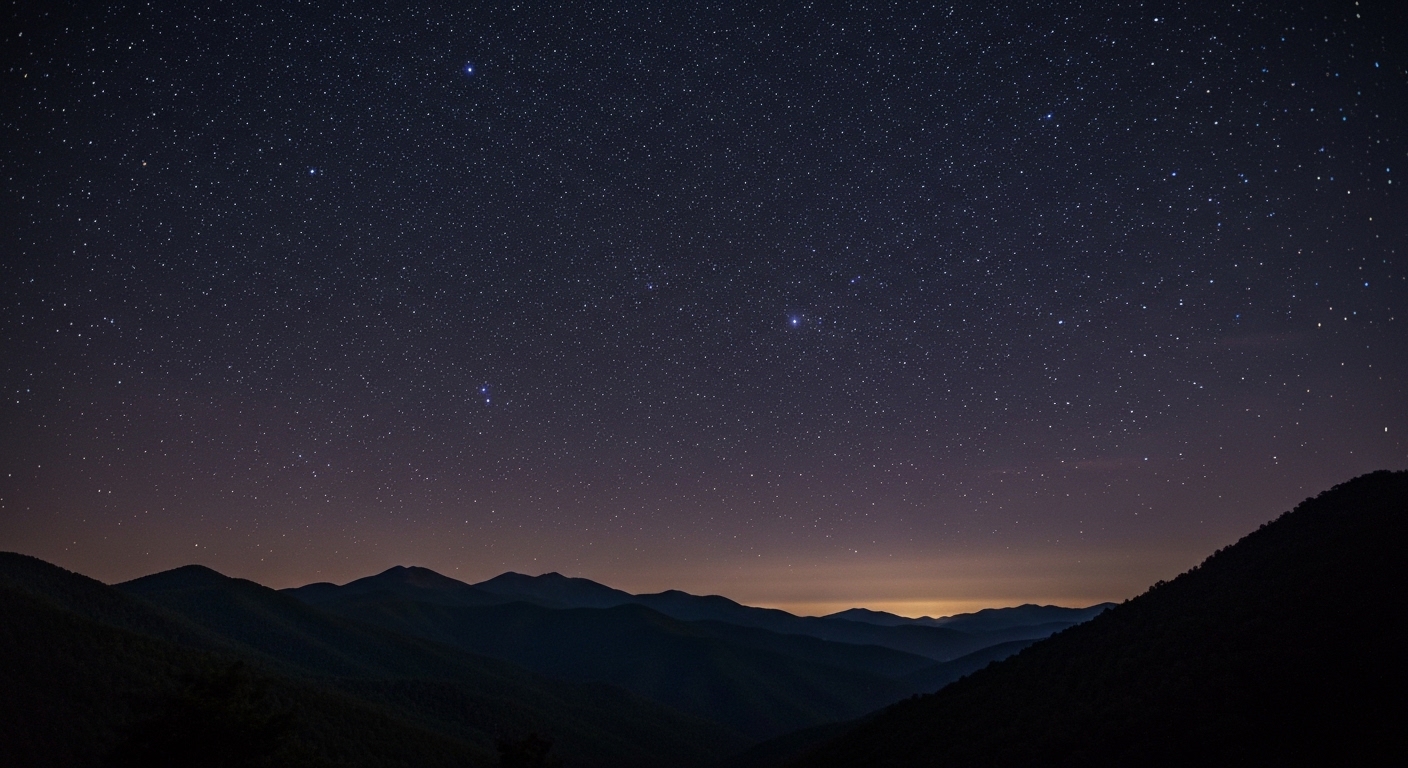
The night sky over the mountains around Franklin can show you the Milky Way with nothing but your own eyes, no telescope required. Western North Carolina holds some of the darkest skies in the eastern United States, a rare thing in a part of the country where light pollution has swallowed the stars almost everywhere else. On the right night, up on the right ridge, you can even catch a glimpse of the northern lights.
That is not a small claim. Most people east of the Mississippi have never seen the Milky Way clearly. Here in Macon County and across the Nantahala National Forest, thousands of protected acres and very little development mean the dark holds. Drive up US-441 or hop onto the Blue Ridge Parkway, and within 30 to 45 minutes of Asheville you can be standing at an overlook far above the valley glow, looking up at a sky most Americans forget exists.
Why are the skies so dark in Western North Carolina?
Two things work in our favor here. The first is elevation. The Blue Ridge and the Great Smokies push you up above the haze and moisture that blur the sky at lower altitudes. The higher overlooks along the Parkway routinely clear 4,000 and 5,000 feet.
The second is simple math. Fewer people means fewer lights. The stretch of country running from Brevard down through Cashiers, Highlands, and out toward Murphy and the Nantahala Gorge stays genuinely rural. There is no metro sprawl bleeding orange light into the clouds. That absence is exactly what makes the stars pop.
Where should you go to see the stars?
The Blue Ridge Parkway is the obvious starting point. Pull-offs south of Asheville near Mount Pisgah give you wide, open views once your eyes adjust. Farther southwest, the overlooks and balds near Franklin and the Nantahala forest get darker still.
If you want a destination with some infrastructure, the region has embraced its night skies. Certain overlooks and open fields at higher elevation are known locally for stargazing gatherings, especially during the big meteor showers. The Perseids peak in August, when the nights are still warm, and the Geminids light up December for anyone willing to bundle up.
You do not need a plan or a permit for most of it. A clear night, a moonless sky, a blanket, and a spot with a view to the north and east are enough.
Can you really see the northern lights here?
Once in a while, yes. When a strong solar storm hits, the aurora borealis has appeared over the high country of Western North Carolina, usually as a soft reddish glow along the northern horizon. It is not a Fairbanks light show, but it is real, and locals who happened to be up on a ridge at the right moment do not forget it.
Your best odds come from getting to a high, dark spot with an unobstructed view north. The same overlooks that make for good stargazing make for good aurora watching when the forecast lines up.
There is something about all of this that goes beyond a single good night out. The dark sky is part of what living in these mountains actually feels like. You step outside on a cold, clear evening, look up, and the whole thing is just there, no drive required, no crowd.
That kind of quiet is getting harder to find, and it is one of the reasons people who move here tend to stay. If a night sky like this sounds like the kind of thing you would want off your own back porch, Jon Tharp is always glad to talk about what that could look like.
Frequently Asked Questions
Where is the best stargazing near Asheville?
Some of the best stargazing sits along the Blue Ridge Parkway, where high elevation and distance from city lights create dark conditions. Overlooks south of Asheville toward Mount Pisgah, along with spots near Brevard and the Pisgah National Forest, offer wide open views. Farther southwest, the areas around Franklin, Cashiers, and the Nantahala National Forest get even darker because there is less development. A short drive up the Parkway from Asheville, roughly 30 to 45 minutes, puts you at overlooks well above the valley haze and glow.
Can you see the northern lights in North Carolina?
It is rare, but it happens. During strong geomagnetic storms, the aurora borealis has been visible from the higher elevations of Western North Carolina, usually as a faint reddish or greenish glow low on the northern horizon. You need a very dark location, a clear night, and a view unobstructed to the north. High points along the Blue Ridge Parkway and open balds give you the best odds. Photographs often capture more color than the naked eye, so bring a camera with a long exposure setting if aurora activity is in the forecast.
What is the best time of year for stargazing in the mountains?
Fall and winter usually bring the clearest, driest air, which means sharper views of stars and the Milky Way. Summer offers warm, comfortable nights and a well-placed view of the galactic core, though humidity and haze can soften the sky. The biggest annual meteor showers, the Perseids in August and the Geminids in December, are worth planning around. Any moonless night with low humidity works well. Check the moon phase first, since a bright full moon washes out all but the brightest stars.
Do you need special equipment to stargaze in Western NC?
No. On a clear, dark night you can see the Milky Way, major constellations, and meteor showers with nothing but your eyes. Give yourself about 20 to 30 minutes for your eyes to fully adjust to the dark, and avoid looking at your phone. A pair of binoculars reveals star clusters and the moons of Jupiter. A small telescope opens up Saturn's rings and deep sky objects. Warm layers, a reclining chair, and a red flashlight to preserve your night vision are the only real essentials.
About the Author
Jon Tharp is a licensed NC real estate broker with Keller Williams. He's helped buyers and sellers across Western North Carolina for over 10 years, specializing in mountain homes, land, and short-term rental investments, with offices throughout WNC covering all mountainous areas. If something in this post has you thinking about a move, he's easy to reach — (828) 347-9055 or smokymountainhomes4sale.com or Jon@jontharphomes.com.
Ready to Find Your Mountain Home Near Blue Ridge?
Whether you're looking to buy, considering a short-term rental investment, or ready to sell, the Jon Tharp Team brings deep local knowledge and marketing that puts your home in front of 50,000+ buyers in the first 30 days.
Search available homes across Western NC or call Jon directly at (828) 347-9055.
Talk to JonWhat Our Clients Say
43 five-star Google reviews — read them all on Google
"Jon is hands down the most dedicated and knowledgeable realtor that I have ever worked with. His expertise made the entire process of selling my home and finding a new one a smooth process."
Amy Davis · 2025
"Jon & his team are the greatest! Very professional, friendly like your neighbor, and always get back to your texts, phone calls & emails within minutes or same day, not days or weeks."
Cynthia Oelschlager · 2025
"I can’t say enough good things about Jon and his team. I was looking for investment properties and Jon spent time researching where would be a good place for an Airbnb — he found 2 beautiful properties."
Diane Cogswell · 2025
More from the Blog