By Jon Tharp, Broker · June 7, 2026
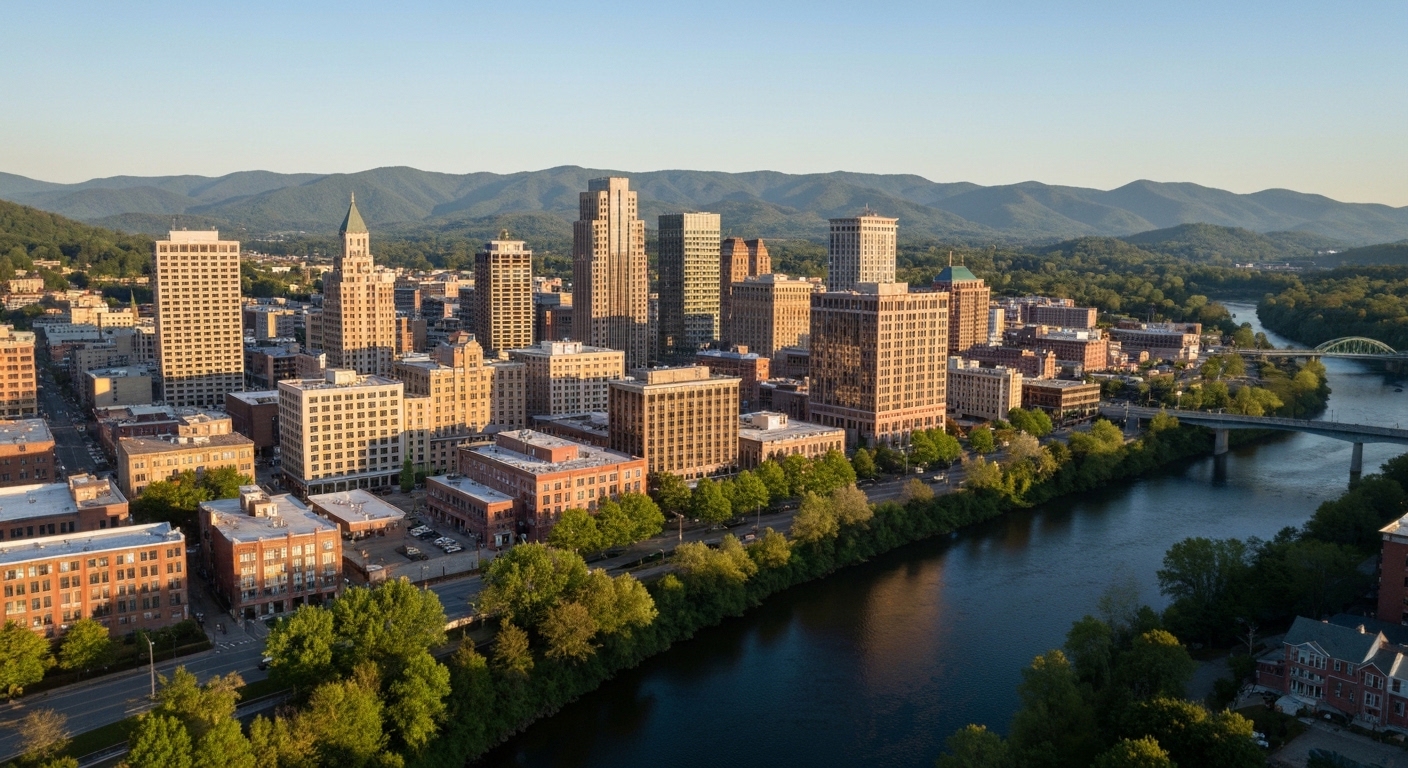
Quick Answer: Asheville is the county seat of Buncombe County and the cultural, medical, and economic capital of Western North Carolina, a real city of about 94,000 set at roughly 2,134 feet in a bowl of mountains. It is the one WNC market where you get genuine urban culture, a nationally known food and beer scene, the Biltmore, live music, a growing airport, and a Level I trauma hospital, alongside the mountains. That comes at a city price: homes sold for a median around $477,000 over the past year, far above the rural WNC towns, in a faster, more diverse market of historic homes, condos, and townhomes. Two things every Asheville buyer should understand: the city has distinct neighborhoods at very different price points, and Hurricane Helene reshaped specific river corridors in 2024, so flood geography matters block by block.
Asheville at a Glance
| Population | About 94,000 in the city (2020 Census); ~270,000 in Buncombe County; the largest city in WNC |
| Elevation | ~2,134 feet, a city in a bowl of mountains |
| Median home price | ~$477,000 sold over the past year; active homes list near $575,000 (as of June 2026) |
| Time on market | Roughly 81 days, faster than the rural WNC towns |
| Market type | A true city market: historic homes, condos, townhomes; only ~21% of active listings are land |
| Property tax | Buncombe County ~$0.55 + City of Asheville ~$0.44 per $100 (plus city-school supplement); verify combined |
| Drive to Charlotte / GSP airport | ~2 hr to Charlotte; ~1 hr to Greenville-Spartanburg; AVL airport is in town |
| Locally famous for | The Biltmore Estate, Beer City USA, Foodtopia, the River Arts District, and the Blue Ridge Parkway |
What is it actually like to live in Asheville?
Living in Asheville means having a real city in the mountains: walkable historic neighborhoods, a nationally known food and beer scene, a growing airport, a major regional hospital, and the Blue Ridge Parkway and Pisgah forest at the edge of town. It is the one place in Western North Carolina where you do not have to trade city amenities for mountain life, and the trade-off is that it costs more and moves faster than anywhere else in the region.
Asheville is the Buncombe County seat and the capital of Western North Carolina, a city of about 94,000 that punches far above its size in culture. It is famous for the Biltmore Estate, for being Beer City USA with more than fifty breweries, for its Foodtopia restaurant scene, for the River Arts District, and for sitting at the hub of the Blue Ridge Parkway where Interstates 40 and 26 cross. The market reflects the city it is: a median sold home around $477,000, a faster 81-day pace, and a true urban mix of historic homes, condos, and townhomes rather than the land-heavy inventory of the rural towns. And Asheville carries the recent memory of Hurricane Helene, which in 2024 devastated specific river corridors while leaving most of the higher-ground city untouched, so understanding the flood geography is part of buying here.
This guide is written for the buyer Asheville actually fits, the retiree or relocation buyer who wants real urban culture with the mountains, who can meet a city price, and who wants the honest picture: the neighborhoods, the market, the Helene flood geography, the short-term-rental rules, and who Asheville suits.
Table of Contents
- What kind of city is Asheville? - What are Asheville's neighborhoods? - What is the Asheville real estate market like? - Why is Asheville famous for food, beer, and the Biltmore? - What outdoor recreation is around Asheville? - How did Hurricane Helene affect Asheville? - How far is Asheville from Charlotte, Atlanta, and the airports? - What internet and utilities can you get in Asheville? - What should buyers know about property here? - What are the property taxes in Asheville? - What are the schools and healthcare like? - How does Asheville compare to nearby towns? - Is Asheville right for you? - Frequently Asked Questions
What kind of city is Asheville?
Asheville is a real city, the cultural, medical, and educational capital of Western North Carolina, set in a bowl of mountains where the interstates cross. That makes it fundamentally different from every other town in this region: it has urban neighborhoods, urban prices, and urban amenities.
The settlement was renamed Asheville in 1797 for Governor Samuel Ashe, but it stayed a small crossroads until the railroad arrived in 1880 and touched off a Gilded Age boom, capped by George Vanderbilt's Biltmore Estate in 1895, still the largest privately owned home in the country. A 1920s building boom gave the city its Art Deco skyline, and then the Depression hit so hard that Asheville chose to repay its debts over roughly fifty years rather than default, a long stagnation that, almost by accident, preserved its historic downtown buildings from mid-century demolition. That intact core became the foundation of the modern arts-and-tourism renaissance. Today the city holds about 94,000 people in a county of roughly 270,000, with a genuine mix of mountain natives, retirees, remote workers, artists, and students.
Day to day, Asheville is urban and creative, with the central tension of a fast-growing, in-demand city: real culture and amenities on one hand, rising prices, traffic, and tourism crowds on the other. It is mountain living without giving up the city, at a price that reflects exactly that.
See what is on the market in Asheville
See Homes for Sale in AshevilleWhat are Asheville's neighborhoods?
Unlike the rural WNC towns, Asheville has real, distinct neighborhoods with their own character and very different price points, and choosing the right one is the most important decision a buyer makes here. Here is a working map.
| Neighborhood / Area | Character | Typical property | Price tier |
|---|---|---|---|
| Downtown / Central | Walkable urban core, historic and new | Condos, lofts, townhomes, some historic homes | Mid to high |
| Montford | Historic district just north of downtown | Restored Victorian and Arts-and-Crafts homes | High |
| West Asheville | Hip, walkable Haywood Road corridor | 1920s bungalows and newer infill | Mid to high |
| North Asheville (Grove Park, Kimberly, Beaverdam) | Established, affluent, tree-lined | Stately older homes, larger lots | High to very high |
| Biltmore Forest | Separate wealthy incorporated town by the Biltmore | Large estates on wooded lots | Top of market |
| Kenilworth | Central, near Mission Hospital | 1920s bungalows and older homes | Mid to high |
| Oakley / Haw Creek (East) | East-side residential valleys | Mid-century and newer homes | Mid |
| South Asheville / Biltmore Park | Newer master-planned, Town Square retail | Newer homes, townhomes, condos | Mid to high |
| River Arts District (RAD) | Riverfront arts and live-work corridor | Studios, lofts, mixed-use | Varies; flood-cautioned |
The quick read: Montford and North Asheville (Grove Park, Kimberly, Beaverdam) sit at the top for walk-to-downtown historic charm and established affluence, with Biltmore Forest as the luxury outlier; West Asheville and Kenilworth are the desirable, walkable mid-to-high tier; Oakley and Haw Creek on the east side and outer South Asheville offer more attainable entry points; and Biltmore Park is the newer master-planned option near the airport. The River Arts District is creative and central but sits in a river corridor, so it carries flood considerations (see the Helene section). Beyond the city, the towns of Black Mountain (east), Weaverville (north), Fairview (southeast), and Arden and Fletcher (south, toward the airport) function as part of the Asheville decision set. I help buyers match the neighborhood to the life they want, since in a city this varied, the neighborhood is the decision.
What is the Asheville real estate market like?
Asheville is a true city market, pricier, faster, and far more diverse than anywhere else in Western North Carolina, with historic homes, condos, and townhomes rather than mostly land. Homes sold for a median around $477,000 over the past year.
Over the past year roughly 2,601 properties sold in the Asheville area, with homes (excluding land) at a median near $477,456, while days on market ran about 81 (as of June 2026), notably faster than the rural towns. The active market has about 1,596 listings, of which only roughly 329, about 21%, are land or lots, the lowest land share of any WNC market because Asheville is a city, with homes asking a median list near $575,000. The price spread is broad and deep: among active homes, about 26% are under $400,000, 28% are $400,000 to $600,000, 23% are $600,000 to $900,000, and 24% are above $900,000. That means Asheville serves entry buyers and a substantial luxury market at once, with the right price band depending heavily on the neighborhood. The headline for anyone coming from a cheaper WNC search is simple: Asheville is materially more expensive than the rest of the region, and you are buying the city.
With this much variety across neighborhoods and price tiers, knowing the areas and the flood geography pays off. Start with current Asheville listings, and if a smaller-town price is more your speed, compare nearby Waynesville to the west.
Why is Asheville famous for food, beer, and the Biltmore?
Because all three are genuinely world-class and central to daily life: a nationally recognized restaurant scene, the country's most celebrated beer city, and the largest private home in America at the edge of town. For a city its size, Asheville's cultural footprint is remarkable.
Asheville brands itself Foodtopia and has earned repeated James Beard recognition for its independent, farm-to-table restaurants, while its Beer City USA reputation rests on more than fifty breweries, from local anchors like Highland, Wicked Weed, and Burial to the East Coast homes of Sierra Nevada (in nearby Mills River) and New Belgium (in the River Arts District). The Biltmore Estate, George Vanderbilt's 250-room château on 8,000 acres, remains the marquee attraction and operates year-round, with the historic Biltmore Village at its gate. Downtown adds the 1929 Grove Arcade, the Flatiron and S&W Art Deco landmarks, a lively busker culture, and music venues like The Orange Peel, while the grand Grove Park Inn anchors the north side. The River Arts District, a former industrial riverfront full of working studios, is rebuilding after Helene but remains one of the country's notable arts districts (confirm current open businesses, as the RAD and Biltmore Village are still recovering).
What outdoor recreation is around Asheville?
Asheville is the hub of the Blue Ridge Parkway and surrounded by national forest, rivers, and the highest peaks in the East, so the outdoor access is exceptional even by mountain-town standards. For hikers, paddlers, and cyclists, it is hard to beat.
The Blue Ridge Parkway runs along the city's edge with scenic overlooks, fall color, and trailheads minutes away, and the French Broad River offers paddling, tubing, and the riverfront greenway through the River Arts District. Pisgah National Forest and Mount Pisgah rise to the southwest, Mount Mitchell, the highest peak east of the Mississippi, is about 40 minutes northeast in the Black Mountains, and DuPont State Recreational Forest, famous for its waterfalls, is about 45 minutes south. Closer in, the NC Arboretum and Bent Creek offer gardens, trails, and mountain biking, and the city's growing greenway system adds urban trails. Easy access to world-class hiking and biking is one of Asheville's core draws and pairs naturally with an active retirement.
How did Hurricane Helene affect Asheville?
Helene was catastrophic for specific parts of Asheville in September 2024, but it is important to be precise: the storm devastated identifiable river corridors while leaving most of the higher-ground city untouched. Asheville is not a "flooded city," it is a city with specific flood-exposed areas.
When Hurricane Helene struck on September 27, 2024, the French Broad and Swannanoa Rivers drove historic flooding, and the destruction concentrated in the river corridors and valleys: the River Arts District, Biltmore Village, and the Swannanoa River valley east toward Black Mountain, which was among the hardest-hit areas in the entire country, with 43 deaths in Buncombe County. The storm also knocked out the city's water system, and the boil-water advisory was not fully lifted until November 18, 2024, nearly two months later. But most of Asheville, the ridges and higher-elevation neighborhoods, did not flood: downtown sits on a hill, and North Asheville, much of West Asheville, Montford, and the higher residential areas were spared the river flooding even as the whole city lost water and power. As of 2026 the city is functioning normally, with clean water restored, downtown, the Biltmore, and the airport running, and most tourism reopened, while the hardest-hit corridors like the RAD and Biltmore Village continue to rebuild.
The buyer implications are concrete: pull the flood map on every property using the FEMA Flood Map Service Center and the NC Flood Risk Information System, treat the RAD, Biltmore Village, the Swannanoa valley, and any river-adjacent lot as elevated-risk until the map proves otherwise, budget flood insurance in those corridors, and remember that higher neighborhoods carry far lower river-flood risk, though steep terrain has its own slope-stability questions. A ridge home in North Asheville and a studio in the RAD are completely different flood risks, and knowing the difference is exactly where local guidance earns its keep.
How far is Asheville from Charlotte, Atlanta, and the airports?
As the regional hub where the interstates cross, Asheville is the best-connected place in Western North Carolina, with its own growing airport and the major metros within a few hours. Mountain and interstate drives are generally faster here than from the rural towns.
| From Asheville to | Distance | Drive time |
|---|---|---|
| Black Mountain, NC | ~16 mi | ~20 min E |
| Hendersonville, NC | ~24 mi | ~30 min S |
| Waynesville, NC | ~28 mi | ~35 min W |
| Greenville-Spartanburg, SC (GSP airport) | ~60 mi | ~1 hr S via I-26 |
| Johnson City, TN | ~75 mi | ~1 hr 15 min NW |
| Knoxville, TN | ~115 mi | ~1 hr 45 min W via I-40 |
| Boone, NC | ~95 mi | ~1 hr 45 min NE |
| Charlotte, NC (and CLT airport) | ~130 mi | ~2 hr E via I-40 |
| Atlanta, GA | ~200 mi | ~3 hr 15 min S |
(Distances and times as of June 2026, via mapping calculators; some are approximate.) The big differentiator is Asheville Regional Airport (AVL), just south of the city near Fletcher and Arden, which is growing fast with expanding nonstop service and a major terminal expansion, a real advantage over the rest of WNC, which has no commercial airport nearby. Between AVL and the interstates, Asheville is the one mountain market with genuine connectivity.
What internet and utilities can you get in Asheville?
As a city, Asheville generally has strong wired and fiber internet, better than the rural WNC towns, though availability still varies block to block, so confirm service at the exact address.
| Provider | Type | Coverage in Asheville | Top speed | Notes (as of mid-2026) |
|---|---|---|---|---|
| Spectrum | Cable | broad (~91% of the city) | up to ~1 Gbps | the dominant wired provider |
| AT&T Fiber | Fiber | roughly 46% and expanding | up to multi-gig symmetrical | the fastest option where available |
| French Broad EMC fiber | Fiber | parts of the broader region | up to ~1 Gbps | co-op fiber on the rural edges |
| Starlink | Satellite | anywhere | ~25-100 Mbps typical | rarely needed in the city; a rural-fringe backstop |
(Coverage from broadband aggregators, mid-2026; treat as directional and re-check at the address.) Most of Asheville has solid cable and growing fiber, so wired internet is rarely the obstacle it can be in the rural towns, but coverage maps still differ street by street, so check the exact address at the provider sites, especially for fiber. On utilities, city homes are on Asheville municipal water and sewer (the system the city is now hardening after Helene), while properties outside city limits may be on private wells and septic, so budget for a well test and septic inspection on rural-fringe parcels.
What should buyers know about property here?
Six things shape a smart Asheville purchase: the neighborhood-and-price reality, the flood geography, the short-term-rental rules, the city-versus-county lines for taxes and schools, the faster market pace, and the growth pressures. This is a city, so the diligence is different from the rural towns.
First, the neighborhood is the decision, and the price varies enormously by area, so get clear on what you can buy where before you fall for a listing. Second, the flood geography matters block by block after Helene, so pull the FEMA map on any property and treat river corridors as elevated-risk. Third, the short-term-rental rules are strict and surprise many buyers: Asheville effectively bans whole-home short-term vacation rentals in residential zones, allowing them only in the Resort district, while homestays are permitted but require the owner to live on-site full-time and rent no more than two bedrooms, so you generally cannot buy an Asheville house purely as a whole-home Airbnb. Fourth, whether a property is inside the city or in unincorporated Buncombe County changes both the tax bill and, often, the school assignment, so confirm by parcel. Fifth, the market moves faster here (about 81 days, and faster in desirable neighborhoods), so be ready to act with financing in hand. And factor the growth and traffic that come with a popular city. In a market this varied and fast, good local guidance, on neighborhood, flood, and the rules, is what protects your purchase.
What are the property taxes in Asheville?
A home inside Asheville pays both the Buncombe County rate and the City of Asheville rate (plus a city-school supplement in the city-school district), while a property in unincorporated Buncombe County pays the county rate plus any fire district. Confirm the exact combined figure by parcel, especially with a county reappraisal in progress.
For 2025-26, Buncombe County's rate is about $0.55 per $100 of assessed value and the City of Asheville's is about $0.44 per $100, with an Asheville City Schools supplemental rate of roughly $0.11 per $100 for properties in that district, so an in-city home carries a meaningfully higher combined rate than a county parcel. Because Buncombe County's 2026 reappraisal is underway and will reset assessed values, confirm the current combined rate and your property's assessment before you rely on a number. On a $477,000 home, the combined city rate works out to well over $5,000 a year, so taxes are a real line item here, higher than in the rural counties.
On the state side, North Carolina is favorable for retirees: Social Security is not taxed, government and military pensions can be exempt under the Bailey settlement, and there is no estate tax. There is no special $35,000 senior exemption (that is a Georgia benefit, not North Carolina); other retirement income is taxed at the state's flat rate (3.99% in 2026). This is general information, not tax advice, so confirm the current county, city, and any fire-district figures with Buncombe County and the City of Asheville, and your situation with a CPA.
What are the schools and healthcare like?
Asheville has two school districts and the region's largest hospital, so both schools and healthcare come down to which part of the area you are in, with abundant options overall.
For schools, the city is served by Asheville City Schools while the surrounding county is served by Buncombe County Schools, and a home's address determines which district and schools a family is assigned to, so confirm the line for any specific property, and note there are private options like Carolina Day School as well. Higher education is a genuine Asheville strength and a retiree draw, with UNC Asheville, AB Tech, Warren Wilson College in Swannanoa, and Montreat College nearby. For healthcare, Mission Hospital (part of HCA Healthcare) is the region's largest hospital and, as of December 2025, the sole Level I trauma center in Western North Carolina, making Asheville the medical hub for the entire region, and the Charles George VA Medical Center is a major draw for veteran retirees, with AdventHealth and Novant also expanding in the area. Having a Level I trauma center and a major VA hospital in town is a significant advantage for retirees choosing Asheville.
How does Asheville compare to nearby towns?
Asheville is the city, distinct from every smaller town around it, which is exactly the choice buyers weigh. Here is the honest read.
- Why buyers choose Asheville over the smaller WNC towns: Asheville offers genuine urban culture, a major airport, a Level I trauma hospital, and walkable neighborhoods that the rural towns cannot match, while towns like Waynesville and the far-western communities are quieter, far more affordable, and more land-rich. Choose Asheville for city amenities and culture; choose the smaller towns for value and quiet. - Why buyers choose nearby towns over Asheville: Black Mountain, Weaverville, Hendersonville, and Waynesville give you a smaller-town feel and lower prices within reach of Asheville's amenities, which is why many buyers who love Asheville actually buy in a satellite town and drive in. Choose a satellite town to trade some convenience for price and pace. - Why buyers choose Asheville as a base: Asheville is the regional hub, with the airport, the hospital, the arts, the food and beer, and the Parkway, plus the interstates that connect everything, all in one city in the mountains. For a buyer who wants the city and the mountains together and can meet the price, nothing else in WNC compares.
Is Asheville right for you?
Asheville is a strong fit for a retiree or relocation buyer who wants real urban culture, walkable neighborhoods, a major airport and hospital, and easy access to the mountains, and who can meet a city price and choose the right neighborhood. If you want arts, food, and beer, a Level I trauma center, a growing airport, and the Blue Ridge Parkway, all in one place, Asheville is the only WNC market that delivers it, and it delivers it well.
It is not the right fit for someone seeking rural quiet and low prices (the smaller WNC towns fit far better), a property to run as a whole-home Airbnb (that is effectively banned in residential zones), or a buyer who wants to avoid flood and growth questions entirely (the river corridors carry real Helene-era risk, and the city is busy and growing). And neighborhood choice, flood geography, the rental rules, and a faster market are all part of buying here.
If urban mountain living with real culture and amenities is what you are after, reach out and I will help you match the neighborhood to your life, read the flood maps corridor by corridor, navigate the rental and tax rules, and find the right home in this remarkable city.
Frequently Asked Questions
Is Asheville, NC a good place to live? For a buyer who wants real urban culture with the mountains and can meet a city price, yes. Asheville is the cultural and medical capital of Western North Carolina, with a nationally known food and beer scene, the Biltmore, walkable historic neighborhoods, a growing airport, and a Level I trauma hospital, all in a city of about 94,000 in a bowl of mountains. Homes sold for a median around $477,000, far above the rural WNC towns. It fits culture-and-amenity-minded retirees and relocation buyers far better than someone seeking rural quiet and low prices.
How much does it cost to buy a home in Asheville? It is a real city market, materially pricier than the rest of WNC. Over the past year about 2,601 properties sold, with homes at a median near $477,456 and an 81-day market, while active homes ask a median near $575,000, with a broad spread (about 26% of active homes under $400,000 and about 24% above $900,000). Price depends heavily on the neighborhood, so ask me for a current, neighborhood-specific read before making an offer.
Did Asheville flood during Hurricane Helene? Specific parts did, severely, but most of the city did not. Helene's catastrophic 2024 flooding concentrated in the river corridors, the River Arts District, Biltmore Village, and the Swannanoa River valley, with 43 deaths in Buncombe County, and the city's water was out for nearly two months. But the ridges and higher-elevation neighborhoods, including downtown, North Asheville, and much of West Asheville and Montford, did not flood. Asheville is not a "flooded city"; it is a city with specific flood-exposed corridors, so pull the FEMA flood map on any property and treat river-adjacent areas as elevated-risk.
Can you run an Airbnb in Asheville? Generally not as a whole-home short-term rental in residential zones. Asheville effectively bans whole-home short-term vacation rentals outside the Resort zoning district, so you cannot buy a typical Asheville house purely to run it as a whole-home Airbnb. Homestays are allowed in residential zones, but they require the owner to live on-site full-time as a primary residence and rent no more than two bedrooms, with a permit. Confirm the current ordinance with the City of Asheville before counting on any rental income.
What neighborhoods should I consider in Asheville? It depends on your budget and lifestyle. Montford and North Asheville (Grove Park, Kimberly, Beaverdam) lead for historic charm and established affluence, with Biltmore Forest as the luxury outlier; West Asheville and Kenilworth are the walkable mid-to-high tier; Oakley, Haw Creek, and outer South Asheville offer more attainable entry points; and Biltmore Park is the newer master-planned area near the airport. The River Arts District is creative and central but sits in a flood-cautioned river corridor. Nearby Black Mountain, Weaverville, and Arden round out the decision set.
What are the property taxes in Asheville? A home inside the city pays both the Buncombe County rate (about $0.55 per $100) and the City of Asheville rate (about $0.44 per $100), plus a city-school supplement of roughly $0.11 in that district, so the combined in-city rate is well above the rural counties (over $5,000 a year on a $477,000 home). A county parcel pays the county rate plus any fire district. A 2026 reappraisal is underway, so confirm the current combined rate and assessment by parcel. North Carolina does not tax Social Security and has a flat income tax (3.99% in 2026); there is no $35,000 senior exemption (that is Georgia), though government and military pensions can be exempt under the Bailey settlement.
Does Asheville have a good airport and hospital? Yes, and both are real differentiators versus the rest of WNC. Asheville Regional Airport (AVL), just south of the city near Fletcher and Arden, is growing fast with expanding nonstop service and a terminal expansion underway. Mission Hospital, the region's largest, became the sole Level I trauma center in Western North Carolina in December 2025, and the Charles George VA Medical Center serves veteran retirees. Having a growing airport and a Level I trauma center in town is a significant advantage for retirees.
Is Asheville too expensive compared to the rest of Western NC? It is materially more expensive, and that is the honest trade-off. Asheville's median sold home (~$477,000) runs far above the rural WNC towns, because you are buying a real city with urban culture, an airport, a major hospital, and walkable neighborhoods. Many buyers who love Asheville's amenities actually buy in a nearby satellite town, Black Mountain, Weaverville, Hendersonville, or Waynesville, to get a lower price and a smaller-town feel while staying within easy reach of the city. I can help you weigh living in Asheville against living near it.
About the Author
Jon Tharp is a licensed NC real estate broker with Keller Williams. He's helped buyers and sellers across Western North Carolina for over 10 years, specializing in mountain homes, land, and short-term rental investments, with offices throughout WNC covering all mountainous areas. If something in this post has you thinking about a move, he's easy to reach — (828) 347-9055 or smokymountainhomes4sale.com or Jon@jontharphomes.com.
Ready to Find Your Mountain Home Near Asheville?
Whether you're looking to buy, considering a short-term rental investment, or ready to sell, the Jon Tharp Team brings deep local knowledge and marketing that puts your home in front of 50,000+ buyers in the first 30 days.
Search available homes across Western NC or call Jon directly at (828) 347-9055.
Talk to JonWhat Our Clients Say
43 five-star Google reviews — read them all on Google
"Jon is hands down the most dedicated and knowledgeable realtor that I have ever worked with. His expertise made the entire process of selling my home and finding a new one a smooth process."
Amy Davis · 2025
"Jon & his team are the greatest! Very professional, friendly like your neighbor, and always get back to your texts, phone calls & emails within minutes or same day, not days or weeks."
Cynthia Oelschlager · 2025
"I can’t say enough good things about Jon and his team. I was looking for investment properties and Jon spent time researching where would be a good place for an Airbnb — he found 2 beautiful properties."
Diane Cogswell · 2025
More from the Blog