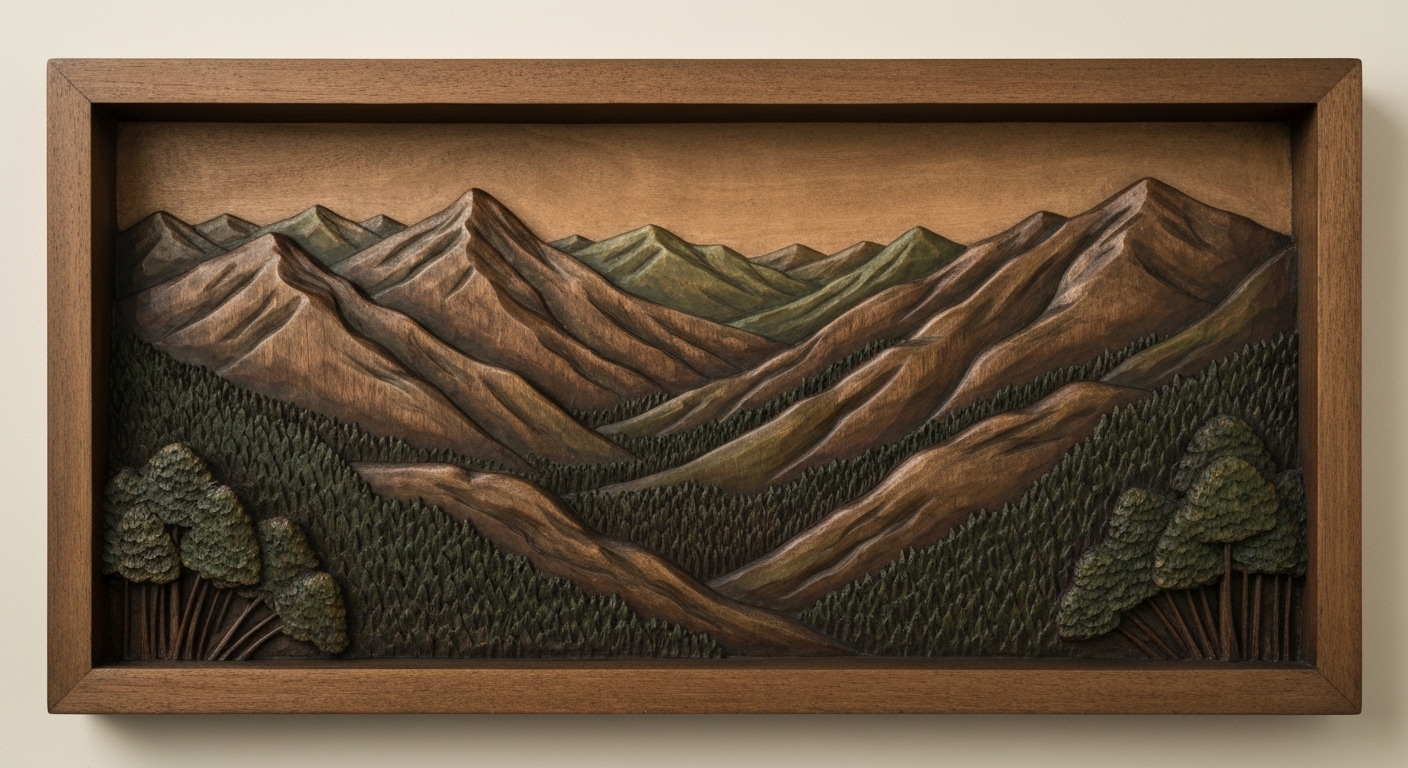
AI-generated image
By Jon Tharp, Broker · June 3, 2026
At a Glance
Davy Arch, a Cherokee historian, storyteller, and Smithsonian-recognized folk artist, will appear at the Pigeon Community Multicultural Development Center in Waynesville on June 11 at 6 p.m. for the Conversations with Storytellers series. He'll demonstrate traditional carving, flint knapping, and mask-making while sharing Cherokee history and contemporary Cherokee life. Tickets are $10 at the door or at pcmdc.org.
A Cherokee historian with work on display at the Smithsonian Institution is coming to Waynesville this month.
Davy Arch, storyteller, traditional medicine practitioner, and folk artist, will speak at the Conversations with Storytellers series on Thursday, June 11, at 6 p.m. at the Pigeon Community Multicultural Development Center. Haywood County sits about 30 miles west of Asheville along I-40, and the Pigeon Center on Pigeon Street has built one of the more consistently interesting cultural programming calendars in the mountains.
Arch grew up on a subsistence farm in Western North Carolina and learned traditional Cherokee knowledge from his grandfather: the old stories passed down through generations, how to hunt and fish, and which plants carried medicinal value. He has spent his adult life turning that inheritance into work recognized at a national level.
At the June 11 event, he'll demonstrate carving, flint knapping, and mask-making while telling Cherokee stories and describing both historical and contemporary Cherokee life. He uses the act of making things as a way into the stories themselves. The demonstrations are not separate from the history. They are the history.
Why does Cherokee history run so deep in Western North Carolina?
The Eastern Band of Cherokee Indians has lived in these mountains for thousands of years. Their ancestral homeland covered much of present-day Western NC, including the river valleys and ridgelines people now associate with the Great Smoky Mountains and the Blue Ridge Parkway. The forced removal of 1838 displaced most of the Cherokee Nation westward. The people who remained, hidden in these mountains, became the Eastern Band. Their tribal seat is in Cherokee, about 50 miles southwest of Waynesville along US-74.
That history is part of this landscape at every level. You find it in the place names, the river systems, the planting traditions, and the medicine knowledge that families like Arch's carried forward through generations without institutional support or formal documentation. When Arch demonstrates flint knapping or talks through traditional plant medicine, he's not offering a historical reenactment. He's preserving something that survived under real pressure, and people are still carrying it forward on purpose.
What is the Conversations with Storytellers series in Waynesville?
The Pigeon Community Multicultural Development Center runs this monthly series to spotlight storytellers from Western NC's African American, Hispanic, and Eastern Band of Cherokee Indian communities. The format is casual and participatory, less like a lecture and more like a conversation.
The series covers written, traditional, musical, and spoken word storytelling and continues on the second Thursday of each month through September. Tickets are $10 at the door or through pcmdc.org. Seniors 65 and over pay $7, students pay $5, and children under 12 attend free.
Is there more to explore about Cherokee culture and history nearby?
Yes. The Museum of the Cherokee Indian in Cherokee, NC is one of the most thorough Indigenous cultural museums in the Southeast. The Qualla Arts and Crafts Mutual, which has operated since 1946, is one of the oldest Native-owned cooperatives in the country. Traditional crafts including basket weaving, pottery, and the carving and mask-making traditions that Arch practices are actively taught and kept in practice there.
The Eastern Band of Cherokee Indians is also a present-day tribal government and community with significant influence on the cultural and economic life of the region. Their reach extends through the US-441 corridor connecting Cherokee to the entrance of the Great Smoky Mountains National Park, one of the most traveled stretches of road in all of Western NC.
People who move to the mountains often talk about the scenery and the pace. The history comes up less, but it matters just as much, and people like Davy Arch are still carrying it forward.
If the culture and history of this region are part of what draws you here, Jon Tharp is happy to talk about mountain living.
Frequently Asked Questions
Who is Davy Arch and why is he significant?
Davy Arch is a Cherokee historian, folk artist, traditional medicine practitioner, and storyteller from Western North Carolina. He grew up on a subsistence farm and learned Cherokee traditions directly from his grandfather, including the old stories, hunting and fishing skills, and the identification of medicinal plants. He has spent his career preserving and sharing those traditions through carving, flint knapping, and mask-making. His work has earned recognition at the national level, including pieces displayed at the Smithsonian Institution, making him one of the most accomplished living Cherokee folk artists in the country.
What is the Conversations with Storytellers series in Waynesville NC?
Conversations with Storytellers is a monthly cultural programming series run by the Pigeon Community Multicultural Development Center at 450 Pigeon St. in Waynesville. The series features storytellers from Western North Carolina's African American, Hispanic, and Eastern Band of Cherokee Indian communities. Events take place on the second Thursday of each month through September and are intentionally casual, with audience participation encouraged. Storytelling forms include traditional narrative, written, musical, and spoken word poetry. Tickets are $10 general admission, $7 for seniors 65 and over, $5 for students, and free for children under 12. Tickets available at pcmdc.org or at the door.
Where is the Eastern Band of Cherokee Indians located in Western North Carolina?
The Eastern Band of Cherokee Indians is headquartered in Cherokee, NC, on the Qualla Boundary, a federally recognized tribal land that sits roughly 50 miles southwest of Asheville along US-74 and US-441. The tribe is descended from the Cherokee who remained in the mountains during the forced removal of 1838, known as the Trail of Tears. Today the Eastern Band operates as a sovereign tribal nation with its own government, cultural institutions, and economy. Their territory sits at the entrance to the Great Smoky Mountains National Park, one of the most visited stretches of road in Western NC.
What traditional Cherokee crafts can you see demonstrated in WNC?
Traditional Cherokee crafts demonstrated in Western North Carolina include wood carving, mask-making, flint knapping, basket weaving, pottery, and finger weaving. These are actively practiced and taught, not simply preserved as artifacts. The Qualla Arts and Crafts Mutual in Cherokee, NC, operating since 1946, is one of the oldest Native-owned cooperatives in the country and sells work made by enrolled tribal members. The Museum of the Cherokee Indian in Cherokee offers additional context on how these crafts connect to broader Cherokee history and ceremonial life. Davy Arch is one of the most recognized practitioners of carving and mask-making specifically.
What cultural attractions are there near Cherokee NC for visitors to Western North Carolina?
Cherokee, NC sits near several significant cultural and natural attractions. The Museum of the Cherokee Indian offers one of the most comprehensive Indigenous cultural collections in the Southeast. The Qualla Arts and Crafts Mutual sells authentic, member-made traditional crafts. The Unto These Hills outdoor drama runs summers in the Mountainside Theatre. The Great Smoky Mountains National Park entrance is just minutes away on US-441. The town of Bryson City, known for the Nantahala Outdoor Center and the Great Smoky Mountains Railroad, is about 10 miles west. The whole US-74 corridor through Haywood and Swain counties connects several of WNC's most historically rich communities.
About the Author
Jon Tharp is a licensed NC real estate broker with Keller Williams. He's helped buyers and sellers across Western North Carolina for over 10 years, specializing in mountain homes, land, and short-term rental investments, with offices throughout WNC covering all mountainous areas. If something in this post has you thinking about a move, he's easy to reach — (828) 347-9055 or smokymountainhomes4sale.com or Jon@jontharphomes.com.
Ready to Find Your Mountain Home Near Waynesville?
Whether you're looking to buy, considering a short-term rental investment, or ready to sell, the Jon Tharp Team brings deep local knowledge and marketing that puts your home in front of 50,000+ buyers in the first 30 days.
Search available homes across Western NC or call Jon directly at (828) 347-9055.
Talk to JonWhat Our Clients Say
43 five-star Google reviews — read them all on Google
"Jon is hands down the most dedicated and knowledgeable realtor that I have ever worked with. His expertise made the entire process of selling my home and finding a new one a smooth process."
Amy Davis · 2025
"Jon & his team are the greatest! Very professional, friendly like your neighbor, and always get back to your texts, phone calls & emails within minutes or same day, not days or weeks."
Cynthia Oelschlager · 2025
"I can’t say enough good things about Jon and his team. I was looking for investment properties and Jon spent time researching where would be a good place for an Airbnb — he found 2 beautiful properties."
Diane Cogswell · 2025
More from the Blog